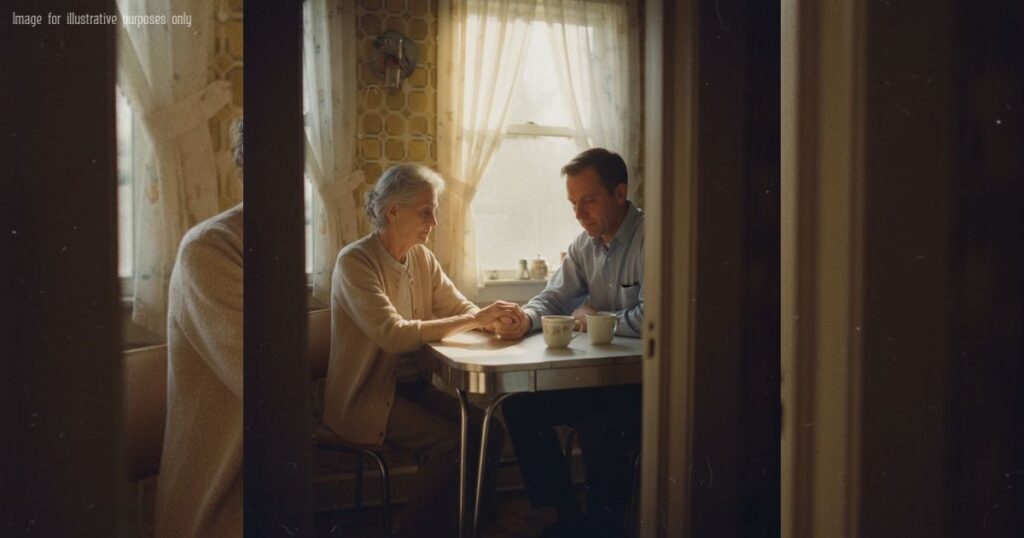

“It’s just a photo,” he said, already aiming. “She worries. And she’s right to.”
He snapped it.
Then, without thinking, he texted it.
I didn’t know that his daughter was the kind of person who posts everything.
I didn’t know she had thousands of followers.
I didn’t know how hungry people were for a story that made them feel something that wasn’t rage.
By the time I got home, my phone was buzzing like a trapped insect.
A message from a coworker:
“DUDE ARE YOU ON THE INTERNET??”
A link.
A video—Frank’s daughter had taken the garage photo and paired it with Frank’s voice message about the cabinet.
She’d turned it into a reel with captions about “a worker who still knows how to fix things” and “a widower trying to hold on.”
No store name. No location. Just the idea.
And the idea caught fire.
Thousands of comments.
Then tens of thousands.
Some people cried in public on the internet, which is the strangest kind of intimacy.
They wrote about their dads’ toolboxes, their grandmas’ kitchens, the way grief hides in objects.
Others were furious.
“Why are we praising this? The employee shouldn’t be doing unpaid labor!”
“This is exactly how corporations exploit ‘good people.’”
“Just buy a new cabinet. Old people hoard junk.”
“Right-to-repair should be law.”
“No, it’s personal responsibility.”
“This is why everything is trash now.”
“This is why workers are broke now.”
People weren’t arguing about a hinge anymore.
They were arguing about what kind of country we’re becoming.
And the controversial part—the part that really poured gasoline—was this:
Frank’s daughter added one line in the caption:
“Maybe the real problem isn’t broken hinges. Maybe it’s how fast we tell each other to replace what’s old.”
That sentence is a match.
Because it pokes the bruise.
It suggests that “new” isn’t always better.
And in modern America, nothing makes people louder than the implication they’ve been living wrong.
The next day at work, I walked in and felt eyes on me like heat lamps.
Not hatred—something more complicated.
Admiration from some.
Suspicion from others.
Kyle pulled me aside near the returns desk.
“People are saying you should get a raise,” he whispered, like raises were mythical creatures.
Tanya called me back into her office before my first break.
Her face was pale.
“Corporate is aware,” she said.
I stared at her. “Did I do something wrong?”
She looked torn—like she had to choose between manager and human.
“They want to feature it,” she said softly. “Some kind of ‘Heart of the Community’ campaign.”
My stomach turned.
Because there it was again: the disinfected version of care.
Kindness repackaged as marketing.
Grief used as a sales tag.
“And?” I said.
“And they also want you to sign a release,” she added. “And they want you to stop doing anything like that again. Ever.”
I laughed once—no humor in it.
“So… I’m a hero as long as I’m quiet.”
Tanya’s eyes shined, just for a second.
“Leo… I’m trying to protect you.”
“From what?” I asked. “Getting hurt? Or being useful?”
She didn’t answer.
Because the answer was: both.
I walked out of that office and looked down the long, endless aisles.
I saw the blister packs. The plastic. The shiny “new.”
The easy replacements stacked like a promise that nothing has to be repaired—including us.
And I realized why the comments were so vicious.
Because fixing things is a moral threat.
If we admit repair is possible, then we have to face what we’ve been throwing away.
Not just cabinets. Not just tools.
People.
Old workers. Tired neighbors. Struggling families.
Even our own attention spans.
It’s easier to call it “progress” than admit it’s abandonment with better packaging.
That night, Frank called me again.
“Leo,” he said, voice low. “My daughter says the video’s exploding. She didn’t mean to… start a war.”
“Too late,” I said.
He sighed. “People are stopping by the house. Not the crazy kind—good folks. Some asked if I knew anyone who could fix a lamp. A blender. A wheelchair brake.”
I closed my eyes.
“Frank,” I said, “what if we did something?”
“What kind of something?”
“A table,” I said. “A toolbox table. One night a week at the community hall. No selling. No branding. Just people bringing broken things and us seeing what we can do.”
There was a pause.
Then Frank’s voice changed—like someone handed him a purpose.
“I’ve got folding chairs,” he said. “And I’ve got coffee.”
I hung up and stared at my hands.
Hands that had been told they were a liability.
And I thought: Maybe that’s the point.
Maybe the thing that can heal us—the quiet work, the patient fixing, the human attention—will always look like a liability to a world that profits off breakage.
The internet will keep arguing.
Some will say, “Buy new.”
Some will say, “Pay workers more.”
Some will say, “Stop romanticizing the past.”
Some will say, “This is the only way forward.”
Let them.
Because here’s the uncomfortable truth that will make people comment until their thumbs cramp:
A society that can’t repair what it loves will eventually stop loving anything it can’t replace.
And next Tuesday, under the same kind of harsh lighting, we’re going to set up a table anyway.
Frank and me. A red toolbox. A coffee pot.
And we’re going to find out how many people have been walking around with broken things—
waiting for someone to finally say, Open it up. Let’s see what we can fix.
Thank you so much for reading this story!
I’d really love to hear your comments and thoughts about this story — your feedback is truly valuable and helps us a lot.
Please leave a comment and share this Facebook post to support the author. Every reaction and review makes a big difference!
This story is a work of fiction created for entertainment and inspirational purposes. While it may draw on real-world themes, all characters, names, and events are imagined. Any resemblance to actual people or situations is purely coincidenta