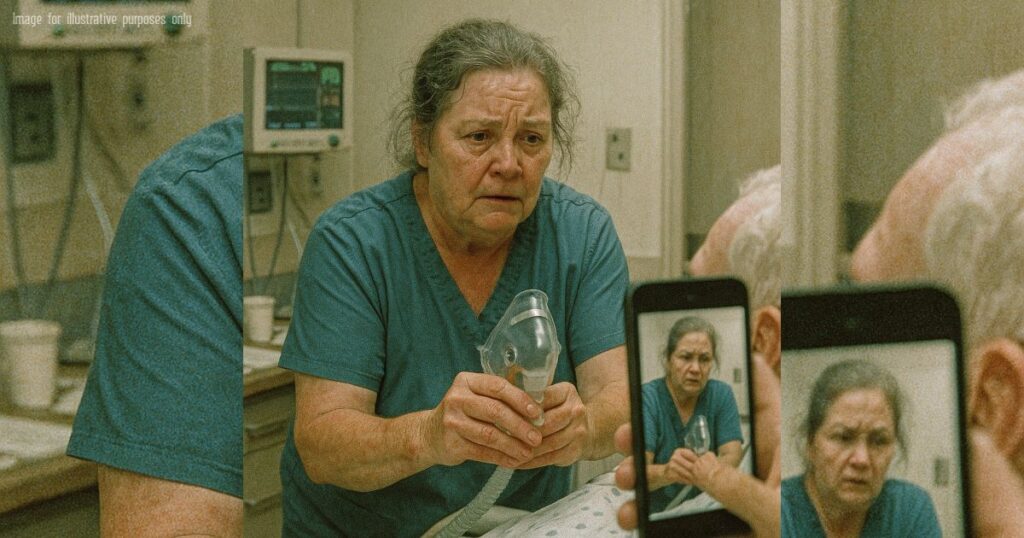
“Yesterday, a stranger on the internet said I should be fired because my hands were shaking while I held his father’s oxygen mask.”
That’s how my last week as a nurse ended.
Not with flowers. With a comment under a blurry video someone took of me on their phone.
I’m 63 years old.
I’ve been a registered nurse in a small hospital outside Des Moines, Iowa, for 38 years.
Tonight, after I finish this cup of cold coffee in the break room, I will hang up my badge for the last time.
When I started in the mid-1980s, nursing felt like joining a family.
We didn’t have fancy machines. The monitors beeped, but not like they do now. We counted drops in IV lines, wrote notes by hand, and charted at a desk, not on a screen.
Families brought homemade cookies to the nurses’ station.
Doctors knew our kids’ names.
If you stayed late to sit with a scared patient, nobody asked you to “justify the overtime.”
We weren’t paid much. We still aren’t.
But there was respect.
People looked at our uniforms and saw kindness, skill, and sacrifice.
Somewhere along the way, something changed.
Slowly. Then all at once.
The computers came.
The pressure came.
The politics came.
And the phones… the phones never stopped filming.
I remember the first time a family member recorded me while I was trying to explain a serious diagnosis.
No one said, “Are you okay?”
They said, “Just so you know, this is going online if you mess up.”
I’ve been cursed at in hallways.
I’ve been called “incompetent,” “lazy,” and “just a glorified waitress.”
I’ve had a man snap his fingers in my face and say, “Hey, you. I’m the customer. Move.”
No one asked how many hours I had been on my feet.
No one asked when I last drank water or used the bathroom.
This past winter, I went twelve hours without sitting down.
We were short three nurses and one aide.
We had heart attacks, strokes, overdoses, and a teenage girl who’d tried to end her own life.
I held hands.
I changed sheets soaked with blood, sweat, and shame.
I called families at 3 a.m. with the words nobody wants to hear.
Then, at 7:15 a.m., a man looked me straight in the eye and said,
“You people don’t care. If you cared, my mother wouldn’t still be in pain.”
He didn’t know I had just held another woman’s hand as she died.
He didn’t know I had cried in the medication room two hours earlier.
He only knew his pain.
And I understand that.
But it still broke something in me.
Patients are different now, too.
Not worse. Just more wounded in ways you can’t see on a scan.
They come in alone, because families are scattered across states, across years of conflict and silence.
They come in with addiction, with fear, with medical bills already stacked on the kitchen table at home.
They scroll through their phones while I hang antibiotics, searching for answers in comment sections instead of asking the person standing right in front of them.
I don’t blame them.
The world is louder now.
Angrier.
More afraid.
We live in a time when people clap for nurses in the evening… and then argue with them in the morning about masks, vaccines, or politics.
We stand in the crossfire of a thousand opinions.
But we are not politicians.
We are not the enemy.
We are the ones who wash your father’s hair when he is too weak to lift his head.
We are the ones who notice your mom’s hands are colder than they should be and call the doctor before anyone realizes her heart is failing.
We are the ones who say, “I’ll stay with you,” when the room suddenly empties after bad news.
With every year, the forms grew thicker.
The time with patients grew thinner.
I spend more minutes clicking boxes than holding hands.
I am judged by numbers on a screen:
“How fast did she push the medication?”
“How quickly did she respond to the call light?”
“How many satisfaction stars did she get this month?”
They don’t measure the moment I sat on the floor with a veteran having a flashback and let him squeeze my hand until his breathing slowed.
They don’t measure the quiet “thank you” whispered by a woman whose body will never heal, but whose mind finally felt heard.
And yet… I stayed.
Because there were always those small sacred moments:
The grandfather who squeezed my fingers and said, “You remind me of my wife. She was gentle, too.”
The little boy in the oncology unit who asked, “Will you still be here when I wake up?”
The widow who mailed a card three months later that simply read, “You were the last kind face he saw. I will never forget that.”
I kept those cards in a shoebox in my locker.
On nights when the shouting got too loud, I would read them on my dinner break—if I had one.
Today, I cleaned out that locker.
I threw away old pens, broken scissors, and expired lotion.
I folded my worn-out scrub jacket, the one that has seen more tears than my own pillow.
At the bottom of the locker was that shoebox.
The cards. The little notes. A photo of a toddler whose mother once said, “He’s alive because you didn’t give up on us.”
I sat on the bench and cried.
Not because I regret becoming a nurse.
But because it feels like the world has forgotten what that word means.
There was no party.
No speech.
My manager gave me a polite smile, a quick hug, and a generic card from the store.
She glanced at her screen twice while thanking me for “my years of service.”
I don’t blame her. She’s drowning, too.
I am leaving behind my stethoscope, my name badge, and the part of my heart that stayed in Room 304, and 217, and that little ICU bed where a baby once wrapped his fingers around my pinky.
What I’m taking with me is this:
Every face I ever sat beside in the dark.
Every story whispered to me at 2 a.m. when fear is loudest.
Every “thank you” that never made it into a survey, but lived in someone’s eyes.
I don’t know what I’ll do next.
Maybe I’ll plant tomatoes.
Maybe I’ll rock grandbabies to sleep.
Maybe I’ll finally learn to rest without feeling guilty.
But I know this:
If you know a nurse—past or present—do more than post a slogan.
Look them in the eye.
Say, “I see you. I’m grateful you were there.”
Teach your children that the person in scrubs is not a servant, not a punching bag, not a target for your anger at the system.
They are the ones who stood between your loved one and the dark, again and again, even when their own hearts were breaking.
Let the nurses of the past know they are not forgotten.
Let the nurses of today know they are not alone.
Because in a world that can be cruel and fast and loud,
they stayed.
They cared.
They remembered every patient—
even when the world forgot them.
—
If you’re reading this, you’ve probably already seen Part 1 of my story.
So let me tell you what the internet video didn’t show.
It didn’t show that the man whose oxygen mask I was holding was calling me by my first name, over and over, because he was afraid.
Click the button below to read the next part of the story.⏬⏬