If you’re reading this, you’ve probably already seen Part 1 of my story.
So let me tell you what the internet video didn’t show.
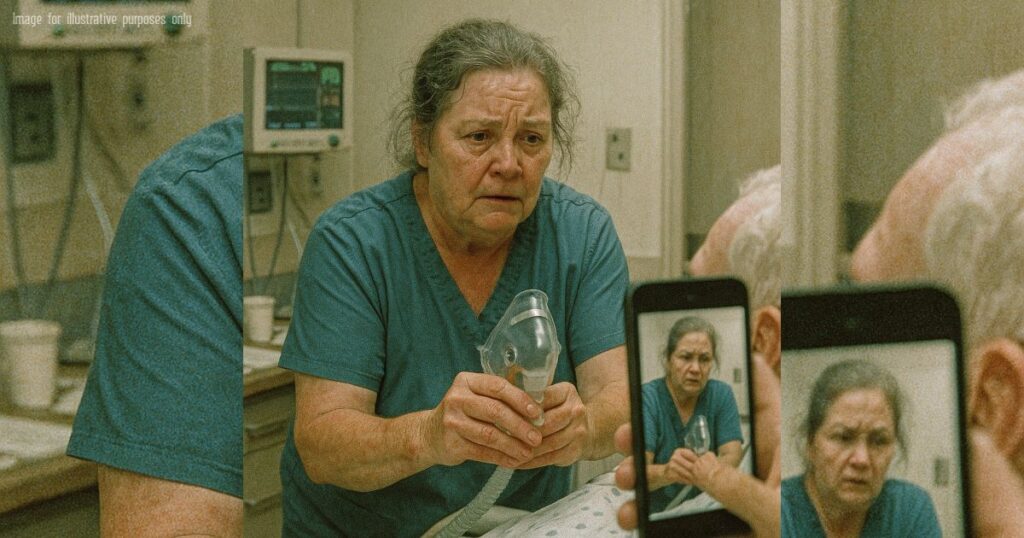
It didn’t show that the man whose oxygen mask I was holding was calling me by my first name, over and over, because he was afraid.
It didn’t show that my hands were shaking because I have arthritis and because I’d already done eleven hours on my feet, not because I didn’t care enough to be steady.
It didn’t show that while someone was secretly filming me, I was silently counting his breaths, watching his chest rise and fall, ready to shout for help if it changed.
All the camera saw was an old nurse with shaking hands.
The comment said,
“Who lets someone that old touch a patient? She needs to retire before she kills somebody.”
That sentence has been living in my head like a splinter.
Let me be very clear: I am retiring. My body is tired. My joints ache in places I didn’t know existed. I forget where I put my glasses at least once a day.
But I did not stay too long because I am selfish or stubborn.
I stayed because for years, there were more beds than nurses.
Because when one of us left, another one wasn’t waiting in line to come in.
Because someone had to show the newer nurses where the extra blankets were hidden, which doctors yelled the loudest but scared the easiest, which families needed softer words and which needed blunt truth.
I stayed because patients kept coming.
I read the comments under that video.
Some people defended me.
“Maybe her hands shake, but you can tell she knows what she’s doing.”
Others didn’t.
“If my dad was in that bed, I’d demand someone younger.”
“Old nurses are burned out and rude. I’ve met them. They shouldn’t be working.”
“This is why healthcare is broken.”
I didn’t reply.
I don’t argue in comment sections.
That battlefield is not meant for people who haven’t slept.
But I want to say this, here, where the words can breathe:
If you think every trembling hand shouldn’t be near a patient, ask yourself who taught the steady ones.
Ask who trained the new graduate nurse how to turn a paralyzed man without tearing his skin.
Ask who stood behind her the first time she walked into a room where someone had just died.
Ask who showed her how to talk to a mother about organ donation without sounding like she was asking for a favor.
It wasn’t the comment section.
It was people like me.
People with lines on their faces and cheap coffee in their veins.
People whose backs hurt every time they go down the stairs.
People who still show up at 6:45 a.m. because they hate the idea of a night shift nurse going home late.
My hands shake now when I hold an oxygen mask.
They also shook while I signed condolence cards.
They shook when I restarted a heart.
They shook when I held a father upright so his child wouldn’t see him fall apart after the diagnosis.
Maybe we should talk about that.
We live in a country where you can compare hotels, phones, and restaurants with star ratings and long reviews.
Now we do that with people.
Nurses. Teachers. Cashiers. Servers. Anyone who stands in front of us while we are hungry, scared, or angry.
One bad moment becomes a permanent label.
“One star. Rude. Didn’t smile enough.”
“Unprofessional. Looked tired.”
“Hands shaking. Should be fired.”
We forget that sometimes the person on the other end of our frustration is on hour eleven of a twelve-hour shift, worrying about their own medical bill, their own aging parent, their own child at home with a fever.
We say, “They chose this job,” as if that cancels their humanity.
Here is the part some people might not like:
Patients and families carry heavy pain.
I know that. I’ve seen it for almost four decades.
But pain does not give anyone the right to treat another human being like a vending machine that swallowed their dollar.
You can be scared, frustrated, and furious at the system.
You can demand explanations.
You can ask for a second opinion, a manager, a different nurse.
But when you snap your fingers at a nurse, when you roll your eyes, when you call them “girl” or “boy” or talk about them like they aren’t in the room?
That’s on you.
Not on your grief.
Not on the hospital.
On you.
I know that will make some people angry.
They’ll say, “You have no idea what it’s like to watch someone you love suffer.”
I do.
My husband died in one of those beds.
Not in my hospital, but in another one, in another town, because I insisted he not be my patient.
I sat in a plastic chair and watched his chest rise and fall, listened to the beeps, waited for a doctor who was running from room to room.
I could have shouted. I could have raged.
Instead, I asked myself, “What would I want someone to say to me if I were the one on the other side?”
You want the truth?
The night my husband died, the nurse caring for him forgot to bring an extra blanket when the room got cold.
She looked exhausted. Her hair was coming out of her ponytail. She mispronounced his name twice.
You know what I remember?
I remember that when he stopped breathing, she closed his eyes gently and whispered, “I’m so sorry” like she meant it with every cell in her body.
I remember that her hands were shaking, too.
I didn’t see a villain.
I saw another human being doing her best in a place where “best” is rarely enough.
Another thing the video didn’t show:
After I held that oxygen mask and adjusted the tubing, I went back to my station and charted every breath, every change, every word he said.
I noticed his color improving.
I called the respiratory therapist to reassess him.
I advocated for a change in his medication because something didn’t sit right with me.
He stabilized.
No one filmed that part.
No one films the stable moments, the careful checks, the quiet victories where nothing terrible happens because someone did their job well.
Those don’t go viral.
Here’s where I think we, as a society, have a choice to make:
Do we want a world where people are so afraid of being filmed that they become cold just to survive?
Or do we want a world where we pause before posting, ask a question, and remember there’s a whole story outside the frame?
Click the button below to read the next part of the story.⏬⏬