I touched the handle of my truck door, but I didn’t open it. My eyes were locked on the shadows near the air pump.
In this neighborhood, after dark, you don’t look too closely at things you don’t want to see. You pump your gas, you get back in your car, and you lock the doors. But I couldn’t leave.
There was a silhouette sitting on the curb. Too small to be a junkie. Too still to be a threat.
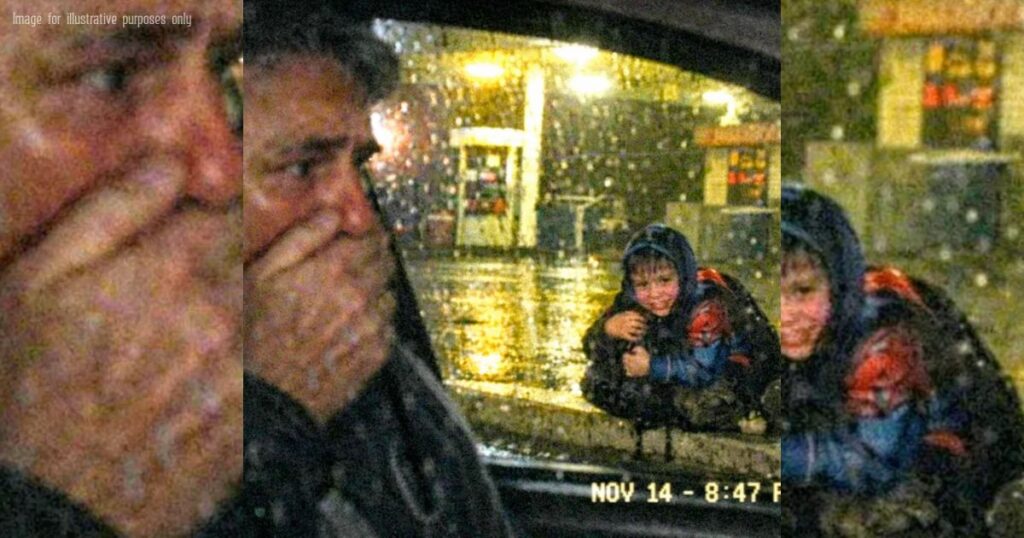
It was 8:45 PM. The temperature was dropping into the low 40s, and the rain was that miserable, spitting kind that soaks right through your bones.
I walked over, my boots crunching on the wet gravel. It was a boy. He couldn’t have been more than seven years old. He was wearing a thin hoodie with a cartoon character on it, hugging a backpack to his chest like it was a shield. His lips were blue.
I’m 71 years old. I served in the Marines. I’ve seen bad things. But seeing a child shaking like a leaf in a dark parking lot? That hits you differently.
“Hey, son,” I said, keeping my voice low so I wouldn’t spook him.
He flinched so hard he almost fell over. He looked up at me with eyes wide with terror.
“My mom said stay right here,” he stammered, his teeth chattering. “She said don’t move. She said she’s watching from the window.”
I looked up. The only building across the street was the massive, gray concrete slab of a Fulfillment Center. One of those places that runs 24/7, shipping packages to people who click “Buy Now” and expect it tomorrow.
“She’s in there?” I asked.
He nodded. “She’s on a double shift. If she leaves her station, the computer logs it. Three strikes and she’s fired. She can’t be fired. We need the car.”
He spoke with the heavy, exhausted maturity of a forty-year-old accountant, not a second-grader. He wasn’t complaining. He was just explaining the brutal math of his survival.
“Come on,” I said. “I’m not leaving you on a curb.”
He hesitated. “Strangers are dangerous.”
“You’re right,” I said. “But hypothermia is faster. Come inside the store. You can sit by the window where she can see you.”
I took him into the gas station convenience store. The fluorescent lights buzzed overhead. I bought him a hot chocolate and a pre-packaged turkey sandwich. We sat on the metal stools facing the window.
“I’m Frank,” I said.
“Leo,” he whispered, wrapping his small hands around the warm paper cup.
“Does your mom know you’re actually outside, Leo?”
He looked down at his shoes. “She thinks I’m in the lobby. But the security guard made me leave. He said it’s private property. No loitering.”
My heart didn’t just break; it burned. A security guard kicking a seven-year-old out into the rain to protect a billion-dollar company’s liability.
We sat there for ninety minutes. I learned that Leo loves Roblox but doesn’t have an iPad. I learned he hates division because “the numbers don’t fit right.” I learned he wants to be a pilot because clouds look soft.
At 10:20 PM, a woman burst through the doors. She was wearing a reflective safety vest over a t-shirt, drenched from running across the street in the rain.
“Leo!”
She rushed over, checking his face, squeezing his arms. She looked frantic. Exhausted. She had the look of a woman who has been holding her breath for five years straight.
Then she looked at me.
The fear in her eyes was primal. In modern America, a mother leaving her child unattended isn’t just a mistake; it’s a crime. She wasn’t just afraid of me; she was afraid of the State. She was afraid of Child Protective Services taking her boy away because she was too poor to afford a babysitter.
“Please,” she whispered, her voice shaking. “Please don’t call the police. I’m a good mom. I swear to God. My sitter quit this morning via text. I called everyone. I have no family here. If I missed this shift, I can’t pay rent. Rent is $2,200 a month. I had no choice.”
She started to cry, a silent, desperate weeping. “Please don’t report me.”
“Stop,” I said gently. I raised my hands. “Nobody is calling anyone.”
I looked at her. Really looked at her.
I saw my own daughter in her eyes. I saw a generation of young parents breaking their backs, working two jobs, driving for Uber, delivering food, and working in warehouses, just to keep a roof over their heads. I saw a system where childcare costs more than a mortgage, and where one flat tire can ruin a family’s life.
“I’m retired,” I said. “I spend most of my days yelling at the news on TV and cleaning my garage for the tenth time. It’s a waste of a life.”
I pulled a pen from my pocket and wrote my number on a napkin.
“Next time the sitter cancels, you call me. I live three miles down the road. I’ve got a warm house. I’ll help him with his math. No charge.”
She stared at the napkin like it was a winning lottery ticket. “Why? You don’t know us. People don’t just do that.”
“Because he shouldn’t be in the rain,” I said simply. “And you shouldn’t have to choose between feeding your son and keeping him safe. That’s not a choice any mother should have to make.”
That was eight months ago.
Today, I picked Leo up from school. We went to the park. He’s actually getting pretty good at long division. We make spaghetti before his mom, Sarah, gets off her shift.
But here is the part that matters. The part that changed everything.
I told my buddies at the VFW hall (Veterans of Foreign Wars) about Leo. These are old guys. Vietnam vets, Desert Storm vets. Guys with bad backs and hearing aids. Guys who thought their useful days were over, who thought the country had moved on without them.
I told them about the boy on the curb.
Now? We have a “Grandpa Patrol.”
It started small. My friend Mike, a retired carpenter, picks up a neighbor’s kid for soccer practice because the dad works two jobs and can’t get off by 4 PM.
Another guy, Dave, who sits in his wheelchair on his porch all day, now has a “station.” He watches the school bus stop every morning and afternoon. He makes sure every kid gets off safely and gets inside their door. The single mom next door told him she used to have panic attacks at work wondering if her daughter made it home. Now, she just texts Dave.
We aren’t doing anything big. We aren’t passing laws. We aren’t starting a non-profit. We’re just filling the gaps.
Last week, Sarah got a new job. An office job. Better hours. No more night shifts at the warehouse. No more standing on concrete for 12 hours. She cried when she told me she didn’t need me to watch Leo every single day anymore.
“You saved us, Frank,” she said, hugging me tight. “I was drowning.”
“No,” I told her. “I just held the umbrella until the storm passed.”
Look around your neighborhood.
There are Leos everywhere.
They are the “latchkey kids” sneaking into empty houses. They are the quiet ones in the grocery cart while their dad counts pennies to see if he can afford the milk and the cereal. They are the ones waiting in old cars in parking lots while their parents run errands they can’t afford to skip.
The world is hard right now. Prices are up. Patience is down. The “Village” we used to talk about raising children? It burned down a long time ago.
Parents are drowning in silence because they are too ashamed to ask for help, and too afraid of being judged.
You don’t need to be rich to fix this.
You don’t need to adopt a child. You don’t need to write a check.
You just need to notice.
Buy the extra meal. Offer the ride. Be the safe place. If you’re retired, if you’re lonely, if you feel like you have nothing left to offer—look at the young families on your street. They need you more than you know.
We have to rebuild the village ourselves. One kid, one umbrella, and one act of kindness at a time.
Be the village.
—
PART 2 — The Village Fights Back When You Try To Rebuild It
I thought the hard part was noticing.
I thought the hard part was walking across wet gravel toward a kid with blue lips, when every instinct in a rough neighborhood tells you to mind your business and live longer.
Turns out the hard part is what happens after you help—when the world decides to put your kindness on trial.
Because the “Grandpa Patrol” didn’t stay a sweet little story for long.
It never does.
The first time it got ugly was on a Tuesday.
Cold day. Bright sky. The kind of winter sun that looks warm but doesn’t do a damn thing for your bones.
Click the button below to read the next part of the story.⏬⏬