PART 2 — The Village Fights Back When You Try To Rebuild It
I thought the hard part was noticing.
I thought the hard part was walking across wet gravel toward a kid with blue lips, when every instinct in a rough neighborhood tells you to mind your business and live longer.
Turns out the hard part is what happens after you help—when the world decides to put your kindness on trial.
Because the “Grandpa Patrol” didn’t stay a sweet little story for long.
It never does.
The first time it got ugly was on a Tuesday.
Cold day. Bright sky. The kind of winter sun that looks warm but doesn’t do a damn thing for your bones.
I was standing at Dave’s “station” with a thermos in my hand, watching the bus stop like we always did—two old men with bad knees pretending we weren’t counting every kid like we were counting blessings.
Leo jumped off the bus and ran to me, backpack bouncing.
“Frank!” he yelled like I was family.
I didn’t even get to answer before a woman’s voice cut through the air like a snapped wire.
“Hey! HEY!”
A minivan rolled up too fast, tires crunching on the curb. The driver’s window slammed down.
She didn’t look at Leo.
She looked at me.
“What are you doing?” she demanded. “Why are you standing here?”
Dave lifted his hand in a slow, friendly wave. “Ma’am, we’re just—”
“I’m not talking to you,” she snapped, eyes still locked on me. “I’m talking to him.”
I felt something old rise in my chest. Not anger. Something worse.
That feeling you get when you realize you’ve been judged guilty before you’ve opened your mouth.
“I’m Frank,” I said calmly. “I live down the road. I help some families with pickups. Make sure kids get home safe.”
Her phone was already up. Recording.
“Of course you do,” she said, loud enough for the whole street. “This is how it starts. Old men hanging around children. You think we don’t know?”
A couple parents turned their heads. A dog barked behind a fence. Someone’s front door creaked open.
Leo’s little hand slid into mine, instinctive.
And I felt him flinch—like he’d just realized loving an old man in public might get him in trouble.
“Ma’am,” Dave said, voice shaky but firm, “you’re scaring the boy.”
“Good,” she shot back. “He should be scared. Kids should be scared. That’s how you keep them alive.”
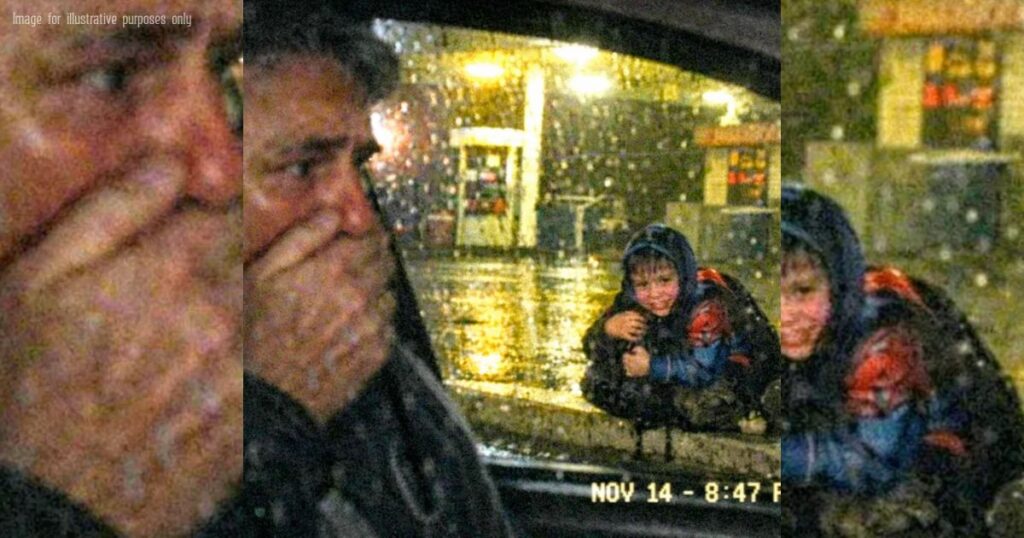
I wanted to tell her about the night Leo sat on a curb in the rain.
I wanted to tell her about the security guard who told a child to leave and “stop loitering.”
I wanted to tell her about a mother running across four lanes of traffic with panic in her eyes because she couldn’t afford one missed shift.
But I knew how this works.
Facts don’t matter when fear is the loudest person in the room.
So I did the only smart thing.
I took my hand off Leo’s.
Slowly.
Like I was handling a loaded gun.
“I hear you,” I said, quieter. “I’m not here to argue. If you want me to step away, I’ll step away.”
Leo’s face turned up toward mine, confused and hurt. Like I’d suddenly become a stranger.
I gave him a small smile. “You go on, buddy. Straight home.”
He didn’t move.
Dave wheeled closer, putting himself between us like a human shield on four rubber tires.
“Enough,” Dave said. “You don’t know him. You don’t know what he’s done for people.”
The woman’s camera stayed on me. “This is going online,” she said. “All of it. People need to see.”
Then she drove off like she’d just saved the world.
Leo finally walked away, shoulders tight.
And I stood there in the cold, feeling the same rain-soaked burn I’d felt eight months ago.
Only this time, it wasn’t my heart breaking.
It was my faith.
That evening, my phone started buzzing.
First one call.
Then three.
Then eight.
Unknown numbers. Blocked numbers.
A text from Mike: “Frank, you seeing this?”
I didn’t want to.
I opened it anyway.
It was a video—cropped, shaky, thirty seconds long.
Two old men at a bus stop.
A kid holding my hand.
A woman yelling.
And then, because the internet loves a villain more than it loves a truth, the caption:
“CREEPY GRANDPA PATROL WAITING FOR KIDS AFTER SCHOOL. SHARE THIS.”
No context.
No mention of the single moms who texted Dave “thank you” with crying emojis.
No mention of the dad who hugged Mike behind a minivan because he didn’t want anyone to see him break down.
Just two old men.
And the word creepy.
That word hits like a brick.
Because you can’t wash it off.
Sarah called me twenty minutes later.
Her voice was tight in that careful way—like she’d put duct tape over panic.
“Frank,” she said.
“Yeah.”
“I saw it.”
“Okay.”
A pause.
Then, the sentence that hurt more than the video.
“Leo’s teacher called me.”
My stomach dropped. “What did they say?”
“They asked… if I still feel comfortable with you picking him up.”
There it was.
The world’s favorite kind of cruelty.
Not a punch.
A question.
A polite, professional question that suggests danger without ever having to prove it.
Sarah swallowed hard. “I told them yes. Of course yes. I told them you’re family.”
Another pause.
Then her voice cracked, just a little.
“But I hate that I had to say it out loud.”
I closed my eyes.
Because I didn’t hate the school for asking.
I didn’t even hate the woman in the van.
I hated the truth underneath it all:
In America right now, we tell parents to “ask for help.”
And then we punish them when they do.
We tell men to “be mentors.”
And then we treat every older man near a child like a crime scene waiting to happen.
We demand a village.
But we also demand a moat.
The next morning, I went to the veterans’ hall.
Same coffee that tastes like burnt pennies.
Same flag in the corner.
Same old men pretending they don’t need anybody.
The room was split down the middle.
“You can’t fight the internet,” one guy muttered. “Let it die.”
“They’re calling us predators,” another guy said, red-faced. “Predators. At my age? I can barely hunt for my glasses.”
Dave sat in his wheelchair, hands clenched on his lap. “My neighbor asked me not to stand outside anymore,” he said softly. “Said it made her ‘nervous.’ I’ve watched that girl grow up. She calls me Uncle Dave.”
Mike slammed his palm on the table. “So what? We quit? We go back to being ghosts?”
No one answered.
Because the truth was hanging there, heavy as smoke:
They were scared.
Not of danger.
Of accusation.
Accusation is a special kind of fear. It doesn’t need evidence. It just needs a headline.
I cleared my throat.
Every eye turned to me.
I’m not a speech guy. Never have been.
But I knew this had to be said.
“We did this because kids were being left alone,” I said. “Not because we wanted medals.”
Click the button below to read the next part of the story.⏬⏬