A couple men nodded.
“And we can pretend it’s not our problem,” I continued, “but it becomes our problem the second a child freezes on a curb while we’re busy protecting our comfort.”
A silence.
Then I added the part that made it controversial.
The part people love to fight about.
“The village didn’t burn down,” I said. “We burned it. One suspicion at a time. One lawsuit threat at a time. One ‘mind your business’ at a time.”
A few guys shifted, uncomfortable.
Good.
Sometimes discomfort is where truth lives.
“I’m not saying throw your doors open to anyone,” I said. “I’m not saying ignore safety. I’m saying we’ve built a world where a kid can be abandoned in public and nobody touches that… but an old man holding a child’s hand becomes the scandal.”
Dave exhaled like he’d been holding his breath for months.
Mike pointed at me. “So what do we do, Frank?”
I looked around the table at men who’d once carried rifles and now carried guilt.
“We do it right,” I said. “In daylight. In the open. With rules. With consent. With transparency.”
No hero fantasies.
No secrecy.
No shortcuts.
Because the only way to rebuild trust is to build it where everyone can see it.
Two days later, we showed up at the community center.
Not with signs.
Not with anger.
With folding chairs and clipboards and a simple offer:
Neighborhood Volunteer Pickup Network.
No fancy name.
No money.
Just structure.
Parents sign up if they want it.
Volunteers sign up if they want to serve.
Everything documented. Everything visible. Everything optional.
Some people came in grateful.
Some came in skeptical.
And some came in swinging.
A woman stood up, arms crossed. “So you’re saying parents should just hand their kids to strangers because they’re tired?”
That sentence lit up the room.
Here we go.
I stood slowly, careful with my knees.
“No,” I said. “I’m saying parents are already doing impossible math. And pretending they’re not doesn’t make kids safer.”
A man in a ball cap barked, “If you can’t afford childcare, don’t have kids.”
There it was—the comment section, in human form.
Half the room nodded like that was wisdom.
The other half looked like they wanted to cry.
Sarah was sitting in the back, Leo beside her. He was drawing clouds in a notebook, pretending not to listen, listening anyway.
I looked at the man in the cap.
I kept my voice steady.
“You ever notice how easy it is to say that when you’re not the one staring at a rent bill bigger than your paycheck?” I asked.
Murmurs.
The man scoffed. “Life’s tough.”
“It is,” I agreed. “That’s the point. Life’s tough. So we can either make it tougher by shaming people… or we can make it safer by showing up.”
Another woman stood up, face hard. “And what about men? Why is it always old men who want to ‘help’? You know how that looks.”
Every head turned toward me again.
I could’ve gotten defensive.
I could’ve gotten angry.
Instead, I nodded.
“You’re right,” I said. “It looks suspicious now. And I understand why.”
She blinked, thrown off.
I continued, “But here’s what I need you to hear: the answer to fear isn’t isolation. The answer to fear is accountability. If you want boundaries, we’ll build boundaries. If you want visibility, we’ll build visibility. If you want mothers involved, we’ll be grateful for it. If you want this to be women-led, we’ll follow.”
The room quieted.
Because that’s not what people expect from an old Marine.
They expect hardness.
They don’t expect humility.
And humility is harder than any fight I ever got into.
After the meeting, Leo walked up to me.
He held out his drawing.
It was a stick figure of me with a big umbrella.
Under it were smaller stick figures—kids, moms, dads, even Dave in his wheelchair.
And above us, in shaky seven-year-old letters, he’d written:
BE THE VILLAGE.
I swallowed.
“Is this for me?” I asked.
He nodded. “Mom says some people are scared,” he said quietly.
“Yeah,” I said.
He looked up at me. “Are you scared?”
I thought about the video.
The comments.
The way Sarah’s voice had tightened on the phone.
The way my hand had slipped off his like I was dangerous.
“Yes,” I admitted.
Leo considered that for a second.
Then he said something that should be carved into every screen in this country:
“Then why don’t they just… come closer and look?”
That night, I hung his drawing on my fridge.
And I sat at my kitchen table, staring at it.
Here’s the truth nobody wants to admit:
We’re living in a time where everyone is exhausted.
Parents are exhausted.
Old people are lonely.
Kids are quieter than they should be.
And the space between us is being filled by suspicion, not community.
Some people will watch our story and say, “This is beautiful.”
Others will say, “This is dangerous.”
Good.
Let them argue.
Let the comments blow up.
Because maybe—just maybe—the argument itself proves the point:
We don’t agree anymore on what it means to be human to each other.
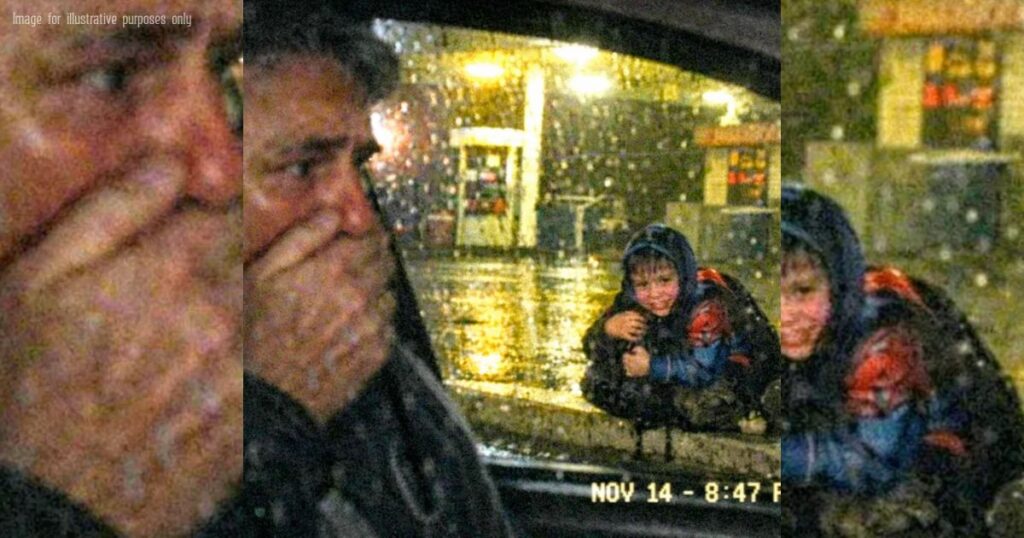
But I know what I saw that night in the rain.
A kid wasn’t safe.
A mother wasn’t safe.
And an entire “advanced” society had decided that was normal.
So I’ll take the risk of being misunderstood.
I’ll take the sideways looks.
I’ll take the whispers.
Because the only thing worse than being accused of caring…
is living in a world where nobody dares to care at all.
If you want a village, you don’t get to demand perfection from the people building it.
You get to demand honesty.
Visibility.
Boundaries.
And the courage to look closer.
Be the village—out loud, in daylight, where everyone can see.
And if that makes people uncomfortable?
Maybe it’s because comfort is what got us here in the first place.
Thank you so much for reading this story!
I’d really love to hear your comments and thoughts about this story — your feedback is truly valuable and helps us a lot.
Please leave a comment and share this Facebook post to support the author. Every reaction and review makes a big difference!
This story is a work of fiction created for entertainment and inspirational purposes. While it may draw on real-world themes, all characters, names, and events are imagined. Any resemblance to actual people or situations is purely coincidenta