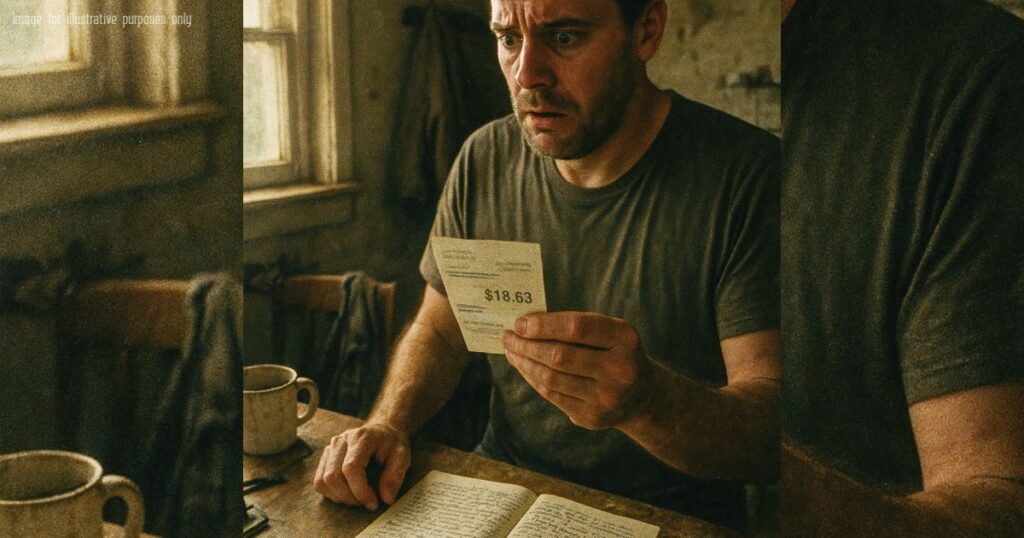
My father died with exactly $18.63 in his checking account and a reputation for being the meanest son-of-a-gun in Trumbull County.
I thought he gambled it away. Or maybe he just drank it away at the VFW hall.
I was dead wrong.
Walking into his house three days after the heart attack, the place smelled like Ben-Gay, stale coffee, and sawdust. It was the smell of a man who worked hard and didn’t believe in “self-care.”
Dad—”Big Jim” to the locals—wasn’t the type to hug you. He was the type to change your oil, grunt, and tell you to drive safe. He believed that feelings were something you kept to yourself, like a winning poker hand.
I was angry as I sorted through his clutter. I’m a consultant in Boston now; I live in a world of spreadsheets and zoom calls. I had been sending him $500 a month for five years to help with “house repairs.”
The roof was still leaking. The carpet was threadbare.
” stubborn old fool,” I muttered, ripping open his closet door to find a suit for the burial.
I kicked over an old, rusted ammo box hidden behind his work boots. The lid popped open.
I expected to find a flask. Maybe betting slips.
Instead, I found receipts. Hundreds of them. And a spiral notebook.
I sat on the floor and opened the book. Dad’s handwriting was chicken-scratch, all caps.
FEB 2019 – SHARON AT DINER – DENTAL WORK. PAID.
JULY 2021 – THE RODRIGUEZ KID – COLLEGE TEXTBOOKS. PAID.
DEC 2023 – WIDOW PARKER – HEATING OIL. PAID.
I frowned. This was the same man who yelled at the TV when gas prices went up ten cents. The man who reused tea bags. Who were these people?
Then, a letter fell out. It was from Mike, the guy who owns the local auto body shop.
“Jim, I hired the boy like you asked. He’s showing up on time. I’m paying him the $18/hour you set, using the cash you drop off every month. He thinks it comes from the shop’s profits. He thinks he earned it. You were right—he just needed some dignity, not a handout. I won’t say a word.”
My chest tightened. I remembered a conversation from Thanksgiving two years ago. A young guy named Leo, a recovering addict trying to get his life back together, was looking for work. No one in town would touch him.
Dad had called him a “knucklehead” at the dinner table.
I looked down at the ledger. JAN 2022 – LEO. WAGES. PAID.
Dad hadn’t just given Leo money. He subsidized a job so Leo could rebuild his own self-worth. He paid a business to hire a man society had thrown away, just so that man could hold his head up high.
I sat there for an hour, reading.
It wasn’t just Leo. There was the single mom whose car transmission “miraculously” got fixed for free. Dad paid the mechanic under the table to say it was a “manufacturer warranty.” There was the elderly neighbor whose insulin co-pay was covered anonymously at the pharmacy every month.
Dad wasn’t broke because he was bad with money. He was broke because he was investing in people who thought the world had given up on them.
He used his Social Security checks to build a secret safety net for a town that thought he was just a grumpy old hermit.
The tears finally came. Not because he was gone, but because I had judged him. I thought he was cold. I didn’t realize he was keeping everyone else warm.
The Funeral
The service was on a Tuesday. I expected a pitiful turnout. Me, the pastor, and maybe a few drinking buddies.
I stood by the grave, staring at the gray Ohio sky, dreading the moment I’d have to walk away alone.
Then, I heard car doors slamming.
I turned around.
A pickup truck. Then a minivan. Then a sedan held together by duct tape. People were walking up the hill.
Not just a few. Dozens.
Mike from the auto shop was there. Next to him was a man in his late twenties, clean-cut, holding a toddler. It was Leo. He looked healthy. Strong.
A woman in scrubs walked up and placed a single white rose on the casket. She whispered, “Thank you for the tires, Jim.”
A young man in a community college hoodie stood tall. “He paid for my books,” he told me, his voice shaking. “He told me if I quit school, he’d kick my ass. I graduate in May.”
The crowd grew. They stood shoulder to shoulder—black, white, Hispanic, Republican, Democrat. In a country that feels so divided right now, here they were, stitched together by the invisible thread of my father’s wallet.
Leo stepped forward. He looked at me, eyes wet.
“Your dad,” Leo choked out. “He found me when I was sleeping in my car. He didn’t give me a lecture. He didn’t give me a dollar bill. He gave me a job. He made me believe I was worth hiring. I didn’t know until today that he was the one paying me that first year.”
Leo wiped his face. “He saved my life. And he threatened to break my nose if I ever thanked him for it.”
A laugh rippled through the crowd. A wet, painful, beautiful laugh. That was Big Jim.
I looked at the sea of faces. I realized then that my father hadn’t died poor. He had simply converted his currency. He didn’t leave behind a stock portfolio. He left behind this.
He left behind a town that was a little less broken, a little more hopeful, because he refused to let people fall through the cracks.
The Legacy
After the service, I went back to the empty house. I sat at his kitchen table and opened his checkbook. Balance: $18.63.
I picked up his pen—the cheap plastic kind he always chewed on. I wrote a check for $18.63 to the local food bank.
Then, I drove to the auto shop. I found Mike in the back.
“I’m going back to Boston on Monday,” I said. “But I want to make a deal. If a kid comes in here looking for work, or a vet needs a break, and you can’t afford him… you call me. I’ll cover the first six months. Just don’t tell them it’s me.”
Mike smiled, a sad, knowing smile. “You sound just like him.”
We spend our lives screaming for the world to notice us, to “like” our posts, to validate our success. But the greatest men don’t build statues of themselves.
They build safety nets for others, woven in the dark, so that when someone falls, they think the world caught them.
Rest easy, Dad. We’ve got the watch from here.
—
If you think my father’s story ended with that Tuesday funeral and $18.63 in his account, you’re wrong.
Part one was about what he did with his money. Part two is about what happened when the people who loved him realized where that money came from—and who it didn’t go to.
Click the button below to read the next part of the story.⏬⏬