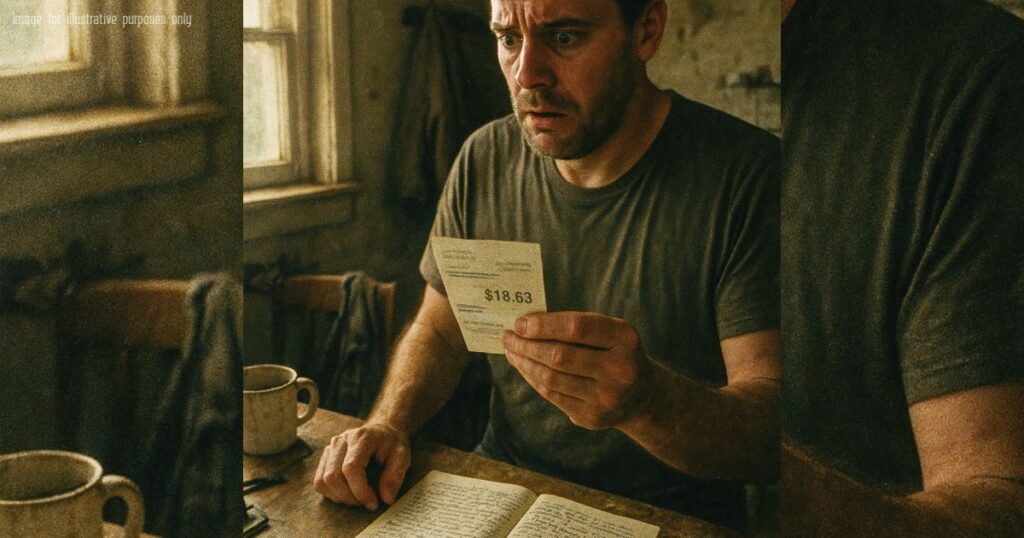
If you think my father’s story ended with that Tuesday funeral and $18.63 in his account, you’re wrong.
Part one was about what he did with his money. Part two is about what happened when the people who loved him realized where that money came from—and who it didn’t go to.
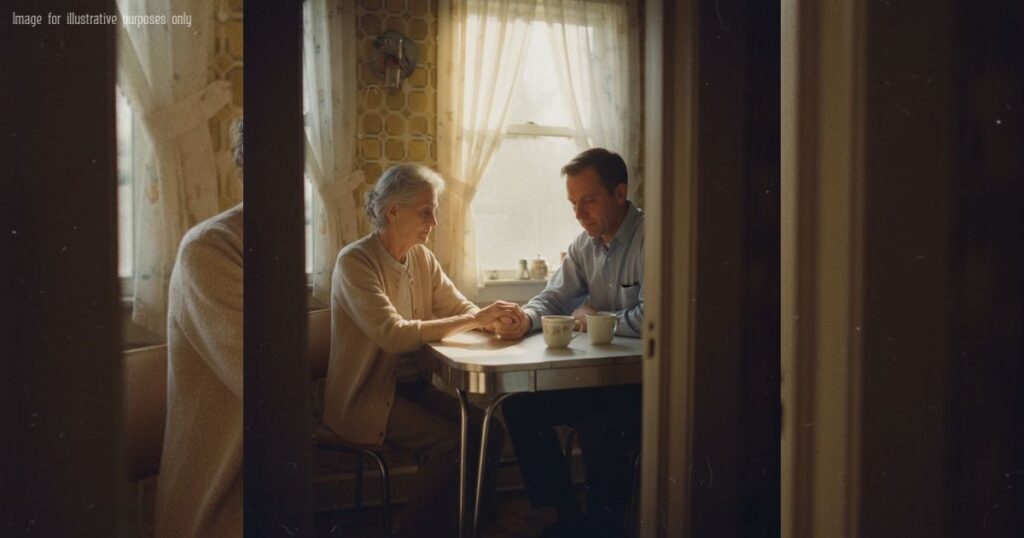
The morning after the funeral, I woke up on his lumpy couch with my tie still on and the ledger stuck to my cheek.
The house was quiet in that strange way old houses get after a death, like the walls are holding their breath.
The coffee maker gurgled to life when I hit the button. Same cheap grounds. Same chipped Navy mug with the faded anchor. I poured a cup and stared at the notebook.
I had fallen asleep with it open to a page that read:
APR 2024 – “B” – KIDS’ LUNCH BALANCES. CLEARED. PAID. DO NOT TELL.
Underneath, in smaller, cramped letters:
“NO CHILD SHOULD BE SHAMED AT THE REGISTER.”
I swallowed hard. Behind every line item there was a story I didn’t know. A face I probably walked past at the grocery store, too distracted by my phone to notice.
My cell buzzed on the table. Boston area code.
My wife.
I took a breath and answered. “Hey.”
“How did it go?” she asked. Her voice was soft, careful. The way you talk to someone holding a glass that’s already cracked.
“It was… more people than I expected,” I said. “He wasn’t alone, Claire. Not like I thought.”
“That’s good,” she said. Then there was a pause. “Did you… find out anything about the money?”
There it was.
I stared at the ledger. At the receipts. At the check register with my name, in his handwriting, next to every $500 deposit.
“Yeah,” I said slowly. “I found out.”
“And?” Her voice sharpened half a notch. “Please don’t tell me the rumors were true and he was at the bar every night.”
I laughed once, but it came out wrong. “No. He wasn’t at the bar.”
“Then where did it go, David?” she asked. “We sent him thirty thousand dollars over five years. That’s not nothing. That’s braces. That’s college credits. That’s a new roof on our house.”
I closed my eyes. I pictured Leo at the grave, holding his toddler. The community college kid. The nurse with the white rose.
“He gave it away,” I said.
“To who?”
“Everyone,” I answered. “To people who needed dentures. To kids who needed books. To single moms whose cars broke down. To… anyone who was falling through the cracks.”
There was a long silence on the other end of the line.
“Wait,” Claire said finally. “He gave our money away? Without telling us?”
“It was his Social Security too,” I protested weakly. “It wasn’t just—”
“But your deposits are right there on the statement, aren’t they?” she pushed. “You said you’d been helping with ‘house repairs.’ He let us believe he was using that money to fix a roof while he sat here under a leak and… and played secret guardian angel for half the county?”
I heard the hurt before I heard the anger.
“Claire—”
“Do you realize,” she said, her voice starting to shake, “that I took on extra projects at work to cover those transfers? That I skipped a family trip to make sure we could afford to help him? Our kids thought Grandpa Jim couldn’t manage his bills. They felt guilty every time we said no to something because ‘we’re helping Grandpa right now.’”
I pressed my fingers into my eyes until I saw sparks.
“He wasn’t irresponsible,” I said. “He was—”
“Responsible for strangers more than his own family?” she snapped.
The words landed like a punch.
I didn’t answer. I couldn’t.
Because the awful truth was: if some consultant from Boston had sent me this story—that their dad gave away the money meant for his own roof—I would’ve said exactly what my wife just did.
I would’ve called it emotional manipulation.
I would’ve called it unfair.
Instead, it was my father, and now I was trapped between the ledger and the people whose names didn’t appear in it: my wife, my kids, my own life.
“Look,” Claire said, softer now. “I’m not saying what he did was all bad. Helping people is—of course it’s good. It’s just… you deserved to know. We deserved to know.”
“I know,” I whispered.
“What are you going to do?” she asked.
I looked around the kitchen. At the cheap linoleum curling at the edges. At the bucket catching water under the leak he’d never fixed. At the stack of unpaid property tax notices on the counter.
“I don’t know,” I said. “But I have to figure it out before I drive home.”
That afternoon, I did something I knew my father would’ve hated.
I went online.
I opened our town’s community page, where people usually complained about potholes and teenagers speeding. My hands hovered over the keyboard.
Then I started typing.
I wrote about Big Jim.
I wrote about the $18.63. About the receipts. About Leo. About the kids whose lunch balances magically disappeared. About the heating oil and the textbooks and the anonymous, gruff kindness that had quietly stitched our divided town together.
I didn’t post names. I didn’t out anyone he’d helped. But I told the truth: that the man everyone thought was just a grumpy old mechanic had been running his own private social safety net out of a checkbook and a coffee can.
And I added one thing I knew would light a match.
I wrote:
“For five years, I sent my father $500 a month for ‘house repairs.’ He spent it on everyone but himself. Part of me is proud. Part of me feels betrayed. I don’t know if what he did was heroic… or selfish… or both.”
Then I hit “post.”
It took about three minutes for the first notification to pop up.
Then ten.
Then fifty.
By evening, the comment section looked like a town hall meeting with no moderator.
“He was a saint,” one woman wrote. “Jim paid for my mom’s medication. If he hadn’t, she wouldn’t be here.”
“This makes me angry,” another person said. “Charity is great, but not when it comes from other people’s wallets. He should’ve asked his son.”
“He raised his kid with enough values that the son would’ve said yes,” someone else argued. “Maybe Big Jim just skipped the guilt-trip part and went straight to the helping.”
“You don’t get to decide for your grown children how their money is spent,” another fired back. “That’s not noble. That’s boundary-crossing.”
“I’d rather have a dad who gave away my money than a dad who hoarded it,” another wrote. “You can’t take it with you.”
It went on and on.
Some people told stories like the ones I heard at the graveside. Others called my dad reckless. A few called me ungrateful for even questioning him. A few more called him emotionally manipulative for never telling his family.
In a country where we can’t agree on much of anything anymore—how to vote, what to teach kids, what “being a good person” even means—the town suddenly had a new debate:
Who do you owe first?
Your family?
Or your community?
Click the button below to read the next part of the story.⏬⏬