Part 2
A week after I ignored my son’s desperate text, the internet decided I was the worst grandfather in America.
At least, that’s what the comment section said.
I didn’t even know about the post at first. I was too busy showing Marcus and three other kids how to braze a copper joint over a propane torch without burning the place down. The city pipes were still half-frozen. Our shop smelled like metal, damp plywood, and cheap hot chocolate. Real life.
It was one of the other volunteers—a younger woman named Tasha—who showed me her phone during a break.
“Mr. Joe,” she said carefully. “Is this… you?”
On the screen was a long paragraph posted to a parenting group. No names, no last names, but I knew it was us before I even finished the first sentence.
“My elderly father chose ‘at-risk teens’ over his own grandson during a dangerous winter storm. Our smart systems failed, the house was flooding, and he ignored our message. My son had a panic attack. Is this emotional abuse? How do we protect our child from a grandparent like this?”
There was a blurry picture of an old toolbox in the back of a pickup. Mine.
Below it were hundreds of comments. People with cartoon avatars and inspirational quotes in their bios weighing in on my soul.
“If my dad did that, he’d never see his grandkids again.”
“Elder abuse goes both ways. Some of these ‘old school’ men are just bullies.”
“Your son’s mental health comes first. Block him.”
“Sounds like your dad is the only adult in the room.”
“Maybe teach your kid how to breathe instead of wrapping him in foam.”
Some defended me. Most didn’t.
I read maybe thirty of them. My chest got tight, not from guilt, but from something colder. Distance. Strangers were dissecting a decision they would never have to live with.
“Do you want me to report it?” Tasha asked. “It’s kinda messed up.”
I handed the phone back. “It’s fine,” I said. “Let them talk. Words don’t fix pipes.”
But that night, alone in the tiny apartment above the shop that the director let me use, I lay awake staring at the water stain on the ceiling.
Was I a monster?
I pictured Noah’s white face, the way his eyes had gone wide at a single drop of blood. I pictured him shaking in a house getting colder by the minute, surrounded by devices that had all gone dark at once. No app to tap. No option to “submit a ticket.”
I closed my eyes and saw Marcus instead, holding the level with steady hands while the wind howled outside the broken window of his mom’s apartment. We’d been there two nights ago, patching a busted line with scrap pipe because there was no savings account, no emergency plumber.
I had made a choice. I could regret that choice and still stand by it. Both can be true.
The next morning, the choice came back to my doorstep.
Literally.
I was in the shop cutting strips of insulation when the bell over the front door jingled. I wiped my hands on my jeans and walked out.
Mark stood there, his hair uncombed, eyes red-rimmed from lack of sleep or too much screen time. Cheryl was beside him in a long, expensive-looking coat that did nothing to hide the fact she was shivering.
Between them, gripping a backpack like a life raft, was Noah.
He looked different. Not physically—still pale, still thin—but his eyes were swollen, like he’d cried until he couldn’t anymore.
For a second, we just stared at each other. The only sound was the industrial heater rattling in the corner.
“Hi, Dad,” Mark said finally. His voice was hoarse. “The pipes are fixed. The house is… a mess, but it’s livable.”
“That’s good,” I answered. My own voice sounded like it had gravel in it. “You find the main shut-off?”
“Eventually,” he said. His jaw tightened. “Our neighbor came over. The one with the old tools. He knew where to look.”
Of course he did. Every house has a story if you bother to learn it.
Cheryl cleared her throat. She looked me up and down like I was an unfamiliar product she wasn’t sure about. “We’re not here to fight,” she said. “We’re here because Noah had something he wanted to say.”
Noah’s fingers dug into the backpack straps. “Grandpa,” he whispered. “Why didn’t you come?”
There it was. The question the internet thought it had the right to answer for me.
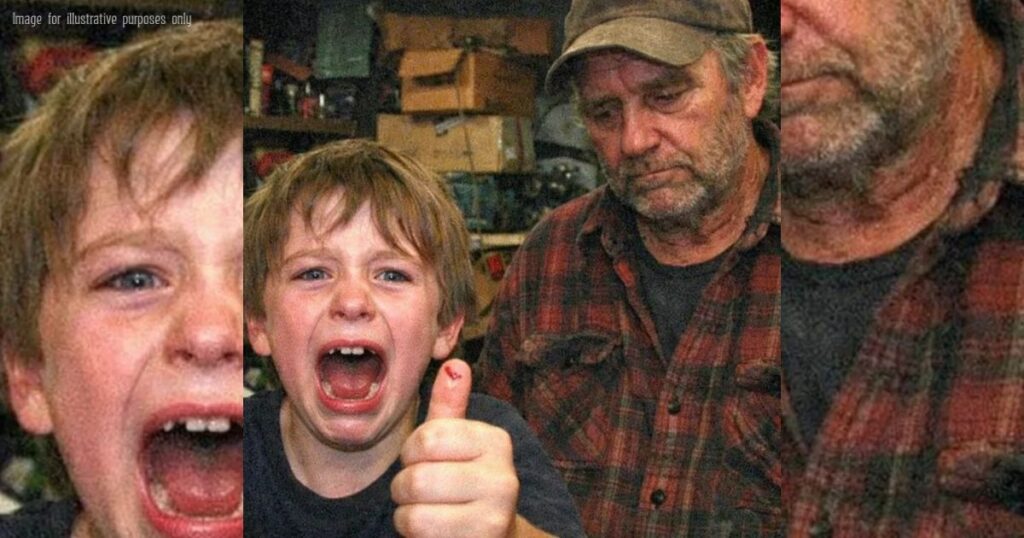
I walked closer, slow, until I was standing a few feet in front of him. Close enough to see the tiny scar on his thumb where the chisel had kissed him.
“Because,” I said, “if I came every time the world scared you, you’d never learn that you can stand in it.”
His eyes filled with fresh tears. Mark sucked in a breath. Cheryl’s arms folded themselves. Defense mode.
“That’s not an answer,” Mark snapped. “He was terrified, Dad. We were freezing. The water was pouring in. Our systems were down. We needed help.”
“You needed help six months ago when you laughed at the idea of Noah learning where the shut-off valve was,” I said quietly. “You needed help when you told me I was ‘toxic’ for wanting to put a tool in his hand that wasn’t made of plastic and pixels.”
“That doesn’t justify—” Cheryl began.
I held up a hand. “You’re right. Nothing justifies leaving a small child in danger.”
Noah’s head jerked up. Mark’s eyes narrowed.
“You weren’t in danger,” I added. “You were uncomfortable. There’s a difference.”
Cheryl’s face went red. “We had water pouring into the basement, Joe.”
“And you had two able-bodied adults, a car, neighbors, and a phone that still worked,” I said. “You had resources. You didn’t need a seventy-two-year-old man to drive on icy roads to rescue a family that refuses to rescue itself from its own fear.”
Exhale. Silence.
Noah swallowed. “So… you’re mad at us?”
“I’m not mad, kiddo,” I said. “I was sad for a long time. Then I got busy.”
He pressed his lips together. His eyes flicked around the shop, taking in the saws, the drill press, the half-finished projects stacked on the shelves.
“What do you do here?” he asked.
“Same thing I tried to do with you,” I replied. “I help people build something that can’t be unplugged.”
Right on cue, Marcus walked out from the back, wiping his hands on a rag. He nodded at me, then froze when he saw my visitors.
“Oh,” he said. “Sorry. I didn’t know you had… people.”
“These are my people,” I said. “This is my son, Mark. His wife, Cheryl. And this is Noah. The kid I told you about.”
Marcus’s eyebrows went up. “The one who made the perfect planter box?”
A tiny spark flickered in Noah’s eyes. “You… told them about me?”
“Yeah,” Marcus said, grinning. “Mr. Joe said you did clean work. He’s kind of stingy with compliments, so that meant something.”
Noah looked at me like I’d just performed a magic trick. Maybe he really thought I talked about nothing but his failure.
“Marcus,” I said, “why don’t you show Noah what we’ve been working on?”
Mark started to protest. Cheryl stiffened. “We didn’t come here for a field trip,” she said. “We came to… to address what happened.”
“Sometimes the best way to address something is to stand in the place where the solution lives,” I answered.
Marcus motioned to Noah. “C’mon. It’s warm in the back. We got a heater that works even when the power’s flaky.”
Noah looked up at his parents, waiting for permission. It hit me then how much of that boy’s life had been spent waiting for green lights from people who were themselves paralyzed.
“It’s fine,” Mark said, voice tight. “Stay where we can see you.”
The boys disappeared into the back. I heard Marcus start explaining something about a tiny home frame we were building for a woman who’d lost everything in the freeze.
Cheryl blew out a slow breath. “Joe, look,” she said. “We know you think we’re overprotective. We know you think screens ruined the world and that kids should bleed a little to grow. But Noah… he spiraled that night. He said, ‘Grandpa doesn’t love me because I’m not brave.’ Do you have any idea what that does to a child?”
“Yes,” I said. “It forces him to ask what bravery actually is.”
Mark shook his head. “That’s not fair. Not everyone is wired like you. Not everyone regulates fear by swinging a hammer.”
“And not everyone regulates fear by pressing ‘order now’ on a delivery app,” I shot back. “But here we are.”
He flinched. I regretted the sharpness, but I didn’t take it back.
Click the button below to read the next part of the story.⏬⏬