PART 2 — “The Oak Block Didn’t Stay in Room 104.”
The next morning, the oak blocks were everywhere.
They poked out of backpacks like contraband. They sat on cafeteria tables next to soggy fries. A few kids held them in the hallway like they were warm stones, thumbs sliding over that beeswax shine the way you’d rub a worry coin.
And, somehow—God help me—Room 104 was trending.
Not my name. Not North Creek High. Just the clip.
A shaky phone video—shot from behind a stack of clamps—caught a dozen teenagers sanding in silence, shoulders moving in a shared rhythm. It caught my voice, too, gravel and tired:
“Hit the wood. Not the world.”
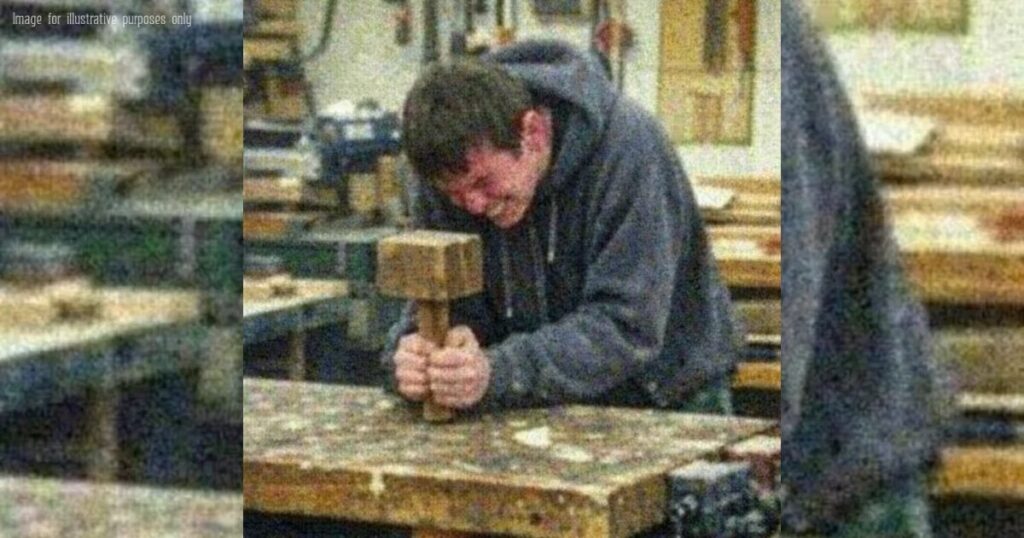
Then the shot swings to Leo. His hands are shaking. His face is wet. He’s rubbing oil into the grain like he’s trying to put himself back together.
The caption somebody slapped on it was the kind that starts wars in comment sections:
“THIS is what schools should teach. Not more screens.”
By second period, my inbox looked like a burn pile.
Half the messages sounded like prayers.
Thank you for seeing our kids.
My son hasn’t smiled like that in months.
This made me cry at work.
The other half sounded like sirens.
You trapped children in a room with a violent kid and didn’t call security?
So you gave an angry boy a weapon and told him to hit something?
This is how tragedies happen.
Fire him.
They weren’t entirely wrong to ask.
Because the part the video didn’t show—the part the internet never shows—is the weight of that two-pound mallet in Leo’s hand before I made a choice.
At 10:17 a.m., the principal’s secretary appeared in my doorway like a funeral director.
“Mr. Miller,” she said softly, “they need you in the conference room.”
They always means trouble.
The conference room at North Creek is all glass and fake cheer. A bowl of mints nobody eats. Inspirational posters with stock-photo mountains. Like you can solve a kid’s panic attack with a sunrise.
Principal Harlow sat at the head of the table with her hands folded tight. Next to her was Mr. Kline from “Student Safety,” a man who always looks like he’s waiting to tackle someone. And at the end was a woman I hadn’t met—district office, crisp blazer, smile like a stapler.
On the table was a printed screenshot of the video.
I didn’t sit. My knees don’t like sitting for politics.
Harlow cleared her throat. “We need to talk about yesterday.”
“About sanding?” I asked.
“About the mallet,” Mr. Kline snapped, like he’d been dying to say the word.
The woman in the blazer slid a paper toward me. “This is a formal notice. You’re being placed on administrative leave pending review.”
The room went quiet enough to hear the ice machine down the hall cough out a cube.
I stared at the paper. The words swam a little. Thirty-two years of showing up before dawn, sweeping up sawdust, fixing jammed blades, teaching kids how to measure twice and cut once—and a single page was supposed to put a period at the end of it.
“Pending review for what?” I asked, though I already knew.
“Failure to follow protocol,” the blazer woman said, calm as a weather report. “A student displayed aggressive behavior with a tool that could be used as a weapon. You did not initiate a safety response.”
Harlow tried to soften it. “We understand you were trying to de-escalate.”
“De-escalate?” Mr. Kline repeated, like the word tasted bad. “You locked the door.”
I felt heat crawl up my neck. “I locked the door because the hallway was full of kids. Because if Leo ran out there swinging, we’d have a real crisis on our hands.”
“So you kept everyone in the room with him,” Mr. Kline said.
“I kept everyone in the safest place I could control,” I shot back. “And I took the energy out of his hands before it landed somewhere it couldn’t be undone.”
The blazer woman tapped the screenshot. “The optics are… complicated.”
There it was. The real god of modern education: optics.
Harlow sighed. “The district is getting calls. Parents. Media inquiries. We need to show we take safety seriously.”
“I take safety seriously,” I said, voice low. “That’s why nobody got hurt.”
Mr. Kline leaned forward. “You realize people are saying you encouraged violence.”
I almost laughed. It came out as a rough exhale. “I handed him a block of wood and sandpaper.”
“You told him to hit something,” he insisted.
“I told him to hit wood, not people. There’s a difference. There’s always been a difference.”
The blazer woman’s smile didn’t move. “Mr. Miller, this isn’t about your intentions. It’s about liability.”
Liability.
A word that has nothing to do with children and everything to do with fear wearing a suit.
Harlow’s voice went smaller. “Just… go home for a few days. Don’t contact students. We’ll call you.”
I stood there a second longer, looking at three adults who had never smelled burning oak or watched a kid’s hands shake while he fought himself. They were terrified of what might happen. I was terrified of what already was happening—and how quiet it looked from the outside.
I pushed the paper back across the table.
“I don’t need a few days,” I said. “I need you to remember you’re running a school, not a courtroom.”
Then I walked out before my throat did something humiliating.
By lunch, the hallway had turned into a courtroom anyway.
Kids showed me their phones in whispers when they thought teachers weren’t looking.
One comment thread called me a hero.
Another called me a dinosaur.
One person wrote, “This is toxic masculinity in a workshop apron.”
Another wrote, “Finally, an adult who doesn’t treat kids like fragile glass.”
Somebody else—probably a teenager with too much time—made a poll:
“Would you rather your kid learn to code… or learn to cope?”
Tens of thousands of votes.
That’s the thing about the internet: it turns real pain into a spectator sport. It strips out the sawdust and replaces it with slogans.
And people love slogans because slogans don’t require you to look a trembling kid in the eyes.
I cleaned my shop like a man cleaning a grave.
I wasn’t supposed to be there, technically. Leave meant leave. But my key still worked, and my hands didn’t know what else to do besides work.
I swept the floor slow. Sawdust rolled into piles like tan snowdrifts. The smell—oak and beeswax—clung to the air. It smelled like yesterday’s miracle.
That’s when I heard the knock.
Click the button below to read the next part of the story.⏬⏬