His mom inhaled sharply. “Leo—”
“I’m tired,” he said simply. “I’m tired of everyone talking about us like we’re a problem to solve.”
He glanced around Room 104, at the battered benches and the old lathe that had outlived four principals.
“This place… it’s the first time in a long time my brain shut up.”
I felt my throat tighten.
“Then make them hear that,” I said.
That night, the auditorium was packed.
Not just parents. Teachers. Community folks. A couple of local tradespeople in work boots. Kids in hoodies. People who never show up for anything unless there’s blood in the water.
At the front sat the board and Principal Harlow and the blazer woman and Mr. Kline, all lined up like judges. Behind them was a screen showing a slide that read:
“Proposal: Transition Room 104 to an Innovation Hub.”
Innovation. The word again. Shiny. Sterile.
A man in the third row stood up first. Loud voice. Anger polished into confidence.
“My daughter doesn’t feel safe,” he said, pointing a finger toward the stage. “And then I see a teacher on video telling a kid to HIT something? Are you kidding me? This is why parents don’t trust schools anymore!”
Applause broke out—sharp, relieved, like people were glad someone said it.
Then a woman stood. Quiet voice. No applause at first.
“My son,” she said, swallowing, “came home yesterday with a piece of wood and said it was the first thing he’d finished in months.”
The room shifted. Uncomfortable.
“He said he didn’t feel judged in that class. He said he didn’t feel like a number.” She looked straight at the board. “If you replace every real thing with a screen, what exactly are you teaching them to be?”
A murmur. A few claps. A few eye rolls.
Here we go. Us versus them. Always.
Then, from the side aisle, Leo stood up.
The air sucked in around him.
He didn’t look like a hero. He looked like what he was: a kid who had almost broken.
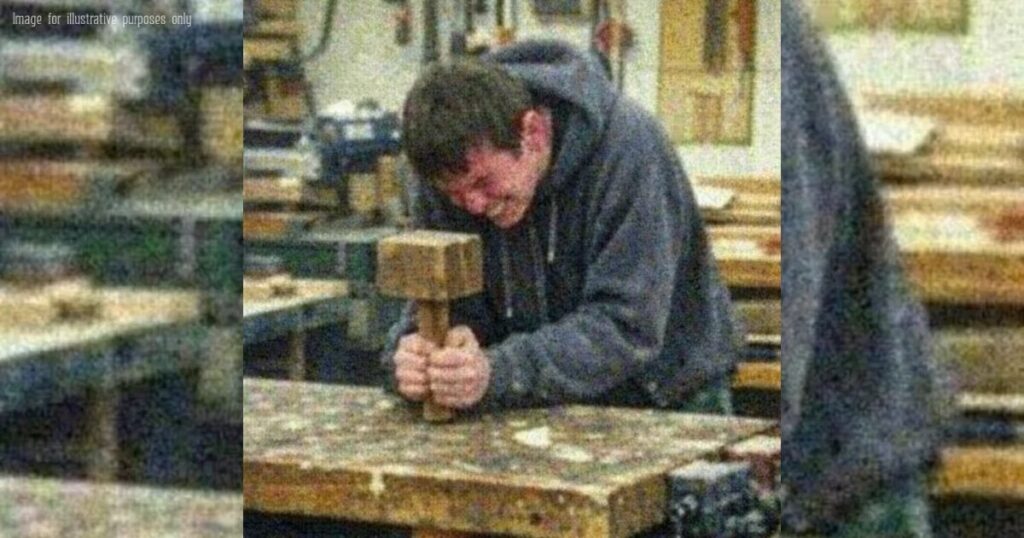
“I’m the one with the mallet,” he said, voice shaking but not collapsing.
A ripple went through the room like wind through dry leaves.
Mr. Kline leaned forward like he wanted to stop him. Principal Harlow looked like she might cry.
Leo kept going.
“I wasn’t gonna hurt anyone,” he said. “I was gonna hurt… everything.” He swallowed hard. “I was angry. I was scared. I felt stupid all the time. Like no matter what I did, I was failing.”
You could hear someone’s kid sniffle. A parent shifting uncomfortably. A teacher’s quiet breath.
“And Mr. Miller didn’t yell,” Leo said. “He didn’t call me a threat. He didn’t call me a problem.” He lifted his oak block above his head like it was a trophy, like it was a witness.
“He gave me something my brain could understand,” he said. “Friction. Work. Something real.”
He looked around at the adults.
“You all keep telling us to ‘reach out,’” he said, voice rising. “But when we do, you hand us an app. Or a pamphlet. Or a deadline.”
The room went dead quiet.
“Yesterday,” Leo said, “an old man handed me sandpaper and didn’t treat me like I was broken beyond repair.”
His voice cracked. “So if you’re going to fire him… at least be honest and say why.”
He pointed toward the stage, toward the slide, toward the future they’d decided on without asking the kids who had to live in it.
“Say you’re not scared of violence,” he said. “Say you’re scared of mess. Scared of feelings. Scared of anything you can’t control.”
That line hit like a nail gun.
People exploded—some clapping, some shouting, some furious, some crying.
That’s what makes things go viral, I guess: not perfection.
Truth that makes everyone uncomfortable.
I didn’t plan to speak. I wasn’t even sure I was allowed in the building. But I found myself standing anyway, my legs moving before my fear could stop them.
I walked down the aisle slow. I felt every eye on me like heat lamps.
When I reached the microphone, I didn’t look at the board first.
I looked at the kids.
All of them.
The athletes. The quiet ones. The ones with perfect hair. The ones with tired eyes.
“I’m not a hero,” I said. “And I’m not reckless. I’m a man who’s watched too many young people go numb.”
I paused. Let it land.
“Yesterday, I made a judgment call,” I said, voice steady. “And if you want to investigate that, fine. You should. Safety matters.”
A few people nodded. A few crossed their arms.
“But don’t confuse a policy with a soul,” I continued. “You can write rules for tools. You can’t write rules for pain.”
I glanced at the slide behind the board.
“And as for the Innovation Hub…” I let the words hang a second. “I don’t hate technology. I hate the lie that technology can replace what these kids are starving for.”
I leaned closer to the mic. The old sawdust in my lungs made my voice rougher.
“You cannot download resilience,” I said. “You cannot simulate belonging. You cannot 3D print character.”
I looked out at the parents now—the tired faces, the defensive ones, the ones desperate for control.
“And if you think the answer to a generation drowning in loneliness is more screens… then you’re not paying attention.”
Some people applauded. Some people didn’t. A few looked angry enough to chew through steel.
Good.
Because the truth is supposed to split a room before it heals it.
I stepped back from the microphone and sat down.
The meeting went on for another hour, full of motions and votes and speeches that tried to make human beings sound like budget lines.
But the thing people kept talking about—outside in the parking lot, in the aisles, later online—wasn’t the proposal.
It was Leo.
It was the block of wood held up like a heartbeat.
And the question that would not die, because it wasn’t just about a woodshop.
It was about what kind of world we’re building for kids who are already splintered.
That night, when I got home, I finally opened the envelope Leo’s mom had handed me.
Inside was a single sheet of notebook paper. The handwriting was shaky but determined.
It said:
“I didn’t want to be the kid everyone was afraid of. I wanted to be the kid who could fix something.”
I sat at my kitchen table for a long time, staring at those words, smelling imaginary beeswax and oak.
Outside, the winter wind scraped branches against my window like sandpaper.
And for the first time since the district told me they were killing Room 104, I realized something that made my chest hurt in a different way:
They can take the lathes.
They can sell the drill presses.
They can paint over the sawdust.
But they can’t unteach what happened in that room.
Because once a kid learns that friction can turn rage into something smooth enough to hold—
Once they learn they can shape themselves with their own hands—
They don’t forget.
And neither does the world that watched it happen and argued about it like it was entertainment.
Maybe that’s the uncomfortable miracle:
Sometimes the thing that saves a kid…
is the same thing that makes everybody else fight in the comments.
And maybe the fight is proof we still care.
Or proof we’ve forgotten how to.
Thank you so much for reading this story!
I’d really love to hear your comments and thoughts about this story — your feedback is truly valuable and helps us a lot.
Please leave a comment and share this Facebook post to support the author. Every reaction and review makes a big difference!
This story is a work of fiction created for entertainment and inspirational purposes. While it may draw on real-world themes, all characters, names, and events are imagined. Any resemblance to actual people or situations is purely coincidenta