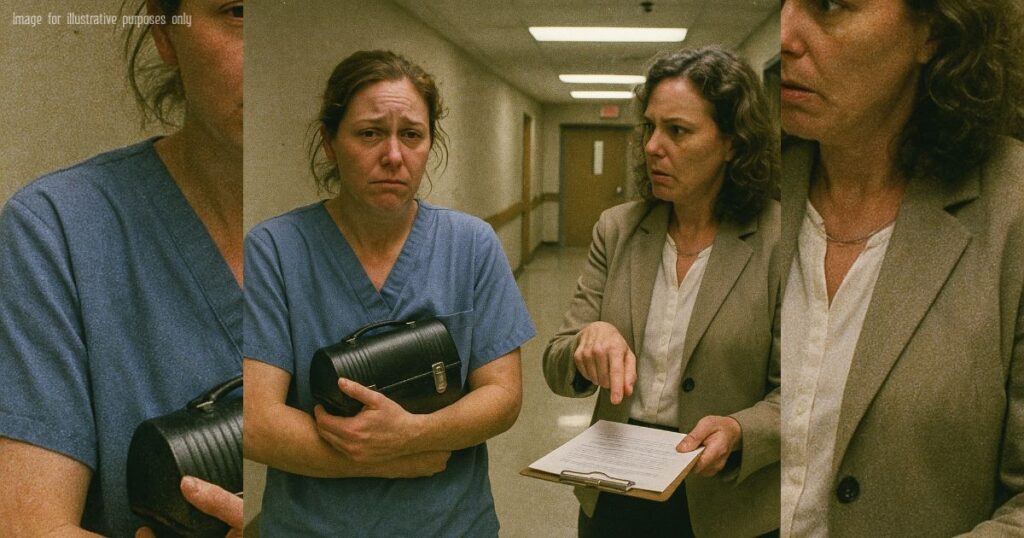
My supervisor wrote me up for bringing “contraband” into the memory care unit. She said I was breaking protocol. I told her I was just saving a man from starving to death.
Mr. Frank hadn’t eaten in four days.
In the medical charts, he was listed as an 82-year-old male with advanced Alzheimer’s and “combative refusal of care.” But if you looked at him—really looked at him—you didn’t see a patient. You saw a man who had spent forty years in a steel mill. His hands were calloused maps of hard labor, his shoulders permanently hunched from carrying the weight of the American dream for a wife and three kids.
The hospital kitchen kept sending up these beige, plastic trays. Puréed peas. Lukewarm oatmeal. Bland gelatin cubes.
Every time I tried to bring the spoon to his mouth, Frank would clamp his jaw shut and turn his head, his eyes flashing with a lucid, terrifying anger. He’d swipe the plastic tray off the table, sending the plastic silverware clattering across the linoleum.
“I’m not a child,” he’d mutter, staring out the window at the parking lot. “I don’t eat slop.”
The doctor was talking about a feeding tube. He said Frank’s body was shutting down.
I worked the graveyard shift that Tuesday. While Frank slept, restless and muttering about “shift change” and “the foreman,” I went through the cardboard box his son had left on the nightstand. It was filled with the debris of a life: a broken pocket watch, a union pin, and a stack of old, yellowed napkins.
I unfolded one. In fading blue ink, a woman’s handwriting read: Don’t work too hard, handsome. Roast beef tonight. Love, Martha.
I realized then what we were doing wrong.
We were treating a geriatric patient in a hospital bed. But in Frank’s mind, he wasn’t here. He was twenty-five years old. He was on the scaffolding. He was the provider. And providers don’t get spoon-fed mush by a stranger in scrubs. Providers eat the lunch their wife packed them before the sun came up.
I clocked out at 7 AM, but I didn’t go home. I went to the thrift store down on 4th Street.
I found it in a bin of junk. A black, domed metal lunchbox. Scratched. Dented. It smelled faintly of old rust and memories. I bought a roll of wax paper—not the cling wrap we use now, but the thick, waxy kind that crinkles when you fold it.
I went to the staff breakroom and made a sandwich. White bread. Thick peanut butter. Grape jelly. I cut the crusts off, just like my grandma used to do. I wrapped it in the wax paper, folding the corners into perfect, tight triangles. I filled a small, battered steel thermos with black coffee, steaming hot.
Then, I forged a note on a napkin. Eat up, Frank. You’ll need the strength. Love, Martha.
When I walked back into Frank’s room, it was noon. The lunch cart was down the hall. I bypassed it.
I walked up to Frank, who was staring blankly at the wall. I didn’t use my “nurse voice.” I didn’t coo at him like he was a baby.
I set the heavy metal lunchbox down on his overbed table.
Clank.
That sound. Metal on hard surface. It was the sound of a breakroom in 1965. It was the sound of a construction site at noon.
Frank’s head snapped up. His eyes, usually cloudy, sharpened. He looked at the box. He looked at me.
“Lunch break, Frank,” I said simply. “Martha sent this over.”
He didn’t speak. His trembling hand reached out and popped the metal latches. Snap. Snap.
He opened the lid. The smell of peanut butter and wax paper hit the sterile air. He saw the note. He picked it up, his thumb brushing over the ink, and for a second, I saw his lips quiver.
He poured the coffee into the cup cap. He unwrapped the wax paper. The crinkle sounded like music.
Frank ate.
He didn’t just eat; he dined. He sat up straight, shoulders back, chewing with a dignity that broke my heart. He wasn’t a dying old man anymore. He was a man taking a well-earned break after a morning of hard work. He wiped his mouth with the napkin, folded it, and put it in his pocket.
When his son, David, came to visit that evening, he found the empty lunchbox on the table. Frank was sleeping peacefully for the first time in weeks.
David picked up the box, and I saw tears track down his face.
“Mom packed this for him every day for thirty years,” David whispered. “Even when they were fighting. Even when money was tight. She never let him go to work without it. It was her way of saying, ‘I’m with you.'”
I’ve packed Frank’s lunch every day for the last two weeks. The doctors say his vitals are up. The color is back in his cheeks.
My supervisor eventually dropped the write-up. She couldn’t argue with the results.
We spend so much time in healthcare trying to fix the body that we forget to honor the person living inside it. We try to force them into our schedule, our protocols, our plastic trays.
But dignity isn’t a medical procedure. It’s a specific kind of love. It’s the smell of black coffee and the crinkle of wax paper. It’s remembering that before they were patients, they were people. They were husbands, wives, workers, and dreamers.
Sometimes, medicine isn’t what saves a life. Sometimes, it’s just a peanut butter sandwich, wrapped the way she used to do it.
Love them for who they are now, but respect them for who they were then. The memories are still real, even if they’re the only ones who can see them.
If you think the story ended with an old man eating a peanut-butter sandwich in peace, you’re wrong—because that dented metal lunchbox ended up putting my whole job, and our idea of “truth,” on trial.
This is what happened after Frank took that first bite.
Click the button below to read the next part of the story.⏬⏬