PART 2 — “The Bill That Arrived After the Apology”
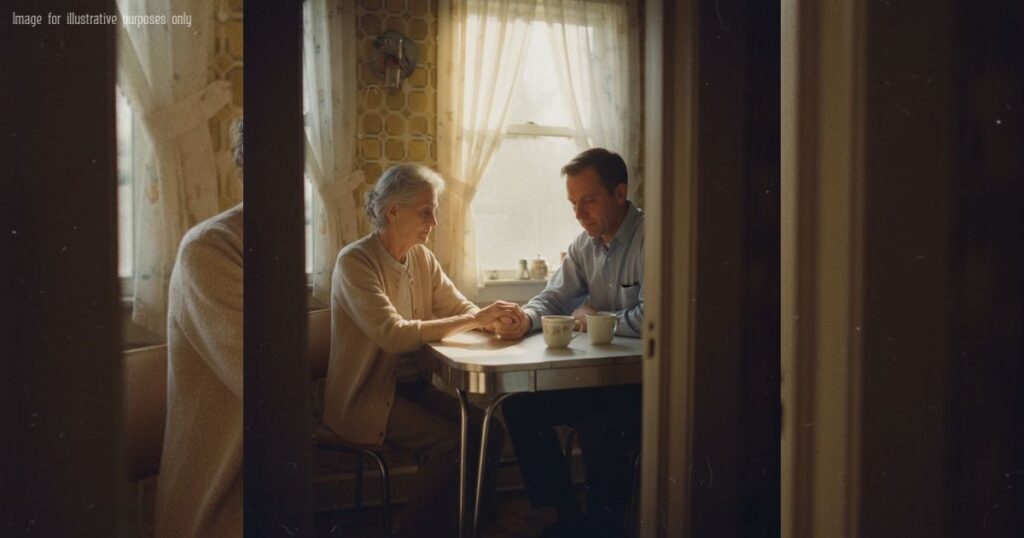
If you read Part 1, you know I ended up on my knees beside my mother’s wheelchair, my face pressed into the hands I spent forty years misunderstanding.
What you don’t know is what happened the very next morning—the morning the system reminded me that love doesn’t come with a receipt… but care does.
And it was due.
The call came at 8:12 a.m., right as I was staring at my laptop, trying to pretend my life still fit inside a calendar invite.
A calm voice said my name, then said my mother’s, then said the words that turned my stomach cold: “We need to discuss her account balance.”
Not “How is she doing?” Not “Did you get some rest?”
An account balance.
I drove back to the facility on autopilot, like my body had learned the route faster than my heart could keep up.
The lobby smelled like lemon cleaner and something sweet trying too hard to cover something else.
A holiday wreath hung crooked on the wall, and a small TV played a game show no one was watching.
At the front desk, a tired woman in scrubs looked up and smiled politely, the kind of smile that says, I care, but I’m also drowning.
“Michael?” she asked.
I nodded, and she handed me a clipboard like it was a verdict.
Forms. Payment schedules. A list of “options” that all sounded like different ways of saying figure it out.
The case manager met me in a small office with a fake plant and a framed quote about hope.
She was kind. She was also blunt, the way people get when they’ve had to say the same hard truth too many times.
“Your mom’s level of care is increasing,” she said. “Memory needs change fast. Safety needs change fast.”
I swallowed. “So… what are you saying?”
“I’m saying,” she replied gently, “that what worked last month may not be enough next month. And the cost reflects that.”
Cost.
That word again.
It hit me like a slap, because just twenty-four hours earlier I had been sobbing into my mother’s hands, promising I saw her now.
But seeing her didn’t magically create money.
And that’s where the shame lives in this country—right in the gap between love and affordability.
I wanted to get angry at the case manager, because anger is easier than terror.
But I looked at her eyes—tired, honest—and I realized she wasn’t my enemy.
She was just a messenger standing in front of a machine bigger than both of us.
“I can bring her home,” I heard myself say.
The words came out fast, desperate, like a man offering his own body as collateral.
Her expression didn’t change, but something flickered behind it.
“We can talk about home care,” she said carefully. “But I need you to be realistic. It’s not just… feeding her. It’s supervision. Medication reminders. Fall risk. Wandering risk. Nighttime confusion.”
Then she paused, and her voice softened.
“And it’s also you.”
“What do you mean?”
“I mean the burnout,” she said. “The guilt. The anger you’ll feel and then hate yourself for feeling. The resentment you won’t admit out loud.”
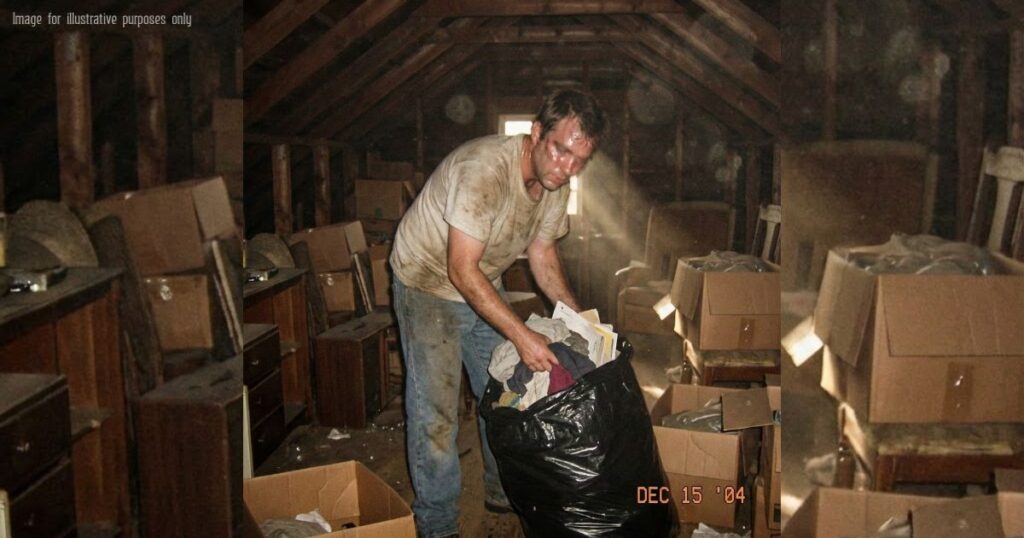
That last part landed hard, because it was like she’d been in my attic with me.
Like she’d watched me shove my mother’s life into trash bags.
Like she knew how close I came to turning my mother into a problem I could drop off and forget.
I left the office with a folder of paperwork and a pressure behind my eyes that felt like a storm.
On the way to my mom’s room, I passed a woman about my age standing in the hallway with her phone up, whispering through tears.
“I can’t do it anymore,” she said. “I can’t keep paying. I’m going to lose the house.”
She looked up and met my eyes for half a second.
We didn’t speak.
We didn’t need to.
That look said everything: I love them. I’m failing anyway.
When I got to my mother’s room, she was awake, staring at the window like the world outside might explain what her mind couldn’t.
I sat beside her, and for a while I didn’t talk.
I just stayed.
Because Part 1 taught me something simple that felt almost holy: presence is a form of apology.
Finally, she turned her head and squinted at me.
“Are you in trouble?” she asked.
It was such a mother question that it almost broke me again.
“No,” I lied. “I’m okay.”
She kept looking at me like she could see the lie’s outline.
Then she said, quiet as falling dust, “Don’t spend it all on me.”
I froze.
My throat tightened.
“Mom…” I whispered.
She blinked, and for one second her eyes cleared in a way that felt impossible.
“I know what things cost,” she said. “I always knew.”
And then it was gone—like the light had flickered and the old house had gone dim again.
She looked away, and I sat there holding my breath, because that sentence wasn’t just a sentence.
It was a lifetime.
It was pawn slips and skipped lunches and medications she didn’t refill.
It was her saying, even now, Don’t let me be the thing that breaks you.
That afternoon, my wife met me at home.
She found me at the kitchen table with the paperwork spread out like I was studying for a test I couldn’t pass.
Her eyes went to the folder, then to my face.
“How bad?” she asked.
I let out a laugh that wasn’t funny.
“Bad enough that I understand why people disappear,” I said.
Her expression tightened. “Don’t say that.”
“I’m not saying I will,” I replied quickly. “I’m saying I get it now. I get why people stop answering calls. I get why families fight. I get why siblings go quiet and pretend they’re ‘too busy’ until the funeral.”
That’s the part nobody likes to talk about, because it’s messy and it doesn’t fit the neat little social media posts about gratitude.
We love the idea of honoring our parents.
We just don’t love the reality of it when it shows up as exhausted nights, strained marriages, and numbers that don’t make sense.
I opened one of the spiral notebooks again that night, hands shaking.
Not the old ones from when I was a kid.
A newer one.
The handwriting was worse.
The date at the top made my stomach drop: three months ago.
I hadn’t even known she was still writing.
I read the first line and felt my chest hollow out.
“Michael thinks I don’t know what I’ve become.”
I read on.
“He gets impatient when I take too long to answer. He doesn’t mean to. He is my boy. He is trying to be good.”
Then:
“If he reads this one day, I want him to know I was never disappointed in him. I was scared for him. I was scared the world would eat him alive the way it tried to eat me.”
I swallowed so hard it hurt.
Because that was it, wasn’t it?
All my life I thought her silence was judgment.
But it was fear.
Protective fear.
Mother fear.
And the next part… the next part is where the comments would explode if this were online, because it’s the sentence that makes people pick sides.
She wrote:
“If he has to choose between saving me and saving his family, I pray he saves his family.”
I sat there a long time, staring at that line until the words stopped being words and became a weight.
Because here’s the controversial truth nobody wants to admit:
Sometimes, taking care of an aging parent doesn’t just cost money.
It costs your health.
It costs your marriage.
It costs your kids’ stability.
And if you’ve never been in that position, it’s easy to judge from a distance.
It’s easy to say, I would never put my mom in a home.
It’s easy to say, Family takes care of family.
But love isn’t a slogan.
Love is logistical.
Love is sleep deprivation.
Click the button below to read the next part of the story.⏬⏬