I stood with my hand hovering over my handcuffs, ready to arrest a seventy-two-year-old man for the crime of sitting on a sidewalk in a town that had forgotten how to breathe.
My radio was chirping with a low-battery warning. The dispatch operator was asking for a status update. And in front of me, sitting on a rusted, folding lawn chair he’d brought from home, was Mr. Miller.
“Sir,” I said, trying to keep the exhaustion out of my voice. “We have been over this. Tuesday. Wednesday. And now Thursday. You cannot block the public right-of-way. This is a Loitering-Free Zone.”
Mr. Miller didn’t look like a criminal. He looked like the grandfather in a picture frame you buy at a department store—worn flannel shirt, a faded baseball cap with the logo of a minor league team that folded in the nineties, and a stainless-steel thermos that had seen more sunrises than I’d seen hot meals.
He took a slow sip of coffee, looked at the empty, pristine pavement that stretched for fifty yards in either direction, and smiled.
“Officer,” he said, his voice like gravel crunching under tires. “I’m not blocking a soul. I’m just occupying the space the world forgot.”
“The property management called again,” I insisted, gesturing to the gleaming glass facade of the new mixed-use complex behind him. It used to be a hardware store where you could buy a single nail. Now, it was a sleek building with a heavy wooden door that required a key fob to enter and a lobby that smelled like sanitizer. “They say you’re hurting the aesthetic. You’re bad for business.”
“There’s no business to be bad for,” Miller replied softly. “Nobody walks here anymore, son. They just drive from their heated garages to their underground parking.”
I sighed, rubbing the bridge of my nose. The headache that had started during the morning briefing was now a full-blown migraine. “Please. Just go home. Don’t make me write the citation.”
He looked at me then—really looked at me—with eyes that were startlingly clear. “I am home, Officer. That’s the problem.”
I didn’t write the ticket. I gave him a warning, got back in my patrol cruiser, and drove away. I told myself I was just being lenient. But as I merged back into traffic, watching the rain start to smear against the windshield, I felt a heavy stone in my gut.
Our town wasn’t bad. It was just… efficient. Over the last decade, the messy, loud, chaotic edges of the community had been sanded down. The old diners with sticky booths were replaced by drive-thru chains where you ordered from an app. The parks had removed the benches to discourage “overnight stays.” The fences had gotten higher. The windows had gotten tinted.
We were safe. We were clean. And we were profoundly, aching lonely.
The next day, Friday, the rain had turned into a steady, cold drizzle. I expected to find Mr. Miller gone. Surely the weather would drive him indoors.
I turned the corner onto Main Street, preparing my speech about “public disturbance.” But my foot hit the brake before my brain caught up.
Miller was there. But he wasn’t alone.
Sitting on the wet concrete next to him, legs crossed, hood pulled up tight, was a kid. I recognized him immediately. Leo. Sixteen years old. He was a “frequent flyer” in our system—truancy, noise complaints, minor vandalism. The kind of kid society writes off before he’s old enough to vote.
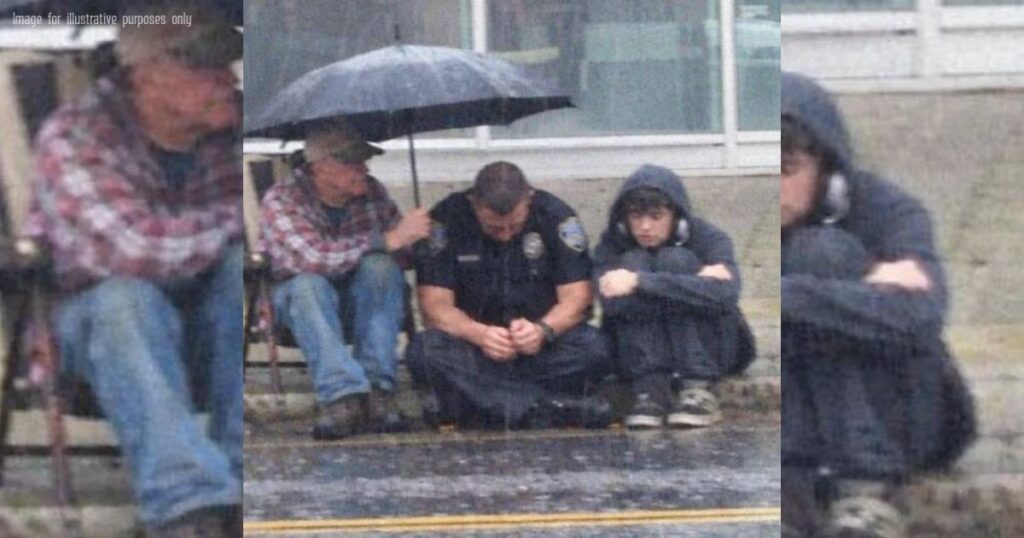
Leo was sitting with his back against the glass wall of the luxury complex. Mr. Miller was sitting in his lawn chair. And between them, Miller was holding a large, black umbrella, tilting it just enough to keep the rain off the boy’s shoulders.
They weren’t talking. Leo had his headphones around his neck, silent. Miller was just watching the cars go by.
I pulled the cruiser over, killed the engine, and sat there for a moment. This was it. Two violations. One for the old man, one for the kid. This was the part where I got out, enforced the code, dispersed the “gathering,” and restored order.
But I couldn’t move.
I watched a woman in a business suit power-walk past them. She slowed down, hesitated, and then did something strange. She didn’t glare. She didn’t check her phone. She looked at the two of them—the old man and the “troubled” teen sitting in the silence—and her shoulders dropped about two inches. She offered a small, sad smile, and kept walking.
I opened the car door and stepped out into the rain.
Leo stiffened when he saw the uniform. He started to scramble up, ready to run or fight.
“Stay down, son,” Mr. Miller said. He didn’t shout. He just stated it like a fact. “You’re dry where you are.”
I walked up to the edge of the umbrella’s protection. “Leo,” I said. “You’re supposed to be in school.”
“It’s lunch period,” Leo muttered, staring at his sneakers.
“Why are you sitting on the sidewalk in the rain with…” I gestured to Miller.
Leo looked up, and the raw vulnerability in his eyes hit me harder than the cold wind. “Because it’s quiet,” he said.
I blinked. “Quiet?”
“My house is… loud,” Leo said, picking at a loose thread on his jeans. “My dad screams at the news on TV. My mom screams at the phone. Everyone online is screaming about everything. If I go to the park, people ask what I’m doing. If I go to the store, security follows me.” He gestured to the old man. “He doesn’t ask me anything. He just lets me sit.”
I looked at Miller. He poured a cup of coffee from his thermos into the plastic lid and offered it to me.
“We used to have porches,” Miller said.
“Excuse me?” I asked, ignoring the coffee.
“In this country. We used to have front porches. Wide ones. You sat out there after work. You didn’t sit there to do anything specific. You just sat to let the neighborhood know you were present. If a neighbor was sad, they’d walk up and sit for a spell. If a kid scraped his knee, he’d run to the nearest porch. We were the neighborhood watch, the therapists, and the news anchors, all from a rocking chair.”
He gestured to the shiny building behind him.
“Now? We build decks in the backyard. Hidden. Private. We build six-foot privacy fences. We enter through the garage. We’ve privatized our lives so much that we forgot that presence is a public service.”
Miller looked at Leo, then back to me.
“This boy isn’t bad, Officer. He’s just got nowhere to be human. The world is telling him he needs to be a consumer, a student, or a suspect. I’m telling him he can just be a person.”
The rain drummed against the umbrella. Presence is a public service.
I thought about my own apartment. The empty rooms. The hours I spent scrolling through feeds of people arguing about politics, feeling my chest tighten with anxiety, convinced the world was ending. I thought about how long it had been since I sat somewhere without checking my phone, without an agenda, without a timeline.
I looked at the “No Loitering” sign bolted to the light post.
Strictly speaking, my job was to enforce the rules. The rules said the sidewalk was for walking, not for being.
But I was tired. And the coffee smelled really good.
I reached out and took the plastic cup from Mr. Miller’s hand. The heat seeped into my cold fingers.
“It’s a violation of city ordinance 42-B to obstruct the pedestrian flow,” I said mechanically.
“I know,” Miller said, taking a sip from the flask itself.
I looked at the wet pavement next to Leo.
“However,” I continued, unclipping my radio from my shoulder and turning the volume down until the static faded away. “Officer discretion is allowed in cases of community engagement.”
I sat down.
I didn’t sit on a chair. I sat right on the curb, the damp concrete soaking immediately into my uniform trousers. I sat just under the edge of Miller’s umbrella.
Leo looked at me like I had grown a second head. Mr. Miller just shifted the umbrella slightly to cover my badge.
We sat there for twenty minutes.
We didn’t solve the opioid crisis. We didn’t fix the economy. We didn’t bridge the political divide that was tearing families apart in the living rooms of the houses just a few blocks away.
We just watched the rain.
A delivery driver pulled up, stressed and rushing. He saw the three of us—a cop, a delinquent, and a pensioner—sitting in a row. He stopped, looked confused, and then gave us a thumbs-up before running back to his truck.
For twenty minutes, I wasn’t the law. Leo wasn’t a problem. Miller wasn’t a nuisance. We were just neighbors.
Eventually, the rain stopped. I had to go back on patrol. Leo had to go back to school.
“Same time tomorrow?” I asked, standing up and brushing off my pants.
“I’m not going anywhere,” Miller said, folding his hands over his stomach. “The porch is always open.”
As I drove away, I realized something that should have been obvious. We have spent so much energy making our towns “smart,” “safe,” and “efficient,” that we engineered the humanity right out of them. We treated loitering like a crime, when sometimes, it’s the only cure we have left.
We don’t need more policies. We don’t need more apps to connect us.
We need to tear down the backyard fences and build the front porches back. We need to stop criminalizing the act of doing nothing.
Because in a world that is constantly demanding your attention, your money, and your outrage, the most rebellious thing you can possibly do is sit on a sidewalk with a stranger, say absolutely nothing, and just let them know they aren’t alone.
—
PART 2 — “THE PORCH THAT WENT VIRAL” (Continuation)
By Saturday morning, the whole town had an opinion about the twenty minutes I spent sitting on a curb.
I didn’t find out because someone told me in person.
I found out because my phone wouldn’t stop vibrating on my kitchen counter like it was trying to crawl away.
One notification after another.
A local community page. A neighborhood group chat. A clip reposted by someone’s cousin. A caption in all caps. A caption in laughing emojis. A caption calling me either a hero or a disgrace.
The video was shaky, shot from inside a car at a red light.
Three figures in a row beneath a black umbrella: a cop in a wet uniform, a teenager in a hoodie, and a seventy-two-year-old man in a folding lawn chair like he was guarding a ghost town.
You could hear the person filming whisper, half-awed, half-mocking.
“Bro… look. The police are… loitering.”
Click the button below to read the next part of the story.⏬⏬