PART 2 — “THE PORCH THAT WENT VIRAL” (Continuation)
By Saturday morning, the whole town had an opinion about the twenty minutes I spent sitting on a curb.
I didn’t find out because someone told me in person.
I found out because my phone wouldn’t stop vibrating on my kitchen counter like it was trying to crawl away.
One notification after another.
A local community page. A neighborhood group chat. A clip reposted by someone’s cousin. A caption in all caps. A caption in laughing emojis. A caption calling me either a hero or a disgrace.
The video was shaky, shot from inside a car at a red light.
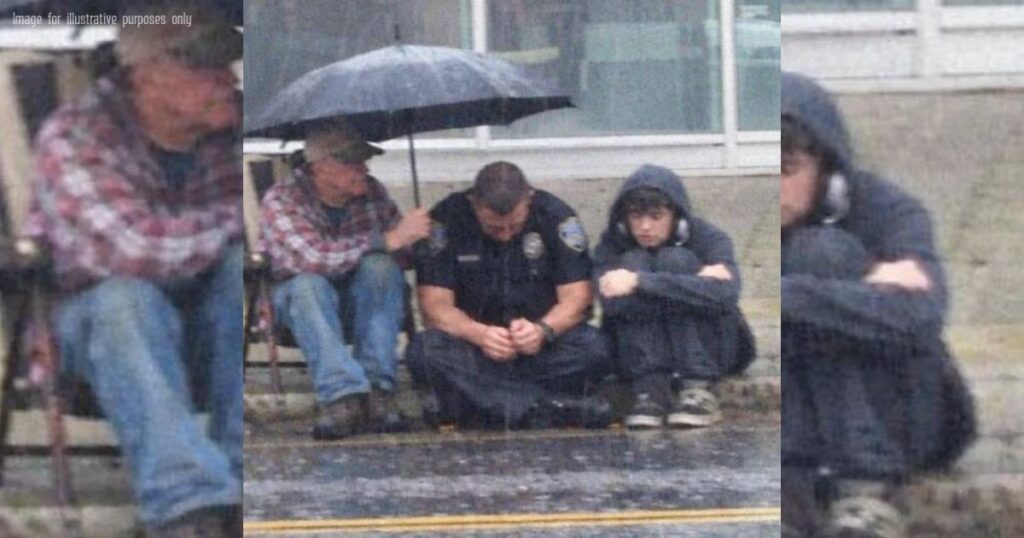
Three figures in a row beneath a black umbrella: a cop in a wet uniform, a teenager in a hoodie, and a seventy-two-year-old man in a folding lawn chair like he was guarding a ghost town.
You could hear the person filming whisper, half-awed, half-mocking.
“Bro… look. The police are… loitering.”
Then the comments came, like they always do—fast, hungry, certain.
“This is what we need. People. Not policies.”
“So he gets paid to sit? Must be nice.”
“He’s enabling delinquency.”
“You’ll arrest a grandma for expired tags but sit with vandals.”
“If you don’t like the rules, move.”
“If your town bans sitting, your town is already dead.”
I stood there in my socks, staring at my own face on a screen, rain darkening my pant legs, my badge catching the gray light.
I hadn’t thought those twenty minutes mattered.
But apparently, they did.
Because the modern town is like that: it can ignore a human being for years, but it will notice you the second you become content.
My radio crackled on my counter. Low battery, like always.
Then it chirped again.
Dispatch.
My stomach tightened.
I answered.
“Unit Twelve,” I said.
A beat. Then the operator’s voice, careful. “The Captain wants you at the station. As soon as you can.”
Not when you’re on shift. Not when you’re done with your coffee.
As soon as you can.
The Captain didn’t yell.
That would’ve been easier.
He just held his phone out across his desk like it was contaminated.
“Is this you?”
He didn’t need to play the sound. The image was enough.
“Yes, sir.”
He leaned back, eyes tired. “Do you know how many calls we’ve had since last night?”
I didn’t answer.
He counted anyway, like he couldn’t help himself. “Property management. The complex. Two business owners. One resident who says she pays good money to live somewhere ‘clean.’ Another who says you’re ‘making the department look soft.’ And—” he paused, like he hated that this mattered, “—someone from the city administrator’s office.”
That last one landed like a weight.
“They’re saying you’re hurting the… what do they call it?” He glanced down at a printed email on his desk, as if the words offended him. “The curb appeal. The investment environment.”
I thought of Mr. Miller’s sentence from yesterday, delivered like a prayer.
Presence is a public service.
The Captain tapped the paper. “You know what I call it? A headache.”
He rubbed his jaw and looked at me with something close to sympathy. “I get it. I do. But my job is to keep this department out of lawsuits and out of headlines.”
“Sir,” I said, choosing my words carefully. “It’s a sidewalk.”
“It’s a sidewalk with a brand-new complex behind it,” he replied, voice flat. “And those people have lawyers. Real ones. The kind who can turn a folding chair into a ‘public safety hazard’ in twelve pages.”
He leaned forward.
“From this moment on, I need you to do things by the book.”
The book.
The same book that made it a violation to be alive without a destination.
“What does that mean?” I asked, even though I knew.
“It means no more porch philosophy,” he said. “No more sitting. No more viral moments. You see loitering, you address it. You document it. You move it along.”
He watched my face.
Then, softer: “Do not make me choose between you and my pension.”
I nodded once. Because that’s what you do in uniform. You nod even when something in you goes quiet.
As I stood to leave, he added, almost as an afterthought:
“And for the record? Half the town thinks you’re a saint. Half thinks you’re the reason society is collapsing.”
He looked down at his desk again.
“Congratulations,” he muttered. “You’re trending.”
I drove to Main Street even though I told myself I wouldn’t.
I told myself it was patrol. Routine. Visibility.
But my hands knew where they were going before my brain admitted it.
When I turned the corner, I expected to see Mr. Miller alone again—him against the glass, stubborn as a mailman.
Instead, I saw something that made me hit the brakes so hard my seatbelt locked.
There were chairs.
Not just a chair.
Chairs. Folding chairs. Camping chairs. A stool that looked like it came out of someone’s garage. A battered porch rocker that had no business surviving a move, let alone existing on a sidewalk.
And in those chairs?
People.
A woman in scrubs with her hair in a messy bun, holding a paper cup like it was keeping her upright.
A man in a suit with his tie loosened and his eyes hollow.
An older couple bundled in rain jackets, fingers intertwined.
A young mom with a stroller, bouncing her baby’s foot gently while she stared out at the road like she was watching for something she couldn’t name.
And right in the center of it all, like the calm eye of a storm?
Mr. Miller.
Same flannel. Same cap. Same thermos.
Leo was there too, hood up, expression guarded, like he didn’t want the world to think he belonged anywhere.
They weren’t chanting.
They weren’t protesting.
They were doing the most dangerous thing you can do in an anxious town:
They were being still.
A hand-painted sign leaned against the light post. Cardboard. Marker.
THE PORCH IS OPEN.
SIT IF YOU NEED TO.
I sat in my cruiser and stared, feeling my chest tighten—not with fear, but with the strange panic of witnessing something honest in a place that had forgotten honesty was allowed.
Then I saw him.
A man standing a few feet away, filming the whole scene with the rigid posture of someone collecting evidence.
He pointed his phone toward the chairs like they were a crime scene.
He noticed my cruiser and walked toward me fast, energized.
“Officer!” he called, waving. “Finally. I’ve been waiting.”
I stepped out into the damp air.
“What’s going on?” I asked, even though I could see it.
He thrust his phone at me, as if the law lived inside the screen. “This. This is what’s going on. This is becoming an encampment. It’s attracting riffraff. It’s—”
He paused, searching for the right word.
“—a bad look.”
A bad look.
Like loneliness was a stain.
I glanced past him at the chairs. Nobody looked dangerous. They looked tired.
The man lowered his voice, conspiratorial. “My wife and I moved here for safety. You know? We chose this neighborhood. We pay the fees. We follow the rules. And now this—this is spreading.”
Spreading.
Like compassion was contagious and he was afraid to catch it.
I looked at the sidewalk.
To his credit, Mr. Miller had arranged the chairs with care. There was still a clear path for pedestrians. A wide enough lane that a wheelchair could pass. Nothing was truly blocked.
It was a porch.
But a porch that had learned the rules of a world that hated porches.
I walked toward the group.
Leo’s shoulders tensed when he saw me. The woman in scrubs sat straighter. The young mom stopped bouncing the baby’s foot.
Everyone waited for the same thing.
For the uniform to ruin the moment.
Mr. Miller lifted his eyes to mine and spoke first.
“Morning, Officer,” he said, polite as Sunday.
I swallowed. “Morning.”
He patted the empty chair beside him. “We saved you a seat.”
I heard the Captain’s voice in my head.
By the book.
I heard the man with the phone breathing behind me.
Encampment. Riffraff. Bad look.
And then I heard something else.
The quiet.
The thing Leo had named yesterday like it was a scarce resource.
I cleared my throat.
“Alright,” I said, louder, for the whole group. “Listen up.”
A ripple went through them. Some braced. Some flinched.
I gestured to the walkway. “This is a public right-of-way. People have to be able to move through. If someone with a stroller or a wheelchair can’t pass, it becomes a safety issue.”
The woman with the stroller nodded immediately, like she’d been waiting for someone to acknowledge that her existence mattered too.
Mr. Miller didn’t argue. He just shifted his chair back an inch and tapped the leg of the rocker beside him.
“Plenty of room,” he said, calm. “We’re not here to block. We’re here to belong.”
A few people murmured agreement.
The man filming scoffed. Loudly.
“That’s not the point,” he snapped. “The point is this makes the area look—”
Mr. Miller turned his head slowly toward him.
Not angry. Not loud.
Just present.
“And what do you think people look like when they’re lonely?” he asked.
Silence.
The man opened his mouth, then closed it again like the answer wasn’t polite enough to say out loud.
The woman in scrubs finally spoke, voice thin with exhaustion.
“I worked a double shift last night,” she said. “I went home, and my apartment was silent. Like… dead silent. I stood in my kitchen and realized I hadn’t spoken to another adult without a headset on in two days.”
She stared at her coffee.
“So I came here. Because I saw the video. And I thought—if a cop can sit down for twenty minutes, maybe I can sit down for ten and remember I’m not a machine.”
The man with the phone rolled his eyes. “Then call a friend.”
The suit guy in the chair beside the rocker laughed once, sharp and humorless.
“Call who?” he said quietly. “Everybody’s busy. Everybody’s ‘fine.’ Everybody’s ‘we should get together sometime.’”
He looked at me, then at Mr. Miller.
“This is the first time in months I’ve been around people without feeling like I’m being sold something.”
The young mom spoke next. “I bring my baby here because nobody yells at me for existing. Nobody tells me to buy a membership. Nobody makes me feel like I’m in the way.”
She rocked the stroller gently.
“I didn’t realize how hungry I was for… normal.”
Click the button below to read the next part of the story.⏬⏬