Normal.
In a town that had replaced normal with convenient.
The man filming stepped forward again, frustrated.
“So we’re just letting anyone set up chairs wherever they want now?” he demanded. “Is that the new rule? Because I’ve got a whole list of things I’d like to put on this sidewalk.”
A few people bristled. Leo’s jaw tightened.
I could feel the moment slipping toward argument, the way everything in America slips that way now—like conflict is the only language anyone’s fluent in.
So I did the only thing I could think to do.
I stepped between them and lowered my voice.
“Sir,” I said to the man with the phone, “you’re allowed to have concerns. You’re also allowed to walk around.”
He sputtered. “That’s not—”
I held up my hand, not aggressive, just steady.
“And you,” I said, turning to the group, “you’re allowed to sit. But if this turns into shouting or blocking or trash, it becomes something else. It becomes a problem.”
Mr. Miller nodded like that was fair.
Because it was fair.
That was the part nobody seemed to remember anymore: two things can be true at once.
We can need peace and still need each other.
Leo surprised me then.
He looked at the man filming and said, voice low but clear, “You can sit too.”
Everyone turned toward him.
Leo shrugged, defensive. “What? You look stressed.”
The man with the phone froze.
Something flickered across his face—something human.
And then it hardened again.
“I’m fine,” he snapped, like fine was a shield.
He walked away, still filming, still certain.
But his pace was slower.
I didn’t sit.
Not at first.
I stood there, rain dampening my shoulders, feeling the invisible leash of my uniform.
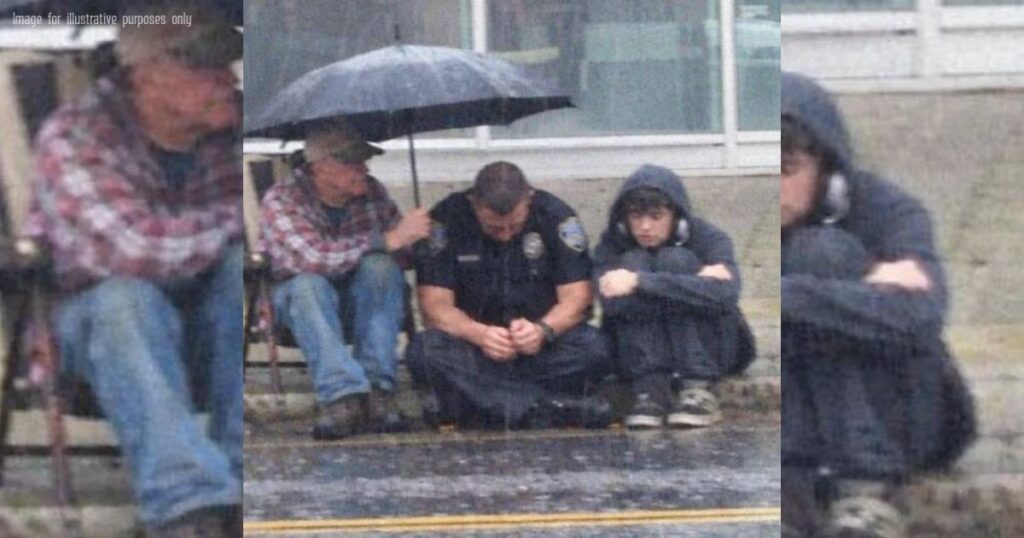
Then Mr. Miller reached into his thermos bag and pulled out a second umbrella.
A cheap one. Black. The kind you buy when you don’t want to admit you need help.
He handed it to me without a word.
As if to say: You can stand under this, even if you can’t sit.
And that’s what I did.
I stood with them for fifteen minutes.
Listening.
Not to speeches.
To stories.
A man who hadn’t spoken to his brother in five years because the last conversation turned into a screaming match about “the state of the country.”
A woman who said she used to know her neighbors’ names, and now she couldn’t even tell if anyone lived in the house beside hers because the curtains never moved.
A teenager who admitted he liked it here because “nobody expects me to be funny or tough.”
A retired teacher who said, “We used to have third places. Now we only have home and work and the inside of our own heads.”
And through it all, Mr. Miller sat like a lighthouse.
Not fixing anyone.
Just refusing to let them disappear.
That was the controversy, I realized.
Not politics.
Not crime.
Not budgets.
The real argument was something uglier and simpler:
Do we owe each other anything anymore?
Or is the only acceptable way to exist in public to be moving—buying—producing—performing?
I looked at the glass building behind us, reflecting the cloudy sky like a mirror that didn’t want to show its own emptiness.
And I thought about how quickly a town will spend money on cameras, gates, signs, and fences—
But how reluctant it is to spend a single inch of sidewalk on a human being having a hard day.
My radio crackled on my shoulder.
Dispatch again.
Then the Captain’s voice came through, tight.
“Unit Twelve. Report. Now.”
My mouth went dry.
Mr. Miller didn’t look scared. He just adjusted his cap against the drizzle.
Leo stared at my badge like it might turn into handcuffs.
The group went quiet, the way animals go quiet when the predator appears—even when the predator is just a man with a mortgage and a uniform.
I lifted the radio.
“Unit Twelve,” I said. “I’m on Main. Community contact. No obstruction. No disturbance.”
A beat.
Then, colder: “Property management is requesting immediate removal. Do you understand?”
I looked at the chairs.
At the stroller.
At the scrubs.
At the suit.
At Leo.
At Mr. Miller’s steady hands, folded like prayer.
I thought of my Captain’s pension. His tired eyes.
I thought of that woman yesterday, the way her shoulders dropped when she saw three strangers simply existing together.
And I understood something that made my chest ache:
If you can arrest people for sitting, you can erase them for being inconvenient.
And if you can erase them, eventually you erase yourself too—piece by piece—until the town is nothing but locked doors and moving vehicles and everyone screaming into screens.
I pressed the button on my radio.
“Understood,” I said carefully. “I’m assessing.”
Then I lowered my hand.
And I made a choice that didn’t feel heroic.
It just felt human.
I turned to the group.
“Here’s what’s going to happen,” I said, voice calm but firm. “We keep the walkway open. We keep it respectful. We keep it clean. And if someone needs to pass, you move without making them feel like the villain.”
Mr. Miller’s eyes glinted. “Fair.”
I glanced at Leo. “And you,” I added, softer, “you stay in school. Even if the world is loud.”
Leo looked away, embarrassed. Then he nodded once.
I looked at the chairs again.
This wasn’t a protest.
This wasn’t an uprising.
It was a porch trying to grow back in cracked concrete.
A quiet rebellion against loneliness.
A threat to the idea that life is only valuable when it’s productive.
My radio chirped again, impatient.
But before I answered, Mr. Miller said something under his breath—so quiet only I heard it.
“They’ll try to stop us,” he murmured.
I swallowed. “Who?”
He lifted his chin toward the light post.
Toward the “NO LOITERING” sign.
Toward the shiny building.
Toward the whole polished, efficient town.
“Anybody who profits from people being alone,” he said.
Then he patted the empty seat beside him again.
Not demanding.
Not begging.
Just offering.
And for the first time in a long time, I realized the most controversial thing a person can do in America isn’t to shout.
It’s to sit down.
Because when you sit down with someone the world has labeled a nuisance—
You’re saying, out loud, without words:
You’re still one of us.
And that is a sentence that will start fights in the comment section for days.
I looked at the empty seat.
Then at the street.
Then at my badge.
And somewhere behind us, I heard the mechanical whine of a truck slowing down—city workers, orange vests, the kind of people who install “solutions” without ever asking what problem they’re actually solving.
Mr. Miller watched them too.
His voice didn’t shake.
“The porch is open,” he said.
“And they’re about to nail it shut.”
Thank you so much for reading this story!
I’d really love to hear your comments and thoughts about this story — your feedback is truly valuable and helps us a lot.
Please leave a comment and share this Facebook post to support the author. Every reaction and review makes a big difference!
This story is a work of fiction created for entertainment and inspirational purposes. While it may draw on real-world themes, all characters, names, and events are imagined. Any resemblance to actual people or situations is purely coincidenta