PART 2 — THE CALL THAT FOLLOWED ME NORTH
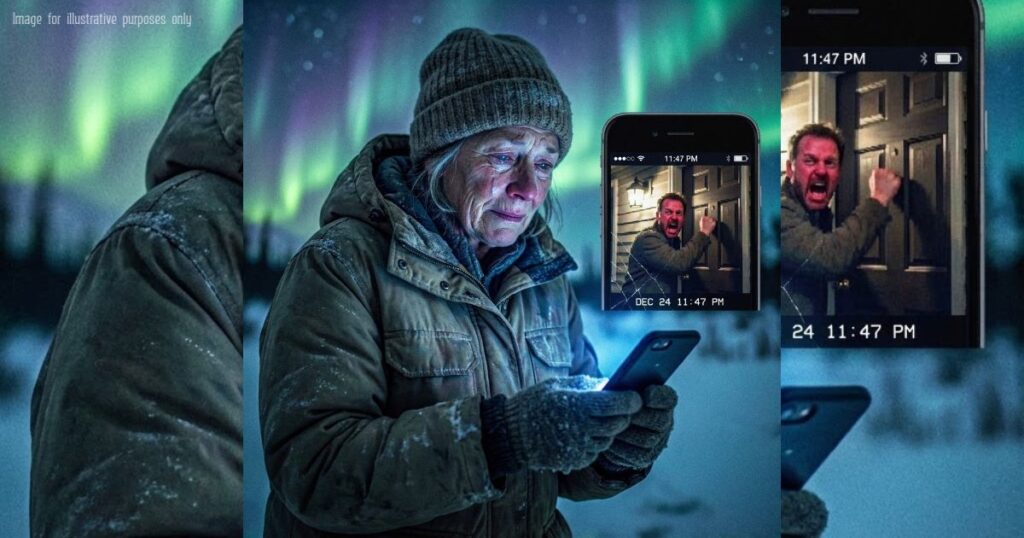
The night I showed my son the Northern Lights, I thought the message would land like a soft apology on fresh snow.
Instead, it hit like a shovel on ice.
I slid my phone into my pocket and tipped my head back again.
The sky was still moving—green ribbons, violet bruises, a slow, holy dance that didn’t care who had forgotten to set a place at a table in Chicago.
A woman near me—puffy jacket, red nose, Texas drawl—offered me a paper cup.
Hot cocoa. Too sweet. Perfect.
“You okay, honey?” she asked, like she’d known me longer than a minute.
I nodded, because the truth was complicated.
I was okay in my bones.
I was not okay in my history.
Back inside the lodge, the heat slapped my cheeks alive.
Boots lined up by the door like tired soldiers.
Someone had strung white lights across a window, and the whole room smelled like wet wool and cinnamon and that clean, sharp scent snow brings in on your coat.
I told myself I wasn’t going to check my phone again.
That lasted twelve steps.
Thirty-two missed calls.
Nine voicemails.
A flood of messages from David, then one from his wife, then one from a number I didn’t recognize, then another from David, and another, and another.
My thumb hovered over the first voicemail like it was a bruise I wasn’t sure I wanted to touch.
I pressed play.
“Mom.” David’s voice cracked on my name. “Please… please call me. I’m sorry, okay? I’m sorry. I didn’t— I didn’t understand. Just… just tell me you’re safe.”
The second voicemail was shorter.
“Mom, we came to your house. The neighbors are looking. Someone said you might’ve—” He swallowed. “Please.”
The third had a different tone—lower, tighter, like he was holding himself together with his teeth.
“Mom, this isn’t funny. The kids are asking where you are. I can’t— I can’t explain this.”
There it was.
Not I miss you.
Not I’m worried about you.
I can’t explain this.
I sat down on a bench by the fireplace and stared at the flames until my eyes watered.
Because here’s the part nobody likes to admit out loud:
Sometimes the panic isn’t about losing you.
It’s about losing the version of you that was convenient.
I didn’t call back right away.
Not because I wanted to punish him.
Because if I called back too fast, I would fold.
I would soften into the old shape—apologizing for my own absence like it was a crime.
I took off my gloves slowly.
My hands looked older in the firelight.
The skin thin. The veins more honest than they used to be.
Frank used to hold these hands like they were precious.
He didn’t hold them like they were an obligation.
I went upstairs to my room and closed the door.
The window was frosted around the edges, like lace.
Outside, the world was silent, and inside, my phone kept buzzing like an angry bee trapped in a jar.
One text finally made me laugh—sharp, surprised, not happy.
DAVID: Did you really buy a one-way ticket?
He made it sound like I’d stolen a car.
Like I’d taken something that belonged to him.
I typed, deleted, typed again.
Then I wrote the truth.
ME: Yes.
Three little letters.
And the room felt ten degrees warmer.
A minute later, three dots appeared.
Then disappeared.
Then appeared again, frantic.
DAVID: Why didn’t you tell me?
There it was, too.
Not What did we do?
Not How did you feel?
Why didn’t you tell me?—as if the problem was the lack of notice, not the lack of room.
I stared at that question until it blurred.
And a memory rose up, uninvited.
Me, in my kitchen in March, calling David because my basement light was flickering and I didn’t want to go down there alone.
I’d left a message.
Then another.
Then I’d told myself, He’s busy. He has a life.
Two days later, he texted: Everything okay?
As if worry had an expiration date.
As if I was an email you replied to when you got around to it.
I set my phone down and went to the tiny bathroom mirror.
I looked at my face like I was meeting myself for the first time.
“Linda,” I whispered, testing my own name in the quiet.
Then I did something that would’ve made old me feel selfish.
I made a plan for the next day that didn’t include my son.
In the morning, the cold had a different personality.
Not biting—more like it was warning you to respect it.
The snow squeaked under my boots, that dry, high sound that only happens when the air is so cold it feels brittle.
At breakfast, a student with pink earmuffs asked if I wanted to join their group for a daytime tour.
“Just so you’re not alone,” she said, and smiled like she meant it.
I almost told her I was alone.
Then I remembered what I’d said to David.
I’m with myself.
So I nodded.
We rode out in a van that rattled like it had stories.
The driver talked about the aurora like it was a neighbor that came and went on its own schedule.
I watched the white landscape roll by and felt something unclench in my chest.
There is a certain peace that comes when nobody expects anything from you.
No casserole.
No babysitting.
No folding chair.
Just you, and a horizon that doesn’t care how useful you are.
At a stop, we got out near a frozen river.
The air was so clean it almost hurt.
One of the students—dark curls, freckles—took a photo of me without asking.
I didn’t mind.
In the picture preview, my cheeks were red, my eyes watery, my mouth slightly open like I’d forgotten to hide my wonder.
I looked… alive.
“Send it to me?” I asked.
She did.
And then, because the world is both tender and reckless, she said, “My mom would never do what you did.”
“What did I do?” I asked.
She shrugged. “Choose yourself.”
The words sat between us like a spark.
Back at the lodge, I finally called David.
Not because I couldn’t handle the buzzing anymore.
Because I wanted to speak while I still felt steady.
He answered on the first ring.
“Mom—”
“Hi, honey.”
There was a pause where I could hear him breathing, fast like he’d been running.
“Are you—are you really in Alaska?”
“Yes.”
“And you’re safe?”
“Yes.”
“You left,” he said, and his voice did something strange on that word—like he was trying to make it sound like a fact instead of a betrayal.
“I did.”
“You didn’t even tell us,” he pushed.
“David.” I kept my voice soft, but I didn’t let it wobble. “I’ve been telling you for years. Just not with words you took seriously.”
Silence.
Then, smaller: “What does that mean?”
It meant so many things I could’ve thrown like stones.
Instead, I chose one honest sentence.
“It means I got tired of shrinking,” I said.
He exhaled hard, like he’d been punched.
“We made a place for you,” he said, and I heard the desperation in it. “We set an extra place, Mom. We wanted to show you—”
“I saw that,” I said. “And I appreciate it.”
“You don’t sound like you appreciate it.”
“I do,” I said, and this is where the truth gets sharp. “But one extra place one night a year doesn’t fix twelve months of feeling like an afterthought.”
He went quiet again.
Somewhere behind him, I heard a child’s voice ask, “Is Grandma coming?”
My throat tightened.
That part hurt.
That part will always hurt.
“I love them,” I said, and my voice finally betrayed me a little. “I love you. I’m not punishing anyone. I’m trying to save what’s left of me.”
David swallowed.