“You’re scaring us,” he said.
I didn’t correct him.
Because what he meant was: You’re changing the story where you stay available no matter what.
“I know,” I said gently. “And I’m sorry for the fear. But I’m not sorry for the choice.”
His voice sharpened, and for the first time, I heard anger.
“What am I supposed to tell people? That my mom just… disappeared on Christmas?”
I almost laughed again.
Not because it was funny.
Because it was so painfully predictable.
“Tell them I went to see the sky,” I said.
“That’s not—” He cut himself off. “Mom, this isn’t a movie.”
“I know,” I said. “In movies, the mother usually stays in the kitchen. In real life, sometimes she buys a one-way ticket because she’s tired of being the background.”
A long pause.
Then, quieter, like he was finally looking at something he’d avoided.
“Did we really hurt you that much?”
I closed my eyes.
I saw last Christmas again.
The perfect table.
The empty space where my body should’ve been.
The folding chair offered like a mercy.
“Yes,” I whispered. “You did.”
On the other end, I heard him breathe in like it hurt.
And then came a voice I hadn’t expected to hear.
His wife.
Not loud.
Not dramatic.
Just… there.
“Linda,” she said, and my stomach tightened at the sound of my name in her mouth. “I didn’t know it felt like that.”
I waited.
Part of me wanted to spit something sharp.
A lifetime of swallowed feelings rose up, ready to bite.
But I remembered my own vow: Never again.
Never again does not mean never again speaking.
It means never again begging.
“I’m not asking you to feel guilty,” I said. “I’m asking you to see me.”
She didn’t answer right away.
Then she said, very quietly, “We thought you wanted… less.”
That sentence—so small—held a whole culture inside it.
The way older women are expected to want nothing.
The way mothers are expected to be grateful for crumbs.
The way people call it love when it’s really just habit.
“I wanted respect,” I said. “I wanted warmth. I wanted a chair that didn’t feel like a punishment.”
David’s voice broke again.
“So what now?” he asked. “Are you… never coming back?”
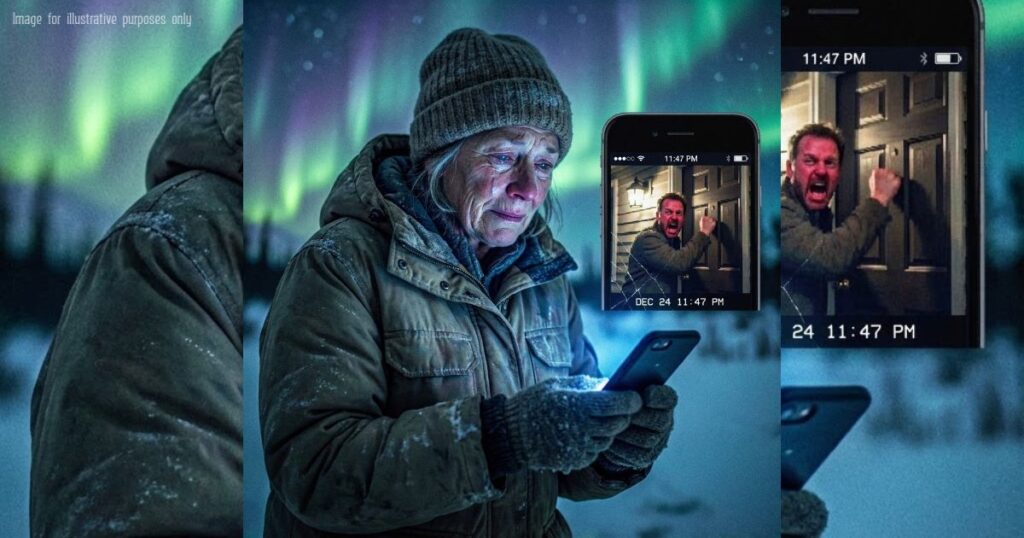
I looked out my window.
Snow falling like feathers.
A world that didn’t know my role, only my breath.
“I don’t know,” I said honestly. “I might. I might not. But here’s what I do know: I’m not coming back to the old version of this.”
He was quiet.
Then he said, “We can change.”
“Good,” I said. “Then change. Not for a photo. Not for Christmas. Not because you’re embarrassed.”
I heard him swallow again.
“And not because you’re afraid I’ll leave,” I added.
He whispered, “Then why?”
“Because you love me,” I said. “In a way that shows up on a random Tuesday. In a way that doesn’t need a holiday to remember I exist.”
That’s when the line went silent enough that I thought he’d hung up.
But then he spoke, and his voice sounded older than it had five minutes ago.
“I found something,” he said.
My heart stuttered.
“What?” I asked.
“At your house,” he said. “In Dad’s toolbox. Taped under the bottom tray.”
Frank’s name still did strange things to me—like reaching into a box of ornaments and cutting your finger on a broken one you forgot was there.
David’s voice shook.
“It’s an envelope,” he said. “It says your name. And it says… ‘Open when you finally choose yourself.’”
I couldn’t move.
I couldn’t blink.
I felt the room tilt, like the world had been waiting for that sentence to land.
“Mom?” David whispered. “Did you know about this?”
I stared at the snow beyond the glass.
At the sky that had danced for me the night before.
At the strange, fierce truth blooming in my chest.
“No,” I said, and my voice came out smaller than I wanted. “I didn’t.”
David exhaled, shaky.
“Do you want me to read it?” he asked.
My hand rose to my mouth without permission.
Because suddenly, the controversy wasn’t just about whether a mother has the right to leave.
It was about whether a son had the right to open the last thing his father hid for her.
It was about boundaries.
It was about trust.
It was about the fact that even after death, Frank was still trying to give me a seat.
Outside, the snow kept falling.
Inside, my phone waited.
And for the first time in a long time, I didn’t feel like the inconvenient guest.
I felt like the person the story had been about all along.
“David,” I said softly, “put it on the table.”
He went quiet.
“You’re coming home for it?” he asked.
I closed my eyes.
And in the darkness behind my eyelids, the aurora flickered—green and violet, like a heart refusing to go dim.
“I’m coming,” I said. “But not the way you think.”
Then I hung up.
Not to run away.
To finally decide what coming back would cost—and what it would require.
Thank you so much for reading this story!
I’d really love to hear your comments and thoughts about this story — your feedback is truly valuable and helps us a lot.
Please leave a comment and share this Facebook post to support the author. Every reaction and review makes a big difference!
This story is a work of fiction created for entertainment and inspirational purposes. While it may draw on real-world themes, all characters, names, and events are imagined. Any resemblance to actual people or situations is purely coincidenta