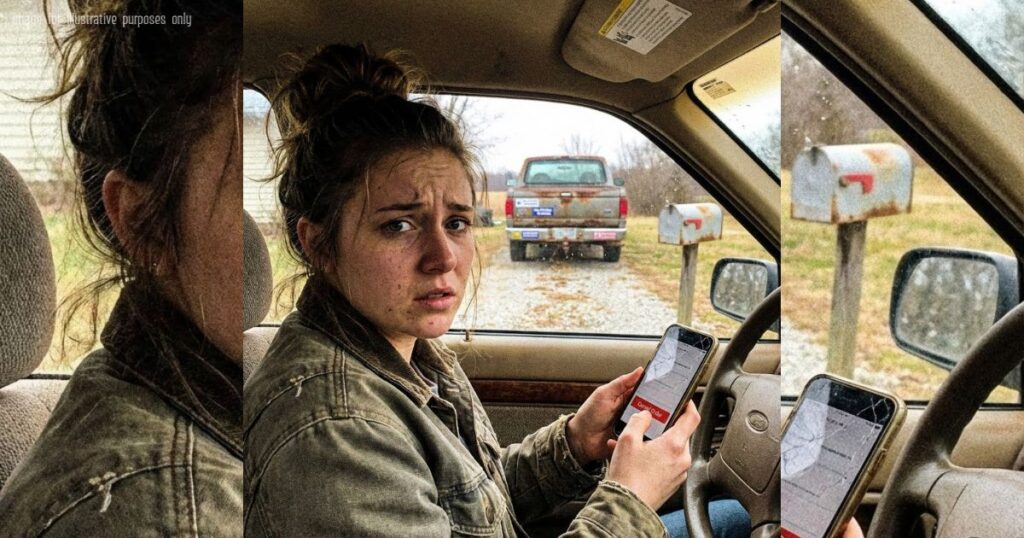
My thumb hovered over the “Cancel Order” button.
I was parked at the end of a gravel driveway that looked less like a home entrance and more like a fortress warning. The mailbox was dented. The pickup truck in the yard was a beast of rusty metal, plastered with bumper stickers that seemed to shout at me. You know the kind. The ones that draw a line in the sand and say, “If you aren’t with us, you’re the enemy.”
My car? It’s a ten-year-old hybrid, covered in stickers about peace, equality, and saving the planet. In this zip code, on the rural edge of Ohio, I felt like an alien. Or worse—a target.
My name is Sarah. I’m 26. I have a Master’s degree that currently qualifies me to deliver rotisserie chickens and toilet paper to strangers while my student loans gather interest like dust bunnies. I live in a world of anxiety, Twitter arguments, and the crushing feeling that my generation has been handed a broken lease on the American Dream.
I needed the tip. So, I took a breath, grabbed the grocery bags, and walked up the drive.
The man who opened the door was exactly who I expected. Mr. Henderson. He was built like a retired heavyweight boxer who had gone a few too many rounds with life. He wore a faded trucker hat and flannel that smelled of sawdust and old tobacco. His hands were massive, scarred, and shaking slightly.
He didn’t smile. He snatched the bags with a grunt that sounded like, “Put it there,” and slammed the heavy oak door before I could even mutter my corporate-mandated greeting.
Great, I thought, walking back to my car. Another angry old man who hates everything I represent. We were two different species. Two different Americas, separated by a screen door and a century of misunderstanding.
But the algorithm is a funny thing. It doesn’t care about politics; it only cares about proximity. Three days later, I got pinged for Henderson again.
The order was small. Just bread, milk, and a specific brand of cheap, instant coffee.
When I got to the grocery aisle, the shelf was empty. The supply chain issues—the ones the news kept shouting about—had finally hit the instant coffee aisle. The app’s protocol was cold and logical: Item unavailable. Refund customer.
I was about to tap “Refund.” It would save me time. It was the efficient thing to do.
Then, I stopped. I looked at the empty shelf, and for a split second, I didn’t see the angry man with the terrifying bumper stickers. I saw my own grandfather. I remembered how, in the months after my grandmother died, his morning coffee was the only routine that kept him tethered to the earth. If that routine broke, his day broke.
I looked at the top shelf. There was a bag of organic, fair-trade, locally roasted coffee. It cost $14. The refund for his cheap stuff was $4.
I don’t know why I did it. Maybe I was just tired of the world being so transactionally cruel. I bought the expensive bag with my own debit card—money I really didn’t have to spare.
I dropped the order at his door. On the receipt, I scribbled a note: “They were out of your usual brand. My treat. This stuff is strong, use less than you think. – Sarah.”
I drove away, feeling foolish. He probably wouldn’t even notice. Or worse, he’d be mad I bought him “hipster coffee.”
He didn’t rate me. He didn’t tip extra. But the next week, a request came through. He had favored me as his preferred driver.
When I arrived, he was waiting on the porch. He wasn’t smiling, but he wasn’t scowling, either. He looked at me, then at my car, then back at me.
“That coffee,” he grumbled, his voice like gravel in a mixer. “Tasted like mud. But… it woke me up.”
“It’s an acquired taste,” I said, guarding myself.
“Better than the brown water I usually drink,” he admitted. He looked at the sky. “Knees are aching. Storm’s coming.”
“My app says 80% chance of snow,” I replied, glancing at my phone.
“Don’t need an app to tell you what the bones know,” he said.
That was it. Thirty seconds. But the next week, it was a minute. We talked about the price of gas (we both hated it). We talked about the pothole at the end of his road (we both wanted it fixed). We never talked about the news. We never talked about the flags on his truck or the stickers on my car. We declared a ceasefire without ever saying the word.
I learned his wife, Martha, had passed three years ago right before Christmas. He learned that I was an artist who couldn’t afford paint.
We were building a bridge across the widest canyon in the country, one grocery bag at a time.
Then came Thanksgiving.
The holidays are a brutal time to be broke and single. My roommates were gone. My family was across the country, and a plane ticket was out of the question. I spent the morning in my apartment, staring at a frozen lasagna, scrolling through Instagram photos of happy families and perfect turkeys. The silence in my room was deafening.
I turned on the driver app. Might as well make money if I can’t make memories.
My phone pinged. A request from Mr. Henderson.
My heart sank. Who orders groceries at 4:00 PM on Thanksgiving?
I opened the message. It wasn’t a shopping list.
“Need help. Turkey is too heavy for the oven. I have arthritis. Payment: I cook, you eat. Don’t make an old man eat alone.”
I stared at the screen. The “Cancel” button was right there. It would be safer. Professional boundaries. Who goes into a stranger’s house in the woods on Thanksgiving?
But then I thought about the silence in my apartment. I thought about the silence in his big, empty house.
I clicked “Accept.”
Walking into his home was like stepping into a time capsule. It smelled of sage, roasted meat, and woodsmoke. It was tidy, but lonely. A shrine to a life that had slowed down. Photos of his wife were everywhere.
He was in the kitchen, wrestling with a roasting pan. He looked smaller without the heavy coat, frail in a way that twisted my heart.
“Wash your hands,” he barked, no “hello.” “Potatoes won’t mash themselves.”
We worked in silence. I chopped. He stirred. The tension I expected—the political arguments, the generational blaming—never happened. Instead, he told me how Martha used to burn the rolls every single year, and how they’d eat them anyway because it made her laugh.
He laughed when he told the story. It was a rusty, unused sound, but it warmed the whole room.
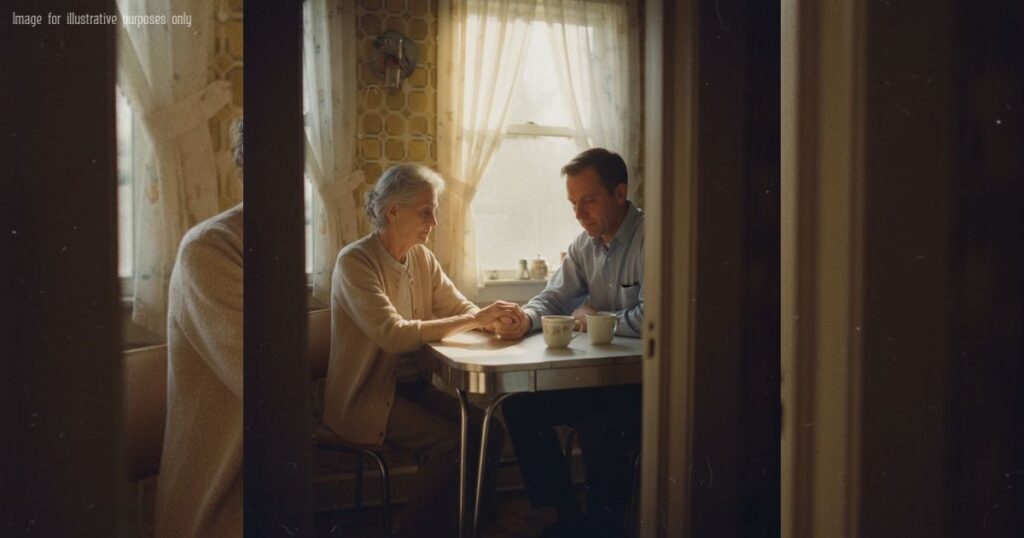
We sat at a small wooden table meant for six, just the two of us. The snow had started falling outside, blanketing his rusty truck and my hybrid car, covering the bumper stickers until they all looked like the same white mounds.
Mr. Henderson cleared his throat. He bowed his head. I felt awkward, but I bowed mine too.
“Lord,” his voice cracked. “Thank you for the food. Thank you for the roof.” He paused, taking a ragged breath. “And thank you for sending someone to pass the potatoes. I was… I was mighty quiet in here.”
I looked up. A single tear was tracking through the roadmap of wrinkles on his cheek.
In that moment, the labels fell off.
He wasn’t a “Boomer.” He wasn’t a “Conservative.” He wasn’t the enemy. He was a man who missed his wife so much it physically hurt.
And I wasn’t a “snowflake” or a “radical.” I was just a young woman who needed to feel like she belonged somewhere.
We sat there for hours. We didn’t solve inflation. We didn’t fix the healthcare system. We didn’t agree on who should be President.
But as I drove home that night, full of turkey and carrying a Tupperware container of leftovers, I realized something terrifying and beautiful.
We are told every day to hate each other. We are told that the person on the other side of the political divide is a monster. We scroll, we judge, we cancel, we block.
But stripped of the screens, stripped of the slogans, stripped of the fear—we are all just people trying to get through the winter. We are all just looking for someone to share a cup of coffee with.
I started this journey $14 in debt for a bag of beans. But the real debt isn’t money.
It’s the debt of kindness we owe each other. It’s the bravery it takes to look past the bumper sticker and see the human being shivering behind the door.
We have so much work to do to fix this country. But maybe, just maybe, the work doesn’t start in the voting booth. Maybe it starts at the dinner table.
Be the one who buys the good coffee.
—
If the first part of this story was about what happened at a quiet Thanksgiving table no one could see, the second part is about what happened when the internet did.
I didn’t plan to go viral.
I planned to post a picture, get maybe twenty likes, and feel a tiny bit less invisible while I reheated leftover turkey in my tiny microwave. That was it.
Click the button below to read the next part of the story.⏬⏬