If the first part of this story was about what happened at a quiet Thanksgiving table no one could see, the second part is about what happened when the internet did.
I didn’t plan to go viral.
I planned to post a picture, get maybe twenty likes, and feel a tiny bit less invisible while I reheated leftover turkey in my tiny microwave. That was it.
The photo wasn’t even good. It was a slightly blurry shot of two plates of food, a pan of mashed potatoes between them, and a wrinkled hand reaching across the table to pass the gravy. You couldn’t see Mr. Henderson’s face. You could barely see mine, just a patch of my hoodie and my chipped black nail polish on the fork.
I cropped out the family photos on his wall. I thought I was being respectful.
I typed a caption:
“Had Thanksgiving dinner tonight with a man whose bumper stickers say I’m everything wrong with this country. We didn’t talk politics. We just passed the potatoes and tried not to be lonely. Maybe that’s where the real work starts.”
I stared at it for a long time.
My stomach twisted. Was I oversharing? Was I turning his grief into content? Was I turning my own loneliness into a performance?
Then the little voice in my head that sounds suspiciously like every influencer I’ve ever followed whispered, “If it’s not posted, did it even happen?”
So I hit “post.”
I put my phone down and told myself I wouldn’t check it for an hour.
I lasted eight minutes.
At first, it was sweet.
Heart emojis. “This is the kind of story we need right now.” “You restored my faith in humanity.” A few people from my building commented, “This is so you, Sarah.” Someone wrote, “You’re a good one.”
I watched the numbers climb: 40 likes. 100. 300. The little red dots felt like someone was finally knocking on the door of my life saying, We see you.
Then the tone changed.
It always does.
“If he’s got those bumper stickers, you don’t know what he supports. This isn’t cute, it’s dangerous.”
“So you had dinner with someone who probably votes against your rights and now you want a cookie?”
“This is how harm gets normalized. Being nice to people who dehumanize you doesn’t fix anything.”
“You’re making oppressed people responsible for educating oppressors. Hard pass.”
The other side arrived, too, because outrage travels in packs.
“Finally, a kid with some sense who doesn’t hate old folks.”
“Maybe if more of ‘your generation’ did this instead of yelling online we’d be better off.”
“Those stickers on your car are the problem, not his truck.”
People started fighting with each other in the comments like I had tossed raw meat into a cage.
They used words like “traitor,” “bootlicker,” “naive,” “brainwashed,” “radical,” “weak.” They used “boomers” and “snowflakes” like they were diagnoses instead of insults.
By midnight, the post had been shared thousands of times. Someone took a screenshot and reposted it with their own commentary. Threads popped up on accounts I didn’t know, debating whether I was “the problem” or “the solution.”
In the middle of all that noise, a thought hit me like ice water.
Mr. Henderson doesn’t know I posted this.
The next morning, I opened my driver app and scanned for his name.
Nothing.
No little notification with his address. No request for bread or milk or the cheap coffee I’d stopped buying because I couldn’t stop imagining his face when he tried it after the good stuff.
For three days, my phone chirped constantly. People messaged me everything from “You’re inspiring” to “You’re enabling hate” to “You’re making all of this up for attention.” A few strangers demanded to know exactly what stickers were on his truck, what shows he watched, what candidates he liked.
They didn’t want to know if he missed his wife. They wanted to know if he was “one of the bad ones.”
On the fourth day, I finally got a ping from his address.
My heart stuttered. It was just one item: instant coffee. The cheap brand.
No “preferred driver” star. No message.
The app assigned the order to me automatically. I could have unassigned myself. Said I was too far. Too busy. Too tired.
Instead, I grabbed my keys.
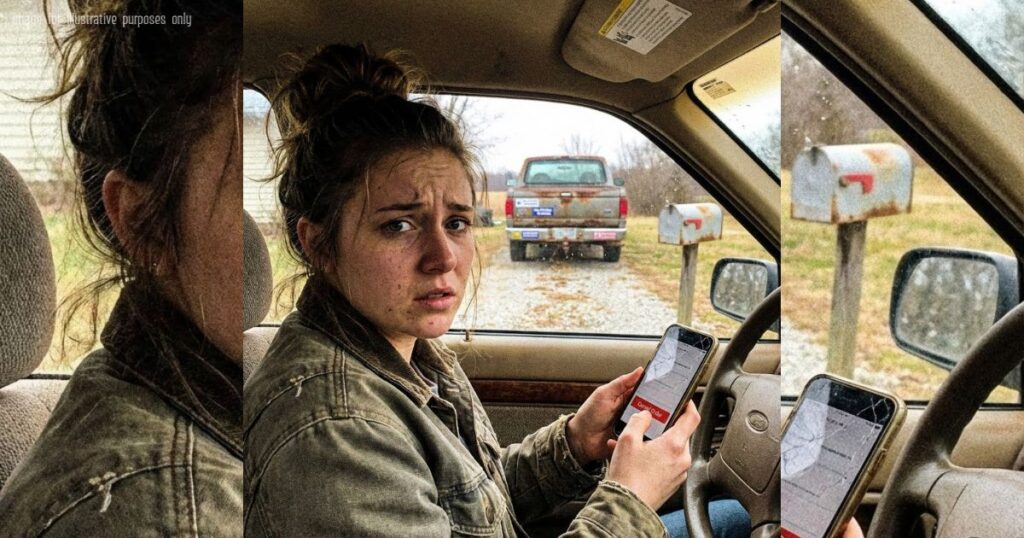
The whole drive out, my phone kept buzzing in the cup holder. I didn’t check it. I already knew what it was: more notifications. More people who had decided who I was based on one blurry picture and a caption.
When I pulled into the gravel driveway, the rusty truck was there, same as always. The snow from Thanksgiving had melted into gray slush. The bumper stickers still shouted, and my car still whispered back with its own.
But there was something new.
A cardboard sign, duct-taped to the front porch railing.
NO PHOTOS. NO PROJECTS. THIS IS A HOUSE, NOT A LESSON.
My throat went dry.
I picked up the coffee and walked slowly to the door. Before I could knock, it opened.
Mr. Henderson stood there, hat on, flannel buttoned wrong, jaw set so tight I could hear his teeth grind.
We stared at each other, the grocery bag between us.
“Morning,” I said, my voice coming out too high. “I, uh… brought your coffee.”
He took the bag gently, which somehow made it worse.
“You did,” he said. His voice was different—flatter, like a door half-closed. “And you brought a whole lot of other folks with you, too, didn’t you?”
The world tilted a little.
“You… saw it?”
“I don’t own a computer,” he said. “But my neighbor’s kid does. She helps me with my email. She came over, real excited, told me I was ‘blowing up.’ Printed some of it out for me.”
He reached into his pocket and pulled out a folded stack of paper. I could see my own caption at the top, and beneath it, angry comments in tiny, crowded font.
He tapped the paper with a gnarled finger.
“You turned my Thanksgiving table into a town square, girl.”
Each word landed like gravel in my stomach.
“I never showed your face,” I said, too fast. “I didn’t use your name. I— I cropped the photos. I tried to respect your privacy.”
He looked at me, really looked at me, like he was trying to line up the girl who washed his dishes with the girl in the comments section.
“Maybe you did,” he said slowly. “But you didn’t ask.”
The silence stretched.
I opened my mouth. Closed it. My brain churned through a hundred explanations that all tasted like excuses.
“I just…” I swallowed. “I wanted people to see that… that we don’t have to hate each other. That it’s possible to sit down, even if we disagree. People are so angry, and I thought if they saw—”
“You thought if they saw me,” he cut in, “they’d feel something.”
He wasn’t yelling. Somehow that made it worse.
He held up the printouts.
“I read what they said about you,” he said. “Some of ’em called you names I won’t repeat. Said you were stupid. Fake. Dangerous. That you were putting folks at risk just by eating at my table.”
He looked down.
“Then I read what they said about me. About… the kind of man I must be. About what I must think, what I must support, what I must have done. Folks who never looked me in the eye decided I was a monster.”
He lifted his gaze again, and there was something behind his anger now. Not rage. Not even disappointment.
Hurt.
“I invited you in because I didn’t want to eat alone,” he said quietly. “Not because I wanted to audition for your audience.”
My eyes stung.
“I’m sorry,” I whispered. “I really am. I didn’t think it through. I didn’t think it would… blow up like that.”
“That’s the thing about fireworks,” he said. “Nobody ever thinks about where the sparks land.”
He shifted his weight, wincing as his knee popped.
“You’re still my driver, far as the app goes,” he said. “I ain’t gonna get you fired. You did help me, and I won’t pretend you didn’t. But I need you to understand something, Sarah.”
I straightened, bracing myself.
“I am not your heartwarming project,” he said. “I am not your exception to prove some point on the internet. I’m just a man whose wife died and whose coffee tastes like mud. That’s all.”
The words sliced clean.
I wanted to tell him he was wrong, that he mattered to people now, that the comments saying “I cried reading this” meant something. But the words curdled before they reached my tongue.
Because who did that really comfort? Him?
Or me?
“I’ll delete it,” I said finally. “The post. I’ll take it down.”
He studied me for a long moment, as if weighing something invisible.
“Do what you think is right,” he said. “But maybe ask next time, before you turn a person into a symbol.”
He stepped back. The door didn’t slam, but it closed firmly, the lock clicking with a final, heavy sound.
On the drive back, I pulled over twice just to cry.
Not cute, cinematic tears. The ugly kind, where your face scrunches, your nose runs, and you gasp like you’ve been punched.
I felt ashamed, defensive, misunderstood, all at once. Part of me wanted to scream that I was trying to do something good. Part of me wanted to throw my phone into the nearest frozen ditch and disappear.
Instead, I went home, sat on the edge of my mattress-on-the-floor, and opened the app.
The post had twice as many likes now. Twice as many arguments beneath it.
A new comment was pinned by someone I didn’t know: “THIS is how we move forward. Be like Sarah.”
I stared at those four words.
Be like Sarah.
I thought about Mr. Henderson’s cardboard sign.
THIS IS A HOUSE, NOT A LESSON.
I tapped the three dots on my post. My thumb hovered over “Delete.”
Twelve hours of my life, months of my rent, years of being crushed under the feeling that nothing I did mattered—and the first time people really listened to me, it was because I had turned a private meal into a public performance.
If I deleted it, the comments would go away. The shares would vanish. The little hit of relevance I’d gotten would evaporate.
But so would all the people using our dinner as ammo to hurt each other.
I took a breath and chose the quieter button.
“Edit.”
I erased the original caption and wrote:
“I shared this story without asking the other person at the table. That was wrong. We are real people, not examples. I’m leaving this up to own my mistake, but I’m asking: if you talk about this, talk like we’re human. Because we are.”
I disabled comments.
Click the button below to read the next part of the story.⏬⏬