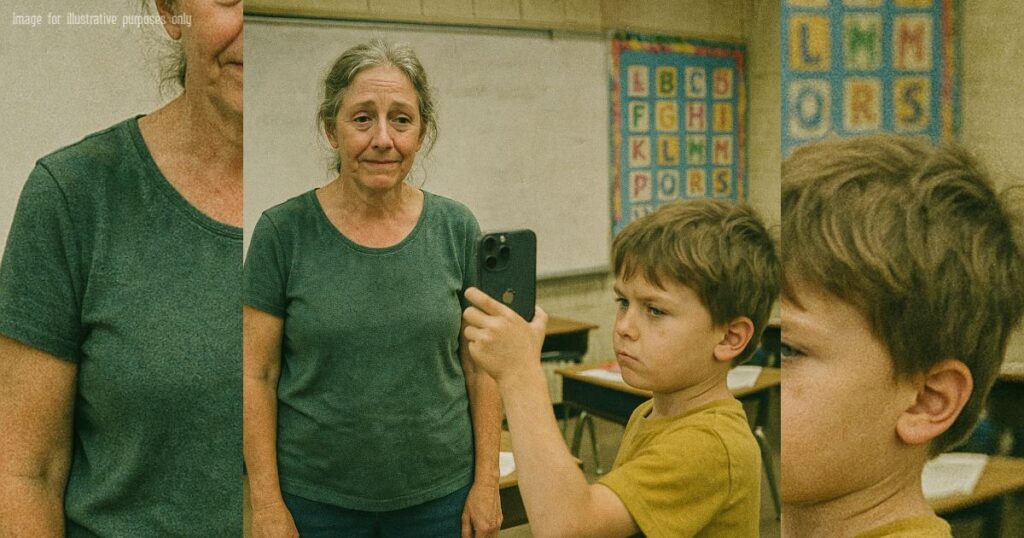
“I’m recording this. My dad says if you yell at me, we can sue the district.”
That wasn’t spoken by a lawyer. Or an angry parent. That was spoken by a seven-year-old boy in my second-grade class, holding an iPhone 14 up to my face.
He didn’t look angry. He looked bored. He looked like he was ordering a sandwich.
I lowered my hand. I wasn’t going to yell. I was just trying to ask him to please, for the third time, stop throwing erasers at the girl with special needs sitting in the front row.
I smiled at him. A sad, tired smile. “You don’t need to record, Tyler. I’m done.”
And I meant it. My name is Mrs. Halloway. For 38 years, I have taught in the public school system of a mid-sized town in Pennsylvania. I have survived budget cuts, four different superintendents, a pandemic, and the shift from chalkboard to SmartBoard.
But today, I packed my final box. I walked out of Room 2B for the last time.
When I started teaching in 1986, this job was a vocation. It felt holy. We weren’t paid well—teachers never are—but we were trusted. When a child got in trouble, the parent asked, “What did my child do?” Today, the email usually starts with, “What did you do to upset my child?”
I remember the days of parent-teacher conferences where we shared coffee and concerns. Parents brought homemade cookies. We were partners. We were a village raising a child together.
Now? I am a service provider. The parents are the customers. And the customer is always right.
Even when their child is throwing a chair. Even when their child hasn’t turned in homework in three weeks. Even when their child is sleeping in class because they were up until 3:00 AM playing video games.
“Mrs. Halloway, you’re failing him? That will ruin his self-esteem.” No, I’m not failing him. I’m telling you he cannot read. And instead of reading with him, you’re threatening my tenure.
It wasn’t one big thing that broke me. It was the thousand little cuts.
It was the morning I spent 20 minutes teaching 7-year-olds how to hide in a closet and stay silent in case a “bad man with a gun” came into the building. Have you ever tried to explain to a weeping first-grader why they have to be quiet so they don’t die? I have. And then I’m expected to teach Math five minutes later like nothing happened.
It was the day a parent emailed the principal because I took away a student’s iPad during a lesson. “He needs it for his anxiety,” she said. He was watching YouTube pranks.
It was the loneliness. Teachers used to eat lunch together in the faculty room, laughing, venting, sharing resources. Now? We sit alone in our classrooms with the lights off, frantically entering data into compliance software, documenting every behavior incident just to protect ourselves from a lawsuit.
We are exhausted. Not tired. Soul-tired.
The children… I love them. I really do. That hasn’t changed. But they are suffering, and nobody wants to admit why.
They are growing up in a world that is too loud, too fast, and too mean. They can swipe a screen before they can tie their shoes. They know how to mimic a TikTok dance, but they don’t know how to apologize when they hurt a friend. They are over-stimulated, sleep-deprived, and filled with an anxiety they don’t have the words to explain.
So they act out. They scream. They check out. And society looks at the teachers and says, “Fix them.”
Fix the behavior. Fix the reading gap. Fix the social skills. Fix the trauma. Do it in a room with 30 kids. With no aide. With textbooks held together by tape. And do it with a smile, or we will put you on an “Improvement Plan.”
I remember when my classroom was a sanctuary. We had a “Reading Rug” where we traveled to Narnia and Hogwarts. We learned that it’s okay to fail, as long as you try again. We learned that being kind was more important than being the fastest.
Now, my value is determined by a standardized test score. I had an administrator tell me last year, “Mrs. Halloway, you spend too much time on social-emotional learning. We need to focus on the data points.”
Data points. They aren’t children anymore. They are data points.
I kept going because of the moments that still glimmered in the dust. The boy who whispered, “I love you, Mrs. H,” when he thought no one was listening. The girl who finally, finally understood subtraction and looked at me like she’d just won the lottery. The drawing of a stick-figure me with the words, You are the best techer.
I held onto those scraps of love. But love doesn’t pay the medical bills for stress-induced high blood pressure. Love doesn’t stop a chair from flying across the room.
So today, I purged the room. I took down the posters that said READ and DREAM. I threw away the stress balls and the sticker charts.
I found a box of letters from the 90s. “Dear Mrs. Halloway, thank you for believing in me when I was a troublemaker. I’m a dad now, and I tell my kids about you.”
I sat on the floor and wept. Because back then, I was allowed to be a teacher. Now, I feel like a warden, a secretary, and a punching bag.
There was no retirement party. The budget is too tight for cake. Just a generic email from the district office: Please return your keys and badge by 4:00 PM.
I left my red pens. I left my rocking chair. But I took my memories. I took the memory of every child who felt safe in my room when the world outside was scary. They can’t take that from me.
I don’t know what I’ll do next. Maybe I’ll work at a bookstore. Somewhere quiet. Somewhere where people don’t yell at me for trying to help.
But I want you to know something. If you are reading this, and you have a child in school: Please. Look at the person standing at the front of that classroom.
They aren’t doing it for the money. God knows they aren’t doing it for the money. They aren’t doing it for the “summers off” (which are mostly spent taking continuing education classes and buying supplies with their own credit cards).
They are doing it because they believe in your child. They are the only ones standing between your child and a system that wants to turn them into a statistic.
They are tired. They are breaking. And they are quitting in droves.
If we don’t start treating teachers like human beings—like the professionals and caretakers they are—there won’t be anyone left to unlock the door. There won’t be anyone left to dry the tears. There won’t be anyone left to say, “You can do this. I believe in you.”
So, to the teachers still standing in the gap: I see you. To the parents: Please, work with us. Not against us. And to the children: I am so sorry we couldn’t make the world softer for you.
We tried. I really, truly tried.
—
If Part One was my goodbye, then let this be Part Two: the part where I tell you what happened after I walked out of Room 2B—and what I really think is breaking our kids.
When I wrote about the boy with the phone in my face, I thought it would end up where most teacher stories go: buried under school newsletters and discount ads in somebody’s inbox.
Click the button below to read the next part of the story.⏬⏬