If Part One was my goodbye, then let this be Part Two: the part where I tell you what happened after I walked out of Room 2B—and what I really think is breaking our kids.
When I wrote about the boy with the phone in my face, I thought it would end up where most teacher stories go: buried under school newsletters and discount ads in somebody’s inbox.
Instead, my former student’s daughter called me two weeks later.
“Mrs. H… you’re on the internet.”
At first, I thought she meant a class photo.
“No, like… really on the internet. My mom sent me a link. It’s your story. People are… arguing about you in the comments.”
I don’t have social media. Not the real kind. I have an email account, a landline, and a flip phone that still needs me to press the number 7 four times to get an S.
But my neighbor printed the story out for me from her computer, comments and all. She handed me a stack like exam papers, still warm from the printer.
“Don’t read the comments,” she warned.
Of course I did.
Some were kind.
“My son had a teacher like you. We lost her to burnout last year. I’m so sorry.”
“Our district is the same. We’re failing teachers and then acting shocked when they walk away.”
Others were… not.
“Imagine quitting on kids and calling yourself a hero.”
“If you can’t handle seven-year-olds, you shouldn’t be a teacher.”
“Teachers like this are the problem. Always playing the victim.”
One said, “The kids didn’t change. The teachers did. You all got lazy.”
I sat at my kitchen table with those words bleeding into my tea, and for the first time since I turned in my badge, I felt something hot rise up in me.
Not grief.
Not exhaustion.
Anger.
Not the kind of anger that throws chairs. The quiet kind. The kind that makes you stand a little straighter.
Because here’s the controversial thing I’m going to say—the thing some people will scroll straight to the comments to fight about:
The kids are not the main problem.
The teachers are not the main problem.
We, the adults, are the problem.
All of us. Parents. Administrators. Politicians on TV arguing about “test scores” and “accountability” like they’re talking about stock prices instead of human beings. Tech companies designing apps to keep children staring at screens until their brains forget how to be bored. Entire communities that only walk into a school building when there’s a sports game or a scandal.
But I’m going to narrow it down, because I lived 38 years in a classroom, not in a legislature.
Here is what I saw from the front of Room 2B:
We keep giving children adult problems, and then we punish them for having child-sized reactions.
We hand them devices they can’t emotionally handle. We let them hear every argument in the house. We talk about money worries, health scares, and the latest terrifying headline while they’re sitting right there at the kitchen table, coloring in dinosaurs.
Then we send them to school and expect them to sit still, manage big feelings, resolve conflicts, and stay “on task” for seven hours without falling apart.
When they can’t, we ask the teacher, “What are you doing wrong?”
I read a comment that said, “Maybe if teachers stopped blaming parents and did their jobs, kids would learn again.”
Let me tell you about two boys from my last five years. I’ll change their names, but the stories are real.
The first boy, I’ll call Ethan.
Ethan came to school with circles under his eyes so dark they looked like bruises. He slept through math. He exploded over small things—someone borrowing a pencil, someone bumping his chair.
I called home.
“Hi, this is Mrs. Halloway from Room 2B. I’m concerned about Ethan’s sleep.”
The voice on the other end was distracted. “Yeah, he’s tired. He plays games online with his friends. That’s how they hang out now. It’s just how kids are these days.”
I gently suggested a bedtime. A device curfew. A charging spot in the kitchen so the screen didn’t glow in his room until 2:00 AM.
“I work late,” the parent said. “The games keep him busy. If he fails, that’s on the school. You’re the professionals. Figure it out.”
Figure it out.
So I tried. I moved Ethan’s seat closer to me. I gave him breaks. I spent my evenings preparing modified assignments so his exhausted brain could at least taste success.
Meanwhile, he stayed up night after night, eyes burning at a screen I couldn’t control. Guess whose job performance was evaluated when his test scores dropped?
Mine.
Now, the second boy. I’ll call him Miles.
Miles also came in tired. Also angry. Also behind.
When I called his mother, she sounded just as tired as he did.
“I know,” she sighed. “I see it. We’re drowning here. Tell me what you’re seeing at school. I’ll tell you what’s happening at home. Let’s figure it out together.”
Together.
She set a bedtime. She wrote it down, taped it to the fridge, and sent me a picture. Devices in the kitchen by 8:30. Lights out by 9:00. She emailed me once a week to ask, “How did Miles do with reading today? Did he seem more focused?”
Some days were still hard. Some days, he still slammed his book shut and muttered words that made the other kids giggle.
But slowly, he changed. Not because I found a magic strategy in a teacher training. Not because of a new program or a trending hashtag.
Because a parent and a teacher pulled in the same direction instead of playing tug-of-war with a child in the middle.
That’s the part nobody wants to hear.
It’s easier to say “We need better schools” than to admit we might need to change how we are parenting, how we are talking, how we are living.
It’s easier to shout “These teachers are lazy and coddled” than to ask, “What does it say about us that the people who spend the most time with our children are breaking down?”
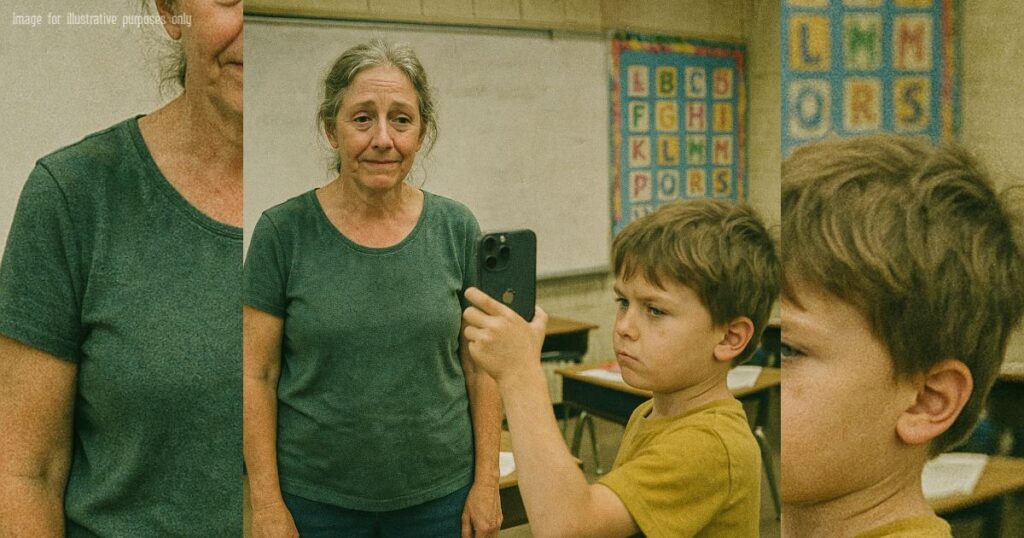
The day I retired, after Tyler pointed that phone at my face and told me his dad said we could be sued, I went home and something small but important happened.
I got an email from the mother of the little girl he’d been throwing erasers at.
Her daughter has special needs. She moves a bit slower. She flaps her hands when she’s excited. She hums when she’s nervous.
The email was short.
Click the button below to read the next part of the story.⏬⏬