They didn’t force me out because I was too old or because I couldn’t teach. They pushed me out because I refused to give an A to a ghost—a ghost made of algorithms that writes better than my students think, but feels absolutely nothing.
My classroom is the last one in the district with a chalkboard. The administration calls it a “legacy hazard” because of the dust. I call it the only place left where mistakes are wiped away by hand, not by a delete key.
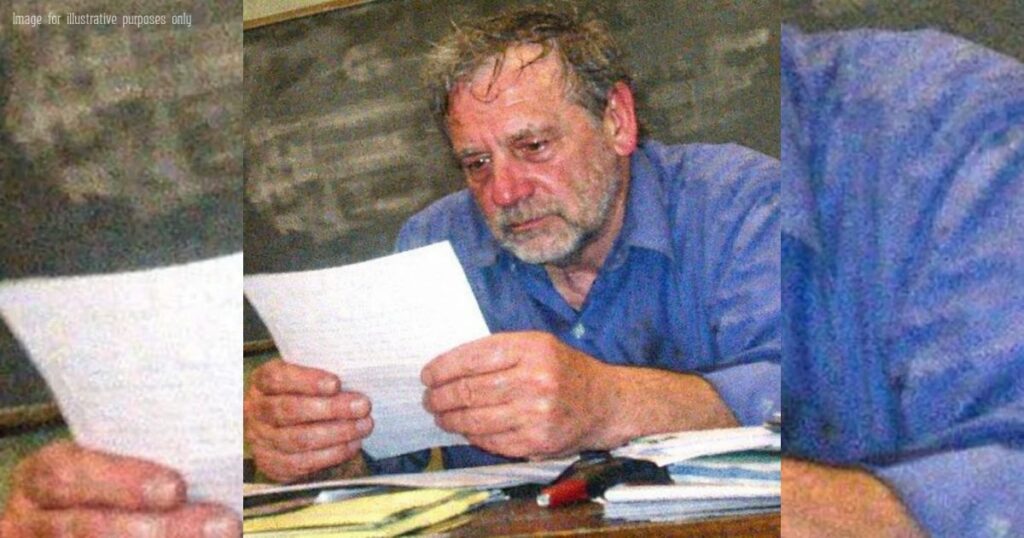
I am Mr. Miller. For thirty-two years, I have taught American Literature in this building. I am the teacher who makes you read the entire book. I am the teacher who deducts points for comma splices. I am the “Hard Teacher.”
In the ecosystem of our high school, I am the vegetable soup. I am the discipline. I am the routine.
The “Cool Teachers” are down the hall. They have smartboards that span the entire wall and beanbag chairs instead of desks. They let students make 15-second dance videos to summarize The Great Gatsby. They say they are “meeting the students where they are.”
I stayed where the students needed to be. Or so I thought.
The end began last Tuesday. It was the deadline for the Senior Capstone Essay. This is the big one. It’s supposed to be a 3,000-word exploration of personal identity. In the past, this assignment caused tears, late nights, and breakthroughs. It was the moment boys became young men and girls found their voices.
I sat at my desk, my knuckles swollen from arthritis—a souvenir from three decades of gripping a red pen. I picked up Leo’s paper.
Leo is a good kid. Or he was. Lately, he’s been different. Disconnected. His eyes are always glazed over, reflecting the blue light of the tablet the school district issued to every student last fall.
I started reading his essay.
“The dichotomy of the human experience is often juxtaposed with the ephemeral nature of societal expectations…”
It was perfect. The grammar was flawless. The vocabulary was collegiate. The structure was mathematical.
It was also completely dead.
There was no struggle in the sentences. No awkward phrasing that showed a teenage brain grappling with a complex idea. It was smooth, sterile, and cold. It was the same voice I’d read in ten other papers that night.
I knew the voice. It wasn’t Leo’s. It was the voice of The Generator. The AI.
I called Leo to my desk the next day. He walked in, wearing noise-canceling headphones, looking annoyed that he had to unplug from his digital stream.
“Leo,” I said, tapping the paper. “This isn’t your writing.”
He didn’t blush. He didn’t look at his shoes. He looked me dead in the eye with a terrifying calmness.
“I prompted it, Mr. Miller,” he said. “I told the program what themes to look for. I curated the output. It’s called ‘prompt engineering.’ It’s a skill.”
“It’s plagiarism, Leo. You didn’t write a word of this. You ordered it like a pizza.”
He sighed, a sound of profound boredom. “Mr. Miller, why should I spend twenty hours writing something that the machine can do in twenty seconds? You teach us to be efficient. I’m being efficient.”
“I teach you to think!” I slammed my hand on the desk, a cloud of chalk dust rising. “I teach you to struggle with your own thoughts until they make sense. If you bypass the struggle, you bypass the learning.”
He shrugged. “My dad says the result is what matters. Not the process.”
I gave him an F.
Two hours later, I was summoned to the Principal’s office.
Principal Stark is young. He wears sneakers with his suit and talks a lot about “synergy” and “customer satisfaction.” He treats the parents like shareholders and the students like clients.
Sitting next to him was Leo’s father, Mr. Vance. Mr. Vance is a wealthy man who donates to the football booster club.
“Arthur, sit down,” Stark said, smiling that tight, political smile. “We have a situation with Leo’s grade.”
“There is no situation,” I said, holding my ground. “He cheated. He used an AI program to generate his Capstone.”
“Now, Arthur,” Mr. Vance interjected, checking his expensive watch. “Let’s not use harsh words like ‘cheated.’ Leo utilized available tools. In my company, if an employee refuses to use the latest software to speed up workflow, I fire them. You’re punishing my son for being prepared for the real world.”
“The real world?” I looked from the father to the principal. “This is an English class. The goal isn’t to produce text. The goal is to produce a human being who can articulate their soul. A machine cannot have a soul, Mr. Vance.”
Principal Stark leaned forward, clasping his hands. “Arthur, look. The rubric doesn’t explicitly ban AI assistance. It’s a gray area. And frankly, failing Leo will ruin his GPA. It will hurt his college acceptances. It will hurt the school’s metrics.”
“Metrics,” I whispered.
“We need to be flexible,” Stark continued. “We need to be the ‘Yes’ school. The ‘Innovation’ school. You’re the only teacher still fighting this. Just change the grade. Give him a B if you have to. But we can’t fail him for being smart with his resources.”
I looked at them. I saw the future.
I saw a world where the product matters more than the person. Where “efficient” is better than “honest.” Where we are raising a generation of editors and consumers, but not a single creator.
I thought of the thousands of nights I spent grading papers, circling mistakes, writing notes in the margins like “Great thought here!” or “Dig deeper!” I thought of the “Grandma” feeling—the exhaustion of caring for children who are being told by everyone else that the easy way is the best way.
I was the vegetable soup. I was the scolding. I was the one making them chew their food when they just wanted to swallow a pill.
And they didn’t want me anymore. They wanted the iPad Grandma. They wanted the A without the ache.
“You’re right,” I said softly.
Principal Stark relaxed. “Thank you, Arthur. I knew you’d see reason. So, you’ll update the grade?”
“No,” I said. I stood up. My knees popped. “I’m not updating the grade. And I’m not teaching tomorrow.”
“What? It’s mid-semester. You can’t just leave.”
“I can,” I said. “Because I am not a teacher to you. I am a content delivery system. And I am obsolete.”
I walked out of the office. I went back to my classroom.
The room was empty. The sun was setting, casting long shadows across the rows of desks. I looked at the chalkboard.
I picked up the eraser. I didn’t erase the board. Instead, I picked up a piece of fresh, white chalk.
I wrote one last sentence on the board. My handwriting was crisp and cursive, a dying art form in itself.
“I cannot teach you how to be human if your society only rewards you for being a user. Good luck with the algorithm.”
I placed the chalk on the ledge. The click echoed in the silence.
I packed my bag. I took my mug, the one that says World’s Okayest Teacher, and my red pens. I left the computer. I left the smart tablet they gave me, still in its box.
On my way out, I passed Leo in the hallway. He was staring at his phone, laughing at a video, his face illuminated by that ghostly artificial glow. He didn’t see me. He didn’t see the man who had spent a year trying to get him to look up at the stars.
I pushed the heavy exit doors open and stepped into the cool evening air.
My phone started buzzing in my pocket. Emails from Stark. Texts from the department head. They were panicking. Who would cover the seniors? Who would prep them for the state exams?
I turned the phone off.
Tomorrow, I’m going to wake up at 7 a.m. I’m going to brew coffee, real coffee, not the pod stuff from the faculty lounge. I’m going to sit on my porch and read a book made of paper. I’m going to read slowly. I might even read the same sentence twice, just because it’s beautiful.
I realized something too late, but just in time: You cannot force nourishment on those who are addicted to candy.
We fired the craftsmen to praise the vending machines, and now we wonder why the world feels so broken and cheap.
I am done being the barrier between them and the abyss. Let the “Fun Teacher” grade the ghosts. I’m going home.
—
I woke up at 7:00 a.m. out of habit, like my bones had an alarm clock built in.
The house was quiet in that way that feels like relief for exactly three seconds—until you remember relief is just silence with a bill attached.
I shuffled to the kitchen, brewed coffee the old way, and sat on my porch with a paperback balanced on my knee.
Then I turned my phone on.
It lit up like a slot machine.
Ninety-three missed calls. Hundreds of texts. Emails stacked like snowdrifts.
And one message, from a student I barely knew, a junior named Tessa with purple hair and the kind of eyes that never stop scanning:
“Mr. Miller… they’re sharing your chalkboard. It’s everywhere.”
Click the button below to read the next part of the story.⏬⏬