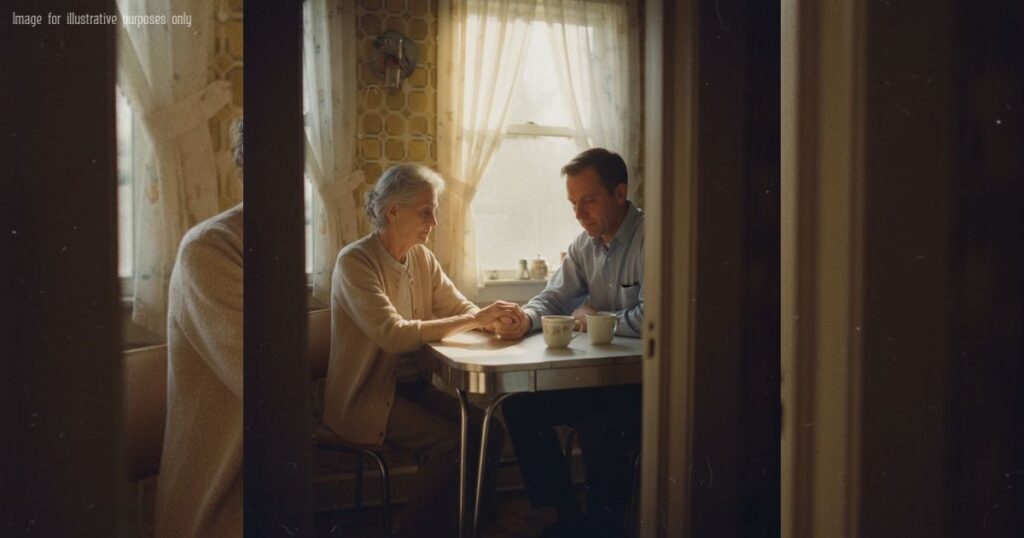

I told my son to “man up” and stop making excuses. I didn’t realize I was shouting at a drowning man until I found his bed empty and the silence in his room became permanent.
My son, Leo, was twenty-three. To the outside world, and frankly, to me at the time, he looked like a failure.
I’m a simple guy. I grew up in a time when sweat equity meant something. I bought my first house at twenty-four working at a local manufacturing plant. I drove a beat-up truck, fixed it myself, and never complained. That was the American way. You work hard, you get the white picket fence. Simple math.
So, when I looked at Leo, I didn’t see a struggle. I saw laziness.
He had a college degree that was gathering dust. He spent his days glued to his phone, delivering food for one of those gig-economy apps, and sleeping until noon. He lived in my basement, wore the same oversized hoodie every day, and had a look in his eyes that I interpreted as boredom.
I was constantly on his case. “The world doesn’t owe you a living, Leo,” I’d say, slamming my coffee mug down. “Get a real job. Build some character.”
The Tuesday that changed my life started like any other. I came home from the shop, grease on my hands, feeling the good ache of a hard day’s work.
Leo was in the kitchen, staring at a bowl of cereal. It was 6:00 PM.
“You just waking up?” I asked, the irritation rising in my chest like bile.
“No, Dad,” he said softly. “Just got back. Did a few deliveries.”
“Deliveries,” I scoffed. “That’s not a career, Leo. That’s a hobby. When I was your age, I had a mortgage and a baby on the way. You can’t even pay for your own gas.”
He put the spoon down. He looked pale, thinner than I remembered.
“The market is tough right now, Dad. Nobody is hiring entry-level without three years of experience. And the rent… a studio is two thousand a month. I can’t make the math work.”
“The math works if you work,” I snapped. “Stop blaming the economy. Stop blaming ‘the system.’ It’s about grit. You think it was easy for me in the 90s? We didn’t have safe spaces. We just got it done.”
Leo looked up at me. His eyes were heavy. Not sleepy—heavy. Like they were holding up the ceiling.
“I’m trying, Dad. I really am. But I’m just… so tired.”
I rolled my eyes. I actually rolled my eyes.
“Tired? From what? Sitting in a car? Playing on your phone? I’ve been on my feet for ten hours. I am tired. You’re just unmotivated. You have everything handed to you—electricity, food, a roof—and you act like you’re carrying the weight of the world.”
The kitchen went quiet. The refrigerator hummed. The news played softly in the background, talking about inflation rates, but I wasn’t listening. I was waiting for him to argue, to fight back, to show some spark.
Instead, he just nodded.
“You’re right,” he whispered. “I’m sorry I’m not who you were at my age. I’m sorry the math doesn’t work for me.”
He stood up, walked over to me, and did something he hadn’t done since he was ten. He hugged me. It wasn’t a strong hug; it was a lean, a collapse of weight against my shoulder.
“I won’t be a burden anymore, Dad. I promise. Get some sleep.”
I stood there, feeling vindicated. Finally, I thought. Finally, I got through to him. Tough love. That’s what this generation needs.
I went to bed feeling like a good father.
The next morning, the house was silent. Too silent.
I woke up at 6:30 AM, ready to wake him up early. We were going to look for “real” jobs today. I was going to drive him to the industrial park myself.
“Leo! Up and at ’em!” I shouted, banging on the basement door.
No answer.
I pushed the door open.
The room was spotless. The piles of laundry were gone. The blinds were open. The bed was made—military tight.
And on the pillow, there was his phone and a folded piece of notebook paper.
A cold shiver, sharper than any winter wind, shot down my spine.
“Leo?”
I checked the bathroom. Empty. The backyard. Empty. The garage.
My old pickup truck was gone.
I ran back to the room and grabbed the note. My hands were shaking so hard I almost ripped the paper.
Dad,
I know you think I’m lazy. I know you think I’m weak. I wanted to be the man you are. I really did.
But the mountain you climbed doesn’t have a path anymore. I’ve applied to 400 jobs this year. I didn’t tell you because I was ashamed. I drove for that delivery app for 14 hours a day just to pay the interest on my student loans, not even touching the principal.
You told me to save. I tried. But when rent is double what you paid, and wages are half of what they should be, saving feels like trying to fill a bucket with a hole in the bottom.
I stopped taking my medication three weeks ago because my insurance cut out and I didn’t want to ask you for money again. That’s why I was “tired.” My brain has been screaming at me, and I didn’t have the volume knob to turn it down.
You were right. The world is for the strong. And I don’t have any fight left.
I’m taking the truck to the old bridge. I’m sorry. You won’t have to pay my bills anymore.
Love, Leo.
The scream that tore out of my throat didn’t sound human. It sounded like an animal caught in a trap.
I dialed 911. I drove to the bridge. I drove so fast the world blurred into gray streaks.
I saw the flashing lights before I saw the river.
I saw the tow truck. I saw my pickup, the one I boasted about fixing, being hauled up from the water, dripping mud and weeds.
I collapsed on the asphalt. The officer who helped me up was a guy about my age. He didn’t say, “It’s going to be okay.” He just held me while I shattered.
It’s been six months.
People tell me, “It wasn’t your fault, Jack. Depression is a silent killer.”
And they are right. It is a disease.
But I can’t stop looking at the math.
I looked at his phone records later. He wasn’t lying. He had applied to hundreds of jobs. He was rejected by automated emails. He was working while I slept. He was fighting a war I refused to see because I was too busy looking at the past through rose-colored glasses.
I measured his success with a ruler from 1990, and I beat him with it when he didn’t measure up.
We tell our kids, “When I was your age, I had a house and a car.” We forget to mention that a house cost two years’ salary then, not twenty. We forget that we had pensions, not gig contracts. We forget that we had hope.
Leo didn’t need a lecture on grit. He needed a dad who understood that “I’m tired” didn’t mean “I need sleep.” It meant “I’m running out of reasons to stay.”
I visit his grave every Sunday. I tell him about the truck. I tell him I’m sorry.
But he can’t hear me.
The world is full of Leos right now. Young men and women who are working harder than we ever did, for half the reward, carrying the weight of a broken economy and a digital isolation we can’t comprehend.
If your child tells you they are tired… if they seem stuck… if they are struggling to launch in a world that has clipped their wings…
Please. Put down your judgment. Throw away your “back in my day” stories.
Don’t tell them to man up. Tell them you are there. Tell them their worth isn’t in their paycheck or their property.
I would give everything I own—my house, my pension, my pride—just to see my son sleeping “lazily” on that couch one more time.
A “perfect” dead son is a trophy of nothing but regret.
Listen to the silence before it becomes eternal.
—
PART 2 — The Comments That Follow a Coffin Home
If you read Part 1, you already know how this ends.
You know there’s a note on a pillow, and a silence so loud it feels like pressure in your ears. You know I spent six months replaying one sentence—man up—like it was a prayer I couldn’t stop saying, even though it never saved anyone.
What you don’t know is what happened after the funeral.
Because grief doesn’t just live in your chest.
It lives in your phone.
It lives in the way people look at you in the hardware aisle. In the way men your age clap you on the shoulder and say, “Kids today,” like they’re talking about a bad batch of lumber.
And it lives in the thing nobody warns you about:
Click the button below to read the next part of the story.⏬⏬