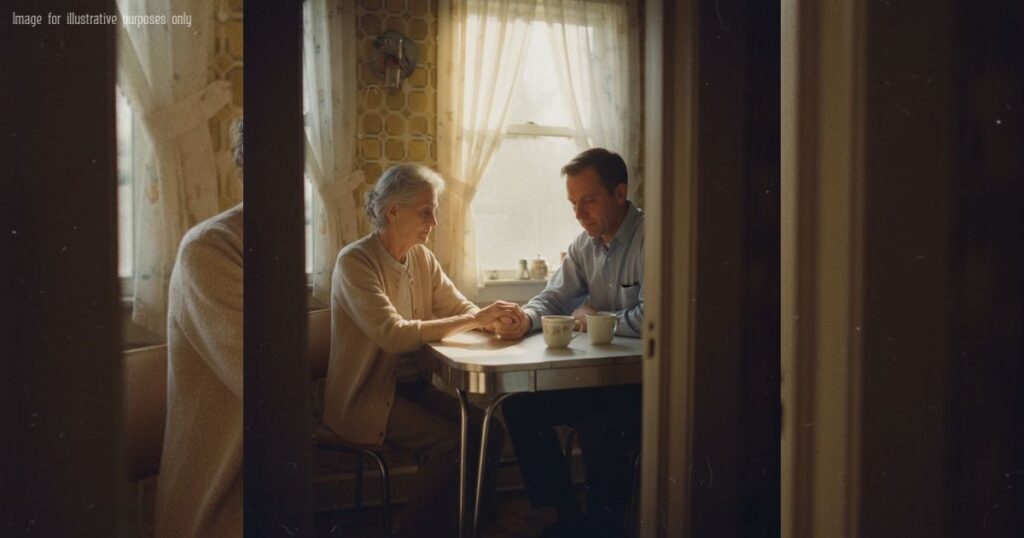

PART 2 — The Comments That Follow a Coffin Home
If you read Part 1, you already know how this ends.
You know there’s a note on a pillow, and a silence so loud it feels like pressure in your ears. You know I spent six months replaying one sentence—man up—like it was a prayer I couldn’t stop saying, even though it never saved anyone.
What you don’t know is what happened after the funeral.
Because grief doesn’t just live in your chest.
It lives in your phone.
It lives in the way people look at you in the hardware aisle. In the way men your age clap you on the shoulder and say, “Kids today,” like they’re talking about a bad batch of lumber.
And it lives in the thing nobody warns you about:
The comments.
The first time I went back into Leo’s basement after the police left, I carried a trash bag like I was going to do something useful. That’s what men like me do. We clean. We fix. We handle.
The room smelled like detergent and cold air. He’d opened the blinds before he left, like he wanted the sun to witness him being neat. The bed was still made tight enough to bounce a coin.
I stood there, staring at that made bed, and my brain did this stupid thing where it tried to bargain.
Maybe he just ran away.
Maybe he’s in a motel.
Maybe he’s mad and he’ll cool off.
Then my eyes landed on the corner of his desk.
A cheap spiral notebook. A pen. And a stack of printed emails, folded in half, like he’d been hiding them from me and himself at the same time.
I opened the notebook.
It wasn’t a diary. It wasn’t poetry.
It was math.
Columns. Dates. Company names blacked out with marker. “Applied.” “Rejected.” “No response.” “Second interview.” “Ghosted.”
Four hundred lines of quiet effort.
Four hundred punches thrown into the air.
My throat made this sound—half laugh, half choke—because my whole life I’d believed effort was a vending machine. You put in work, you get a prize. Leo had put in work until his hands bled.
The machine never dropped anything.
I sat on the floor like an old man who’d forgotten how chairs work.
And for the first time since I found the note, I didn’t just miss him.
I understood him.
Two weeks after the funeral, I found myself in the parking lot of a small brick building with a plain sign out front that said SUPPORT GROUP in letters that looked like they’d been peeled off a window.
I almost drove away.
Because walking into that place felt like admitting something I’d been trained my whole life not to admit:
That I didn’t know how to carry this.
Inside, there were twelve metal chairs in a circle and a coffee pot that tasted like regret. There were women with swollen eyes and men who stared at their hands like their palms had answers.
A guy about my age nodded at me like he already knew my name.
“Lost a kid?” he asked, not unkind.
I tried to speak.
Nothing came out.
He didn’t push. He just slid a box of tissues toward me like he was offering a wrench.
That night, I listened to a mother describe how her daughter “was fine” right up until she wasn’t. I listened to a father say, “I told him to toughen up,” and then he folded in half over his knees like his spine had turned to water.
When it came to my turn, I heard myself say it out loud for the first time.
“I told my son to man up.”
Nobody gasped. Nobody judged. Nobody said, “How could you?”
They just nodded, slow and heavy, like we were all standing in the same cold rain.
And that’s when it hit me: I wasn’t the only parent who used the old words like they were safe.
Three days later, I did something I never do.
I wrote about it.
Not a long thing. Just a post on a local online community page where people usually argue about potholes and fireworks and whether the new coffee place is “ruining the town.”
I typed it with one finger, like I was defusing a bomb.
I didn’t use Leo’s full name. I didn’t name any businesses. I didn’t blame anyone.
I just told the truth.
I wrote: I told my son to man up. I thought I was motivating him. I didn’t realize I was yelling at a drowning man. If you’re a parent, please—when your kid says they’re tired, don’t treat it like laziness. Treat it like a flare.
I stared at the screen for a full minute.
Then I hit post.
Within an hour, it had more reactions than anything I’d ever said in my life.
And then the comments started.
Some were kind. People wrote, I’m sorry. They wrote, Thank you for sharing. They wrote their own stories in paragraphs so long you could feel how desperate they were to be heard.
But a chunk of them—enough to make my stomach clench—came in like fists.
Stop blaming the economy. People have had it worse.
This is what happens when you baby them.
You’re turning tragedy into an excuse.
If my kid lived in my basement, I’d kick him out. That’s how you teach responsibility.
One guy wrote, Men used to die in wars. Now they die because they have to work? Give me a break.
I stared at that sentence until the letters stopped looking like letters and started looking like a wound.
Because the cruel part wasn’t that strangers had opinions.
The cruel part was this:
A lot of them sounded like me.
I didn’t sleep that night. I kept refreshing like a fool, watching my son’s death turn into entertainment for people who didn’t know his laugh, didn’t know how he used to tap a rhythm on the steering wheel when he drove, didn’t know he cried at animal rescue videos like his heart had no skin.
At 2:17 AM, a private message popped up from a name I didn’t recognize.
Sir. I saw your post. I’m 24. My dad talks like you used to. I can’t do this anymore.
I stared at that line until my vision went blurry.
This is the part where I want to tell you I said the perfect thing.
The brave thing.
The wise thing.
I didn’t.
I typed with shaking hands: Where are you right now? Are you alone?
Click the button below to read the next part of the story.⏬⏬