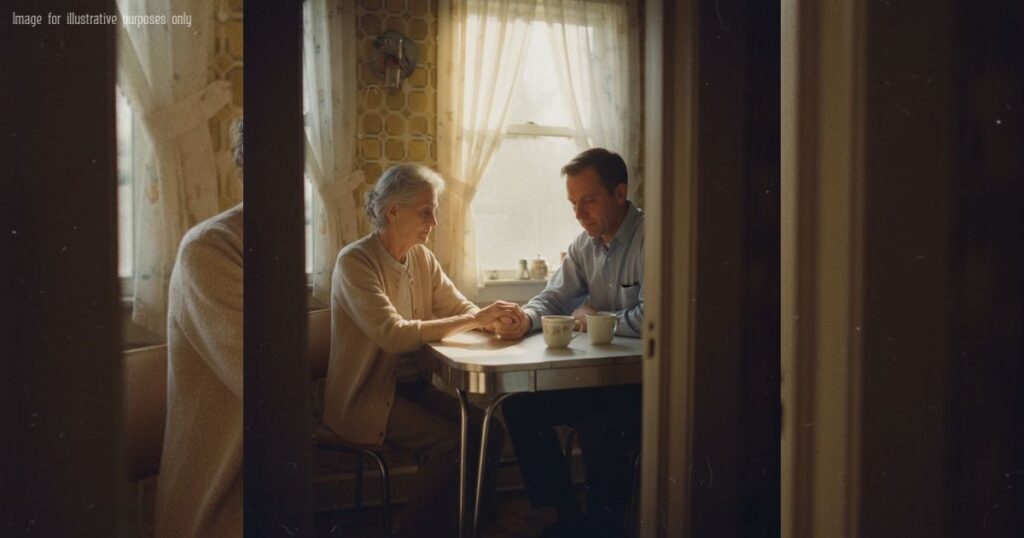

I tracked my 74-year-old father with an AirTag because I thought he was buying drugs. I wish I was exaggerating.
I sat in his dim living room in Ohio, staring at his bank ledger. The house was freezing—he kept the thermostat at 60 degrees to save on gas. Dad, a retired carpenter named Arthur, survives on a thinning Social Security check. He eats generic mac and cheese three nights a week. He tapes his shoes when the soles separate.
But there it was. A monthly withdrawal of $215.00. “City-Side Storage, Unit 102.”
He had been paying this for eight years. That’s over $20,000.
My stomach churned. Dad didn’t have $20,000. I was already paying his phone bill. I was looking for assisted living facilities because we couldn’t keep this house much longer. And all this time, he was bleeding cash?
My mind spiraled. Was it an online romance scam? Was he hoarding trash? Was it a gambling debt?
“Dad,” I slammed the ledger on the table. “What is Unit 102?”
He stopped washing his single plate in the sink. His shoulders stiffened. “Drop it, Mike.”
“I can’t drop it! You can’t afford your blood pressure meds, but you’re paying rent on an empty box? I’m cancelling the card.”
Arthur turned around. His face, usually soft and apologetic, was stone cold. “You touch that account, and you’re not welcome in this house.”
He walked out.
I didn’t sleep that night. Two days later, my phone pinged. The AirTag I’d slipped into his glovebox was moving.
I followed his rusted Ford F-150 to the industrial edge of town. It was a grey, biting Tuesday. He pulled up to a storage facility surrounded by barbed wire. I parked a block away, heart hammering, ready to confront a dealer or a scammer.
I watched my father—a man with bad knees and arthritis—heave the metal shutter up.
I marched over, ready to scream. I expected floor-to-ceiling newspapers. I expected rot.
Instead, I froze in the doorway.
It wasn’t a storage unit. It was a showroom.
It was breathtakingly clean. The concrete floor was swept. Along the left wall, heavy industrial shelves held “Starter Kits” wrapped in clear cellophane. Kitchen: A toaster, two plates, silverware, a pot, a pan. Bathroom: Fresh towels, unopened soap, a toothbrush holder.
On the right, furniture. A dining table, sanded and re-stained to look new. A crib with a brand-new mattress. A rack of clothes, steam-ironed and organized by size: “Interview Suits,” “Winter Coats,” “Kids 2T-4T.”
And there was Dad. He wasn’t doing drugs. He was tightening a screw on a high chair.
A battered sedan pulled up behind me. A young woman, maybe 24, stepped out. She looked exhausted, wearing a hoodie that was too thin for the weather. She was carrying a baby carrier.
Dad’s face changed. The hardness vanished. He smiled—a look of pure warmth.
“Morning, Chloe,” he said gently. “I found that microwave you needed. And I got a space heater for the drafty bedroom.”
The girl, Chloe, didn’t speak. She just looked at the stack of items. She looked at the fresh pillows.
“I can’t pay you yet, Arthur,” she whispered. “My ex… he drained the accounts before I left.”
“We don’t use money here,” Dad said, lifting a box of pots into her trunk. “The price is that you keep going. You make that apartment safe for this little one. That’s the deal.”
She grabbed his hand, burying her face in his rough, calloused palm. She sobbed. It wasn’t a polite cry; it was the gut-wrenching sound of someone who had been holding their breath for years finally letting go.
“You’re the only reason we’re not in the car,” she choked out.
Dad just patted her shoulder. “You’re doing the hard work, kid. I’m just the logistics guy.”
When she drove away, I stepped into the light.
“Dad?”
He jumped, dropping his screwdriver. He looked at me like a kid caught stealing cookies. “I told you to leave it alone, Mike.”
“Dad… you’re broke. You’re skipping meals.”
He sat down on a plastic bin, looking at his hands. “Do you remember 2008? The crash?”
“Yeah. You told me business was slow.”
“I lied,” he said softly. “I lost the business. I lost the house before we moved to the rental. For three months, while you were away at college, I lived in this truck. I showered at the YMCA. I parked in Walmart lots to sleep.”
I stared at him. The air left my lungs. “You never told me.”
“A father doesn’t tell his son he failed,” he said, his voice cracking. “It kills you, Mike. Not the hunger. The invisibility. You walk down the street and people look right through you. You feel like you’ve fallen off the edge of the earth and no one noticed.”
He wiped his eyes with a rag. “One night, it was five below zero. I was out of gas. A guy knocked on my window. I thought he was a cop telling me to move. He handed me a sleeping bag and a gift card for a hot meal. He didn’t preach. He didn’t ask for a thank you. He just said, ‘Stay warm, brother.’ That sleeping bag saved my toes. Maybe my life.”
He looked up at the rows of neatly folded towels. “I made a deal with God that night. If I ever got back on my feet, I’d be the guy knocking on the window.”
“How long?” I asked, my throat tight.
“Eight years,” he said. “I fix up furniture people throw out on curb days. I hunt the clearance aisles. The local women’s shelter has my number. They send me the ones who are starting from zero—usually escaping bad situations. The Section 8 voucher gets them a roof, but it doesn’t get them a spoon to eat soup with. It doesn’t get them a bed.”
“How many families?”
“I don’t count,” he shrugged. “Maybe 400?”
“And the $215 rent?”
“It’s my tithe,” he said simply. “It’s cheaper than therapy.”
I drove home in silence. I cried until I had to pull over. I cried for the arrogance of thinking I knew my father. I cried for the secret burden he’d carried for fifteen years.
Then, I opened my laptop.
I didn’t ask for money. I posted a photo of Dad standing in Unit 102, holding a toaster. I wrote: “My 74-year-old dad eats ramen so he can afford to run a secret department store for domestic violence survivors. We need a bigger unit. Who has a truck? Who has furniture?”
I expected a few likes from my friends.
I woke up to a viral storm.
The post had 45,000 shares. My inbox was crashed. “I own a moving company in Cleveland—we’ll donate a truck and two guys every Saturday.” “I’m a manager at a storage chain—we’re giving you three climate-controlled units, rent-free for life.” “I have a dining set.” “I have baby clothes.” “I have a brand new mattress.”
By the next Saturday, “Arthur’s warehouse” wasn’t a secret anymore. It was a movement.
Thirty volunteers showed up. A local bakery brought coffee and donuts. High school football players were lifting sofas. A mechanic was in the parking lot fixing the brake lights on a young mom’s car for free.
Dad stood in the middle of the chaos, holding his clipboard, looking overwhelmed. He wasn’t the invisible old man anymore. He was the Commander.
But the moment that broke me happened last week.
We were expanding into the new unit. A luxury SUV pulled up. A woman stepped out—immaculate suit, designer bag, radiating confidence.
She walked straight to Dad.
“Arthur?”
He squinted, adjusting his glasses. “Yes, ma’am? Can we help you with a donation?”
“You don’t recognize me,” she smiled, tears instantly brimming in her eyes. “Six years ago. I had a black eye, a two-year-old boy, and two garbage bags of clothes. You gave me a kitchen table, a lamp with a yellow shade, and a toolbox. You told me, ‘You’re strong enough to build the rest.'”
Dad’s mouth dropped open.
“I’m a contractor now,” she said, weeping openly. “I own my own construction firm. I employ forty people. My son is in private school.”
She pulled an envelope from her purse. “I’ve been looking for you.”
She handed it to him. It was a check for $25,000.
“For the next girl,” she said. “And the toolbox? I still have it. It’s on my desk.”
My dad, the Vietnam vet, the man who never showed emotion, took off his glasses and buried his face in his hands. He held onto that successful CEO like she was his own daughter.
We have a nonprofit now. It’s called “The Starter Kit Project.” We operate in three counties.
But Dad? He still fights me on one thing.
Every month, he insists on paying the rent for that original Unit 102 out of his own Social Security check.
“Why, Dad?” I asked him yesterday. ” The foundation has plenty of money now.”
He looked at the concrete floor where he used to stand alone.
“Because I never want to forget,” he said, signing the check with a shaky hand. “Some bills you pay with money. This one? I pay this one with gratitude. As long as I’m breathing, I’m paying the rent on hope.”
In a world that tells us to hoard, to fear our neighbors, and to build higher walls, an old carpenter taught me the only truth that matters:
You aren’t truly rich until you have something to give away.
—
PART 2 — The Internet Loved My Dad… Then It Tried to Eat Him Alive
If you read Part 1, you already know the punchline: I put an AirTag on my 74-year-old father because I thought he was buying drugs—then I found a hidden “department store” he ran for survivors starting over with nothing.
What you don’t know is what happened after the post went viral.
Because the internet doesn’t just lift people up.
It also shows up with cameras, opinions, and pitchforks—then asks you to smile for the screenshot.
The first week after the post, my phone stopped feeling like a phone.
It felt like a fire alarm I couldn’t turn off.
I got messages from strangers telling me my dad restored their faith in humanity.
Click the button below to read the next part of the story.⏬⏬