
They were standing in front of me.
The man tilted his head. “I’m looking for someone. A girl. Thinks she can disappear.”
Dad’s voice stayed even. “We don’t help with that.”
The man’s jaw tightened. “I didn’t ask you to play hero. I asked you where she is.”
Dad took off his glasses slowly and wiped them with his shirt, like he had all the time in the world.
“You’re in the wrong place,” he said.
The man stepped closer.
Close enough that I could smell stale smoke on him.
“You old?” he said to Dad, like age was an insult. “You think you can stand in the way of a man finding his family?”
Dad put his glasses back on.
And the next thing he said wasn’t brave.
It wasn’t tough.
It was simple.
“No.”
One word.
A wall.
I swallowed. My heart was pounding so hard it made my ears ring.
The man’s eyes narrowed. “I’ll ask again.”
Dad turned slightly—not away from him, but toward the sign on the wall.
The one that said NO FILMING. NO PHOTOS.
He tapped it once.
Then he looked the man in the face.
“You’re not getting anything from me,” he said. “Not a name. Not a hint. Not even a conversation.”
The man laughed, sharp and humorless. “Then I guess I’ll just keep coming back.”
Dad nodded, like he’d expected that answer.
Then he did something that surprised me.
He didn’t threaten.
He didn’t puff up.
He didn’t escalate.
He reached into his pocket and pulled out a small notepad.
Wrote something down.
Tore the page off.
And held it out.
The man stared at it.
“What’s that?” he asked.
Dad’s voice stayed calm.
“It’s a phone number,” he said. “For a counselor. Someone who can help you handle what you’re feeling without destroying people.”
The man’s face twisted like Dad had slapped him.
“You’re out of your mind.”
Dad didn’t move.
“Maybe,” he said softly. “But I’m still not helping you hunt her.”
The man held Dad’s gaze for a long second.
Then he spat on the concrete floor.
And walked out.
The unit felt smaller after he left.
Like the air had been squeezed.
I turned to Dad.
My voice shook. “Was that… Chloe’s ex?”
Dad’s eyes were tired.
“I don’t know,” he admitted. “And I don’t want to.”
I stared at the door, realizing the real cost of my viral post.
Not money.
Not logistics.
Exposure.
I whispered, “This is my fault.”
Dad exhaled.
Then he reached out and squeezed my shoulder.
“Listen,” he said. “You didn’t cause his behavior. You shined a light, and some people hate light because it shows what they are.”
He looked at the shelves.
At the cribs.
At the coats.
Then he said the sentence I’ll never forget:
“Doing good doesn’t make you safe. It just makes you responsible.”
That night, I didn’t sleep.
I kept replaying the moment in my head.
The way that man said, “I’ll just keep coming back.”
The way my father didn’t crumble.
Didn’t panic.
Just held the line.
And it made me think about something ugly in American culture right now:
We love stories of kindness…
as long as they don’t inconvenience anyone.
As long as they stay cute.
As long as they don’t come with messy reality.
But real kindness isn’t a Hallmark moment.
It’s a boundary.
It’s a decision.
It’s saying no to the wrong person even when your voice shakes.
It’s locking the door not because you’re cruel…
but because you’re protecting someone who has already survived enough.
The next morning, Dad called the shelter contact we work with and told her what happened.
No drama.
No hero speech.
Just facts.
And by afternoon, we had new protocols.
New pickup windows.
A new discreet location plan in motion.
Not because we were scared…
but because we were learning.
Because hope isn’t just something you give away.
It’s something you guard.
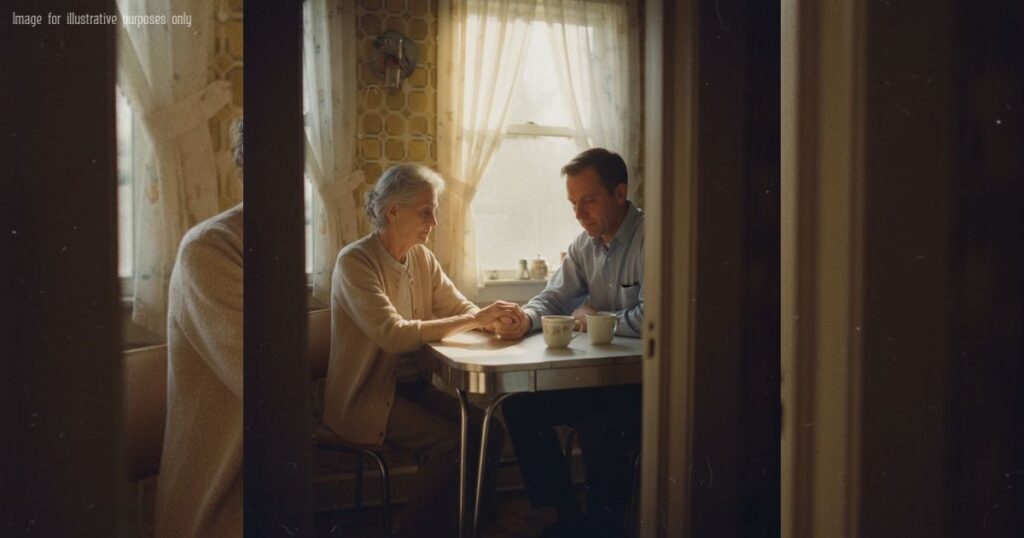
A few days later, Dad and I sat at his kitchen table.
The same dim, cold house.
The same old ledger.
Except now, there were more zeros in the account than Dad had ever seen.
And he still looked like the same man who taped his shoes.
I said, “Do you regret it? Going viral?”
Dad stared into his coffee like it held an answer.
Then he shook his head once.
“No,” he said. “But I hate what people think they’re owed.”
“What do you mean?”
He looked up at me.
“The internet thinks every good thing is public property,” he said. “They think because they clicked ‘share,’ they bought a piece of somebody’s life.”
He paused.
Then he added, “And they think helping is the same as watching.”
His hand drifted toward the checkbook on the counter.
The one he still used to pay for Unit 102 every month.
I swallowed.
“Dad… after what happened… why keep paying that rent yourself?”
He didn’t answer right away.
He just turned the pen in his fingers like it was a tool he trusted more than words.
Finally, he said, “Because that unit reminds me what it feels like to be invisible.”
Then he looked at me—really looked at me.
“And I never want to become the kind of man who helps people just to feel important.”
He signed the check.
Slow.
Shaky.
Certain.
Then he slid it across the table like it weighed nothing.
“Son,” he said, “there’s a kind of charity that feeds your ego.”
He tapped the check once.
“And there’s a kind that feeds someone’s future.”
He stood up, pulled on his coat, and headed for the door.
“Come on,” he said.
“We’ve got a family starting over today.”
Before we left, I glanced at my phone.
Another argument was exploding under the original post.
People fighting about who deserves help.
About whether survivors should “prove” anything.
About whether men should be included.
About whether a 74-year-old should be allowed to spend his own money.
About whether I was a terrible son for tracking him.
I stared at the screen for a long second.
Then I put my phone face-down.
And followed my father into the cold.
Because the comment section can debate all day.
But out there—in the real world—someone still needs a bed.
Someone still needs a spoon.
Someone still needs a start.
And here’s the truth that might make people mad, but it’s the truth anyway:
If your kindness requires a verdict, it’s not kindness. It’s a transaction.
Dad taught me that.
Not with a speech.
With a storage unit.
With folded towels.
With a refusal to sell someone else’s pain for attention.
And now I want to ask you something—because I already know this will split people right down the middle:
If you were me… would you have tracked your father?
If you were my dad… would you keep paying the rent out of your own check?
And if you showed up to help… could you do it without needing proof, credit, or content?
Thank you so much for reading this story!
I’d really love to hear your comments and thoughts about this story — your feedback is truly valuable and helps us a lot.
Please leave a comment and share this Facebook post to support the author. Every reaction and review makes a big difference!
This story is a work of fiction created for entertainment and inspirational purposes. While it may draw on real-world themes, all characters, names, and events are imagined. Any resemblance to actual people or situations is purely coincidenta