PART 2 — “If You Read Part 1, You Know I Turned Off the App”
If you read Part 1, you know I did something most folks would call reckless.
I went offline in the middle of a Sunday rush, spent forty-two dollars I didn’t have, and marched back into a stranger’s apartment with a three-pound chuck roast like it was a rescue rope.
I also did something else—something I didn’t think about until the adrenaline wore off.
I crossed a line.
Not a legal line. Not the kind that comes with sirens and handcuffs. I mean the newer kind. The invisible kind everyone keeps now. The “don’t get involved” line. The “mind your business” line. The “if you didn’t order it, you don’t deserve it” line.
Monday morning, that line came back to collect interest.
I woke up to the sound of my phone buzzing itself off the nightstand and onto the floor. The screen lit up like a bad omen.
ACCOUNT TEMPORARILY PAUSED.
A REPORT HAS BEEN FILED.
PLEASE CONTACT SUPPORT.
My stomach dropped so hard I swear it tugged at my spine.
I stared at those words until they blurred. Support. As if there were a human on the other side who cared that I was sixty-eight with a rattling ‘98 truck and a rent payment that didn’t care about “reports.”
I sat up and checked my bank account.
Thirty-one dollars and some change.
So there it was—my controversial little Sunday sermon, paid for in full the very next day.
I made coffee that tasted like burnt pennies and stared at my kitchen table. It’s just me in this house now. My wife has been gone three years, and the quiet she left behind is the kind that sits on your shoulders like wet wool.
In Part 1, I told that young dad to protect the table.
Turns out I didn’t have anyone sitting at mine.
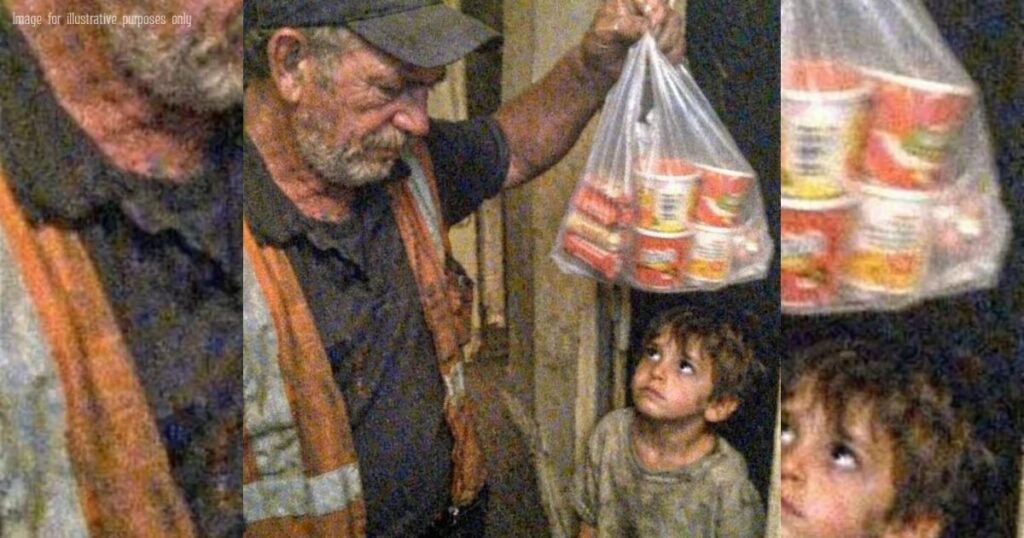
I picked up the phone with hands that had welded steel for four decades, hands that used to be steady even when sparks flew, and I called the number on the screen.
Automated voice.
Press this. Say that. Please hold.
I held. Of course I did. That’s what the working class does. We hold.
After twenty minutes of listening to music that sounded like a dentist drill singing lullabies, a voice finally came on.
Flat. Scripted. Young enough to be my grandson.
“Sir, your account was paused due to a safety concern reported by a customer.”
“A customer?” I said. “The family I helped didn’t—”
“I’m not able to discuss details,” the voice cut in, polite as a locked door. “For safety reasons, you may not enter a customer’s residence.”
“I didn’t,” I lied automatically, then hated myself for it. I hated that the system made liars out of people who were just trying to be decent.
There was a pause—keyboard tapping, like judgment being typed out in real time.
“You can submit an appeal,” the voice said. “It may take several days.”
Several days.
That might as well have been several lifetimes.
When the call ended, I sat there with the phone in my hand, staring at my own reflection in the black screen like I was looking at a man I didn’t recognize.
Was I a hero?
Or was I just an old fool who couldn’t accept the world had changed?
I could already hear the arguments in my head—the ones people spit out like slogans.
“You can’t save everybody.”
“Not your problem.”
“He chose to have a kid.”
“You broke the rules.”
“You’re enabling.”
“You’re preaching.”
“Stay out of people’s lives.”
And then I pictured that five-year-old’s face—the way his shoulders sank when “roast” turned into “hot dog night.”
A kid shouldn’t learn disappointment that early. It settles in the bones.
I grabbed my jacket and my truck keys.
If I was going down for crossing a line, I at least wanted to know whose line it was.
The apartment complex looked even uglier in daylight. In the sun, you could see where the “luxury” was just paint—cheap trim, swelling wood, a lobby that smelled like fake lemon cleaner covering up real despair.
I didn’t sneak in this time.
I walked straight to the management office and stood in line behind two women arguing about a fee that sounded like it had been invented by someone who never had to check their balance before buying bread.
When it was my turn, the clerk didn’t look up at first.
“What can I do for you?” she asked, already tired of me.
“I was here last night,” I said. “Third floor. I delivered groceries. I need to know if there was a complaint.”
Her eyes flicked up, and something in her expression tightened.
“Are you the older gentleman in the cap?” she asked.
“Yes, ma’am.”
She pressed her lips together like she was deciding what kind of trouble I was.
“There was a report,” she said carefully. “From a resident. Not the tenant you delivered to.”
Of course.
It’s always someone watching from a safe distance, isn’t it?
“What did they say?” I asked.
She hesitated. Then, like she couldn’t help herself, she leaned forward just a little.
“They said you forced your way into someone’s unit,” she whispered. “That you could be dangerous.”
Dangerous.
I laughed once—short, bitter. “Ma’am, I can barely lift a bag of dog food without my shoulder clicking.”
She didn’t laugh back. “People are scared,” she said. “You know how it is.”
Yeah.
I know how it is.
We live in a country where folks will watch you bleed from across the street and call it “boundaries.”
“Which resident reported it?” I asked.
“I can’t share that,” she said, retreating behind policy like it was body armor. “But I’m going to ask you not to return to anyone’s unit unless requested.”
I nodded. I wasn’t here to make her life harder.
“I just need to talk to the young man,” I said. “The one with the little boy.”
Her face softened the tiniest bit. Not much. Just enough to prove she still had a human heart under the rules.
“Unit 3C,” she said quietly. “But… be careful.”
I thanked her and took the stairs.
Halfway up, I heard someone behind me.
A crisp voice, sharp with the confidence of someone who’s never had to choose between gas and groceries.
“Excuse me.”
I turned.
A woman stood there, maybe early thirties. Hair perfect. Fitness watch. Coat that probably cost more than my truck payment. She held her phone in her hand like it was a badge.
“You shouldn’t be here,” she said.
“Morning to you too,” I answered.
“You went into someone’s apartment last night,” she said. “That’s not okay.”
Her eyes moved over me like I was a suspicious package.
“You the one who reported it?” I asked, not raising my voice, just asking plain.
Her chin lifted. “I did what I had to do.”
“There it is,” I said, and I couldn’t keep the tired out of my tone. “The modern prayer.”
She bristled. “You don’t know me.”
“I know fear,” I said. “I know people don’t want to get hurt. But I also know that boy in there was hungry in a way you can’t fix with a security gate.”
Her eyes narrowed. “So you decided you had the right to play savior?”
That one hit a nerve, because it was the exact word I’d been trying not to say to myself.
“I decided I had the responsibility to act like a neighbor,” I said.
“We’re not neighbors,” she snapped. “I pay to live in a secure building. People like you—”
She stopped herself, but it was too late.
People like you.
I felt something hot rise in my chest, but I swallowed it. I wasn’t here to fight her. Fighting her would be easy. Easy is what the world is full of.
“Finish it,” I said quietly.
She looked away for half a second, then looked back with that hard honesty people use when they think cruelty is the same as truth.
“People who don’t belong here,” she said. “You don’t get to just walk in.”
I let that sit between us.
And here’s the part that’s going to make people argue in the comments, because it always does:
I didn’t call her names.
I didn’t tell her she was evil.
I just asked one question.
“Did you eat dinner last night?” I said.
She blinked. “What?”
“Did you eat?” I repeated.
She hesitated. “Yes.”
“Did you eat alone?” I asked.
Her throat moved as she swallowed.
That tiny human twitch—the one that betrays a person’s real life—told me everything.
I nodded once. “Yeah,” I said softly. “I thought so.”
Her jaw tightened again, like she hated that I’d seen something.
“You’re manipulating,” she said.
“No,” I said. “I’m remembering. There’s a difference.”
I turned away and walked up the last flight.
Behind me, her voice followed like a warning label.
“Stay away from them. You could make things worse.”
I didn’t answer.
Because the truth is… she might’ve been right.
Sometimes help comes with strings you don’t even see.
Sometimes pride gets wounded.
Sometimes a man already drowning doesn’t need a lecture—he needs a life jacket.
I didn’t know which one I’d given that young dad.
I knocked on 3C—gentle this time.
The door opened, and there he was, still in that worn warehouse vest even though it was his day off. Like he couldn’t afford to take the uniform off, even at home.
His eyes widened when he saw me.
“Sir—” he started, panicked. “I didn’t report you. I swear to God, I didn’t.”
“I know,” I said. And I did know. His shame had been honest. His gratitude had been real.
The little boy appeared behind his leg like a shy shadow.
Then, to my surprise, he stepped forward and wrapped his arms around my thigh like he’d known me for years.
“You’re Roast Grandpa,” he said, muffled against my jeans.
The dad’s face crumpled for a second—half laugh, half sob.
I cleared my throat, because old men like me don’t know what to do when love shows up unannounced.
“I came to check on you,” I said. “And to apologize.”
The dad blinked. “For what?”
“For barging in,” I said. “For pushing past you. You didn’t invite me. I acted like I had the right.”
He stared at me like no one had ever apologized to him in his life.
Then he looked down at his son, and his voice got quiet.
“It’s the first time in months,” he said, “that my kid went to bed full and happy on a Sunday.”
He swallowed hard.
“So I don’t know what the right answer is,” he admitted. “I just know… it mattered.”
He stepped back and opened the door wider.
“Come in,” he said.
I didn’t.
Not right away.
Because now there were rules attached to kindness, and breaking them had consequences.
“I can’t,” I said. “Not unless you ask me to.”
He stared at me, confused.
“I’m asking,” he said.
So I stepped inside—slow, careful, like I was crossing into sacred ground.
The apartment smelled different than it did yesterday.
Not like cleaner.
Like onions.
Like garlic.
Like somebody had tried.
On the stove sat that dusty stockpot, washed clean and set out like a trophy.
The dad saw my eyes land on it and gave a small, embarrassed smile.
“I tried again,” he said. “Not a roast. Couldn’t swing it. But I did potatoes. Real ones. And I browned the meat like you said. Took longer… but…”
Click the button below to read the next part of the story.⏬⏬