The flashing blue lights in the driveway were the last straw.
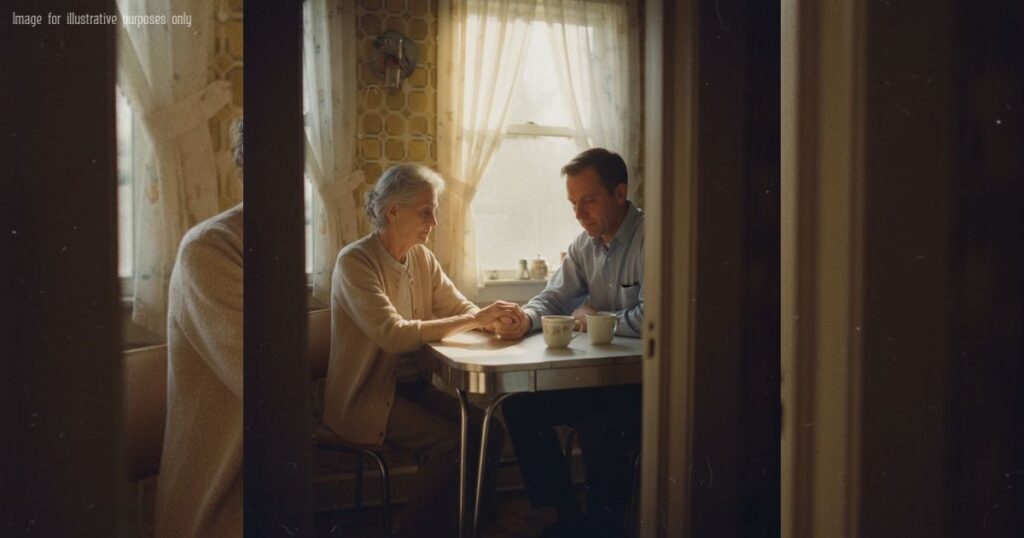
I pulled up to my father’s house, my knuckles white on the steering wheel. The Sheriff’s deputy was already leaving, tipping his hat to my dad, who stood on the porch looking like a stone statue.
“What happened?” I asked, storming up the walkway.
“Mrs. Higgins down the street,” Dad grunted, not looking at me. “Said she heard barking. Said I’m running a kennel without a permit.”
“Are you?” I asked, my voice sharp. “Because the neighborhood group chat is blowing up, Dad. They’re calling you ‘The Flipper.’ They say you get free dogs from the county shelter, fatten them up, and sell them for profit. They say you’re sick.”
My father, Arthur, is 72 years old. He’s a man who barely speaks, eats dinner out of a can, and spends his life in the garage. But his habit with dogs was… weird.
Every six months, like clockwork, he brings home a “hopeless” case. I’m not talking about cute Golden Retriever puppies. I’m talking about the dogs on death row. The three-legged Pitbulls. The scarred German Shepherds that shake when you raise a hand. The ones nobody wants.
For six months, I watch him spoil them. He buys the expensive grain-free food on his fixed pension. He walks them five miles a day. I’ve seen him sitting on the floor reading the newspaper out loud just so the dog gets used to a human voice.
And then? They vanish.
No collar. No goodbye photos. Just an empty bowl and Dad driving his rusted Ford pickup back to the pound to get another one.
“Where is Gunner?” I asked. Gunner was a Rottweiler mix with a torn ear he’d had since Christmas. That dog loved my dad.
“Gone,” Dad said, turning back into the house.
“Did you sell him? Did you take him back to the pound because he got too big?”
“Drop it, son.”
I couldn’t drop it. The thought of my father—the man who taught me to fish and fix a tire—betraying an animal for a few hundred bucks made me sick.
The next morning, at 5:00 AM, I sat in my car down the street, watching his house. Sure enough, Dad came out. He loaded a large bag of dog food and a heavy tactical vest into the truck.
I followed him.
I expected him to go to a shady meet-up spot or a back-alley breeder. Instead, he drove forty minutes out of the suburbs, past the city limits, to a rundown motel near the Veteran Affairs (VA) hospital. It was the kind of place where people live when they have nowhere else to go.
He parked in front of Room 12. I watched from a distance, my phone camera recording, ready to get the evidence I needed to confront him.
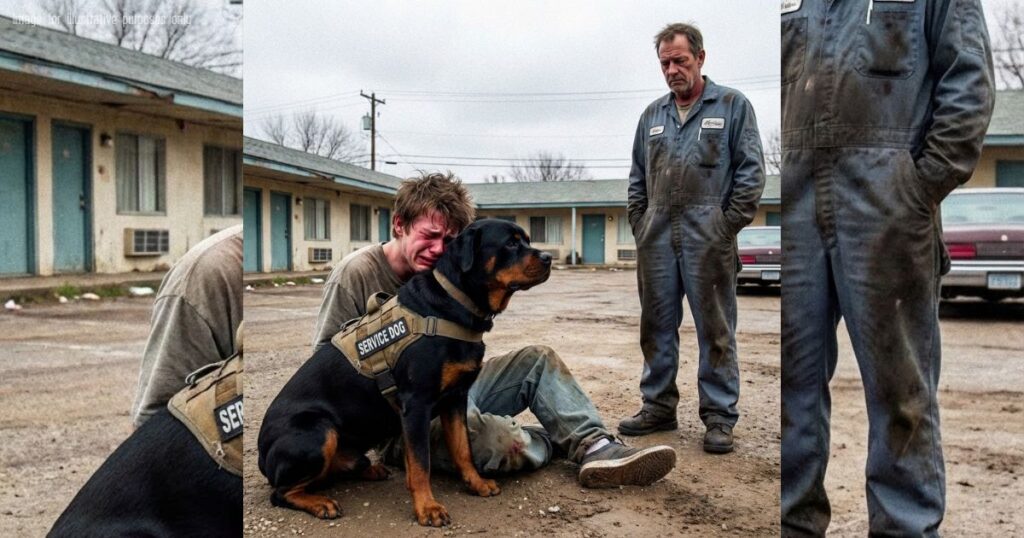
The door opened. A young man stepped out. He couldn’t have been older than 24, but his eyes looked ancient. He was wearing baggy sweatpants and a frantic, terrified expression. He was missing his left arm.
Dad didn’t say a word. He just opened the passenger door of his truck.
Out jumped Gunner.
But this wasn’t the goofy dog I saw chewing on a rubber tire last month. Gunner looked professional. Focused. He was wearing a vest that said SERVICE DOG – DO NOT PET.
The dog didn’t run around. He trotted directly to the young man’s right side—his blind side—and sat down, leaning his heavy body against the kid’s leg.
I watched the young man crumble. He fell to his knees in the parking lot dirt, burying his face in Gunner’s neck, his shoulders shaking with sobs. Gunner didn’t flinch. He just stood there, solid as a rock, anchoring the boy to the earth.
Dad handed the kid a thick folder. Not cash. Papers.
I got out of my car and walked over. My anger was gone, replaced by a lump in my throat so big I could barely breathe.
“Dad?”
Arthur jumped. He looked at me, then at the kid, and sighed. He motioned for me to walk with him, away from the reunion.
“You weren’t supposed to see this,” he mumbled, lighting a cigarette with trembling hands.
“You trained him,” I whispered. “You didn’t sell them. You’ve been training them.”
Dad took a long drag and looked at the motel. “Do you know how much a fully trained PTSD service dog costs in this country? Twenty thousand dollars. Minimum. Sometimes thirty.”
He shook his head. “Insurance doesn’t cover it. The VA waiting list is years long. These boys and girls… they come back from overseas, and they can’t sleep. They can’t go to the grocery store because the crowds make them panic. They sit in dark rooms waiting to die.”
He gestured to the young man, who was now wiping his eyes, a small, hopeful smile on his face as Gunner licked his hand.
“I can’t give them money,” Dad said, his voice cracking. “I’m just a retired mechanic living on social security. I don’t have cash. But I have time. And I know dogs.”
“But why the secrecy? Why every six months?”
“Because that’s how long it takes,” he said simply. “To take a broken dog and turn him into a soldier’s lifeline. I take the dogs society threw away, and I teach them to save the humans society forgot.”
“And the neighbors? The police?”
“Let them talk,” he shrugged. “Doesn’t matter.”
“Does it hurt?” I asked, looking at his watering eyes. “You love them. I know you do. Giving them away… doesn’t it break your heart?”
Dad dropped his cigarette and stomped it out. He looked at me, and for the first time in years, I saw the gentle father I remembered from my childhood.
“Every single time,” he whispered. “I cry the whole way home, son. It feels like ripping a piece of my chest out.”
He looked back at the young veteran, who was standing up now, walking confidently toward the street with Gunner at his heel.
“But then I think about that boy sitting alone in this motel room with a loaded gun on the nightstand because he feels like nobody has his back. And I realize…”
Dad patted my shoulder.
“My heart is old. It can handle breaking. Theirs can’t.”
We drove to the county shelter together that afternoon. The smell of bleach and wet fur hit us as we walked in. Dad didn’t look at the cute puppies in the front window.
He walked straight to the back, to the cement run labeled “CAUTION: AGGRESSIVE. SCHEDULED FOR EUTHANASIA.”
Inside was a large, terrified mongrel showing its teeth, cowering against the cold wall.
Dad opened the gate. He didn’t care about the sign. He sat down on the dirty concrete floor, ignoring the growls, and held out his scarred hand.
“Hey there, buddy,” he whispered softly. “Don’t worry. You’ve got a big job ahead of you. Let’s get to work.”
The neighbors still think my dad is crazy. They see an eccentric old man cycling through pets.
They don’t see the network of veterans across the state who are finally sleeping through the night. They don’t see the lives saved by a man who understands that sometimes, true love isn’t about what you keep.
True love is building something beautiful, just to give it away to someone who needs it to survive.
—
PART 2 — They thought the “AGGRESSIVE” sign was the danger. The real danger was how fast people decided my father was a villain… without asking a single question.
The dog in the back run doesn’t have a name on the clipboard.
Just a number, a warning label, and a date circled in red.
Dad reads it like a man reading his own obituary.
Then he does something that makes my stomach flip.
He opens his folder—the thick one he gave the young veteran—and he slides a blank page out.
On the top line, he writes one word in block letters:
Click the button below to read the next part of the story.⏬⏬