PART 2 — They thought the “AGGRESSIVE” sign was the danger.
The dog in the back run doesn’t have a name on the clipboard.
Just a number, a warning label, and a date circled in red.
Dad reads it like a man reading his own obituary.
Then he does something that makes my stomach flip.
He opens his folder—the thick one he gave the young veteran—and he slides a blank page out.
On the top line, he writes one word in block letters:
DIESEL.
Like he already knows.
Like the dog already belongs to someone he hasn’t even met.
“Dad,” I whisper. “You can’t name a dog that wants to eat you.”
Arthur doesn’t look up.
“I’m not naming him for me,” he says. “I’m naming him for the job.”
Diesel stands in the corner like a storm cloud trapped in concrete.
His lips are pulled back. His eyes are too bright. His ribs show under a coat that used to be thick.
His front paws keep shuffling, like he’s trying to find a door that isn’t there.
The shelter worker hovers behind the gate, nervous.
“Are you sure?” she asks Dad, the way people ask if you’re sure before you jump off something high.
Dad nods once.
“I’m sure.”
The worker slides papers through the slot and talks fast—rules, responsibilities, common sense warnings.
I catch phrases like liability and no guarantees and the county can’t—
Dad signs without blinking.
He doesn’t sign like a man adopting a pet.
He signs like a man volunteering for a war.
On the drive home, Diesel rides in the back seat because Dad doesn’t use cages.
Not because he’s careless.
Because he believes cages teach a broken dog one message: you don’t belong.
Diesel doesn’t bark the whole way.
He just breathes like a machine that’s overheating.
Every time a car passes too close, his body goes rigid.
And every time Dad’s truck hits a bump, Diesel flinches like the world is about to hit him back.
I watch my father in the rearview mirror.
Old hands, knuckles thick, gripping the wheel with the same steadiness he used to hold my bike seat when I learned to ride.
Except now he’s holding something else up.
A creature everyone gave up on.
A creature that might bite.
A creature that might fail.
And my father is doing it anyway.
Because someone out there is failing too.
And nobody is lining up to help them.
When we pull into his driveway, the neighborhood is quiet.
Too quiet.
Curtains twitch.
A door opens and closes across the street.
A dog barks somewhere far away, and Diesel’s ears flatten like he’s bracing for a punch.
Dad parks, shuts off the engine, and just sits there.
“Rule one,” he says softly, like he’s talking to Diesel but also to me. “No surprises.”
He gets out slow.
He opens Diesel’s door slow.
He doesn’t reach in.
He doesn’t yank.
He just stands there and waits like patience is a physical thing he can hand over.
Diesel doesn’t move for a long time.
Then, inch by inch, he steps out.
His nails click on the driveway.
He stares at the house like it’s a trap.
Dad points at the porch.
“Up.”
Diesel doesn’t go up.
He doesn’t go down.
He freezes, and that warning label—AGGRESSIVE—suddenly feels like the smallest word in the world.
Dad lowers himself onto the driveway, right there in the gravel, like he’s seventy-two and doesn’t care who sees him sitting on the ground like a kid.
He pats his thigh.
“Come on,” he murmurs. “We’re not doing fear today.”
Diesel’s nostrils flare.
His jaw flexes.
Then he takes one step.
Then another.
And when he reaches Dad, he doesn’t lunge.
He doesn’t snap.
He leans forward just enough to sniff Dad’s scarred hand.
Dad doesn’t flinch.
He smiles, just barely.
“There you are,” he says.
I feel my throat tighten, because the way Dad says it…
It’s not hello.
It’s welcome back.
That night, I don’t go home.
I tell myself it’s because Diesel needs watching.
But the truth is, I can’t leave.
Not now that I’ve seen what my father really does with his “hopeless cases.”
It isn’t just training.
It’s translation.
He translates pain into purpose.
He translates chaos into routine.
He translates a creature nobody trusts into a creature someone can lean on when their hands won’t stop shaking.
Diesel doesn’t sleep.
He paces the living room until dawn, circling like a planet that doesn’t know where the sun is anymore.
Dad doesn’t get mad.
He doesn’t raise his voice.
He doesn’t punish the dog for being broken.
He sits on the couch with his boots on and reads the newspaper out loud, the same way I’ve seen him do for the others.
Diesel keeps pacing.
But the pacing changes.
It gets slower.
Less frantic.
And around 3:12 a.m., Diesel finally stops.
He lowers himself onto the rug—still tense, still ready—but down.
Dad’s eyes close for a second like he’s praying.
Then he opens them and looks at me.
“This is the part people don’t post online,” he says.
I blink. “Post?”
Dad jerks his chin toward the window.
“Look.”
I move the curtain just an inch.
Across the street, a phone screen glows inside a parked car.
Someone is filming the house.
My stomach drops.
“Are you kidding me?”
Dad shrugs like he’s been expecting it.
“They don’t sleep either,” he says. “Just for different reasons.”
In the morning, the reason shows up.
Not in a uniform.
On a screen.
I’m pouring coffee when my own phone starts buzzing like a trapped hornet.
Messages. Alerts. A missed call from my cousin I haven’t spoken to in two years.
Then a notification from a local community page I forgot I even followed.
A shaky video fills my screen.
My father’s truck.
A rundown motel.
Room 12.
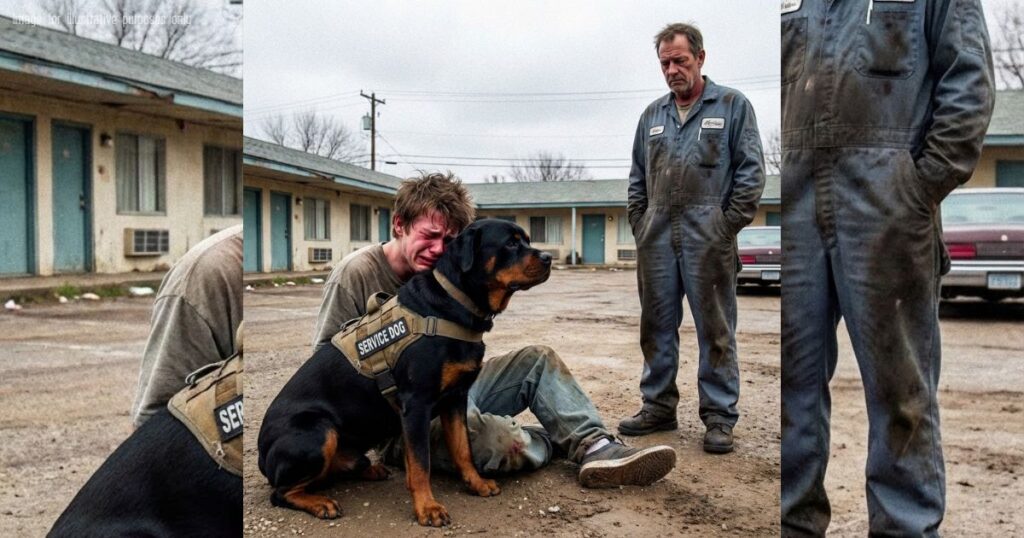
A young veteran—one arm, haunted eyes—dropping to his knees as Gunner presses into him like a living anchor.
And the caption stamped across the top in angry, bold text:
“OLD MAN RUNNING A DOG SCAM? WATCH THIS.”
My chest goes cold.
The comments are already exploding.
Half of them are laughing.
Half of them are furious.
Some are calling Dad a saint.
Others are calling him a con artist.
And sprinkled between them like broken glass are the worst kind of opinions—people who don’t know the story but are sure they know the truth.
“Service dogs aren’t supposed to look like that.”
“That vest could be fake.”
“Why is the kid living in a motel?”
“If he’s really a veteran, where’s the help?”
“Why should we feel bad? Everybody has problems.”
“This is exactly why you don’t bring ‘aggressive’ dogs into neighborhoods.”
And then the line that makes my hands start shaking:
“Call animal control. He’s endangering the community.”
Dad walks into the kitchen, sees my face, and doesn’t even ask.
He just takes the phone and watches the video one time.
He doesn’t react the way I expect.
No rage.
No panic.
Just a long, tired exhale like he’s been carrying this moment on his back for years.
“They finally caught me,” he says.
“Dad,” I choke out. “They’re going to come after you.”
He sets the phone down carefully, like it’s a weapon.
“Let them,” he says. “But they don’t get the kids.”
“What kids?”
Dad’s eyes harden.
“The ones in those motel rooms,” he says. “The ones who don’t want to be seen.”
He turns to the living room.
Diesel is standing in the doorway, watching us.
Not snarling.
Just watching.
As if he can feel the storm building in the air.
That afternoon, it hits.
Not lightning.
Knuckles.
A hard knock on the door that makes Diesel’s body snap tight.
Click the button below to read the next part of the story.⏬⏬