Dad holds up a hand—steady, calm—and Diesel stays.
Two people stand on the porch.
Not cops.
A county worker in a plain jacket, clipboard in hand.
And a woman with her hair pulled back, eyes tired, wearing the look of someone who’s spent her life trying to help people who don’t trust help anymore.
“My name is Tessa,” the woman says. “I’m with a local support group for returning service members.”
Dad’s jaw clenches.
“We don’t do interviews,” he says flatly.
“It’s not an interview,” she replies. “It’s a warning.”
The county worker clears his throat.
“We’ve received multiple complaints,” he says. “About unlicensed boarding. About aggressive animals. About—”
“About gossip,” Dad cuts in.
Tessa steps forward, lowering her voice.
“That video is spreading,” she says. “People are saying you’re selling dogs. People are saying you’re running a ‘fake service dog pipeline.’”
My cheeks burn.
“That’s insane,” I snap. “He’s giving them away.”
Tessa’s eyes flick to me. Soft. Understanding.
“I know,” she says. “Some of my people have one of his dogs. I’m not here to accuse him.”
She looks at Dad like she’s trying to see past the stone.
“I’m here because the internet doesn’t care about truth,” she says. “It cares about a story that makes people feel righteous.”
The county worker shifts awkwardly.
“We’re not saying you’re doing something criminal,” he adds quickly, like he’s trying to keep everything tidy and safe. “But we do need to verify compliance with county animal welfare guidelines.”
Dad laughs once.
Not humor.
Bitter.
“You mean you need a box checked,” he says. “A form signed. A label slapped.”
The county worker opens his mouth, then closes it.
Tessa keeps her eyes on Dad.
“Arthur,” she says gently, like she knows his name from mouths that said it with gratitude. “If you want to keep doing this, you can’t do it alone anymore.”
Dad stiffens.
“I do it alone because it’s cleaner,” he says. “No spotlight. No pity. No speeches.”
“It’s not about spotlight,” she insists. “It’s about protection. For you. For them.”
Dad’s gaze flicks back to Diesel.
Then to the street, where a car slows down, like it’s deciding whether to stop and stare.
“You want to protect them?” Dad says quietly. “Stop people from turning their pain into content.”
Tessa flinches, because it’s true.
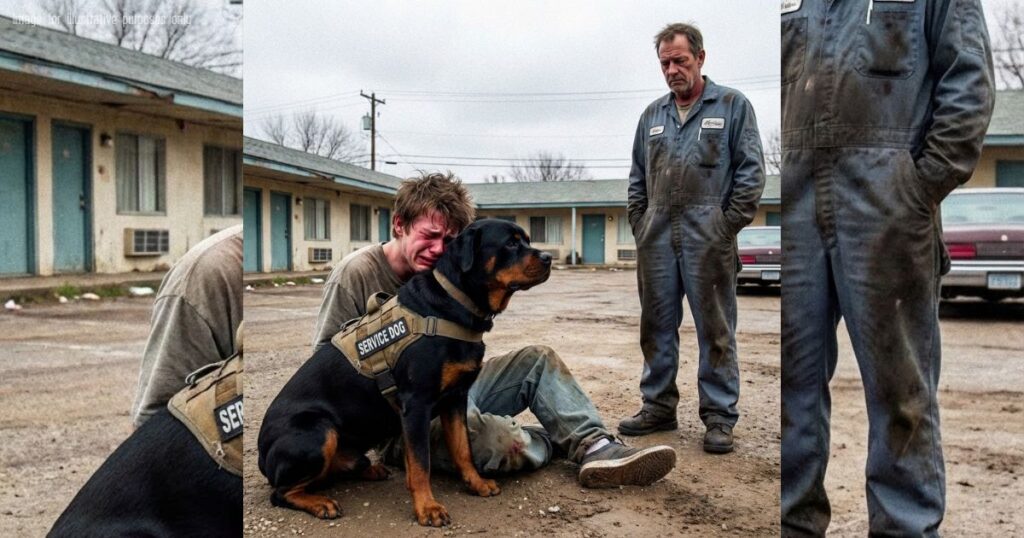
Somebody filmed a young man breaking down in the dirt and called it a scandal.
Somebody watched a moment of survival and decided the most important thing was a caption.
The county worker scribbles something.
“We can schedule an inspection,” he says. “And we’ll need documentation if any of these dogs are being placed as service animals—training records, evaluations, placement agreements—”
Dad’s mouth tightens.
“You’re worried about paperwork,” he says. “I’m worried about bodies.”
Silence.
Even Diesel stops breathing so loud.
Tessa steps closer until she’s almost inside the doorway.
“Arthur,” she says softly. “You can be right about the mission and still get shut down by the rules.”
Dad’s eyes flash.
“And you can be right about the rules and still be wrong about the people,” he fires back.
That’s the line.
That’s the line I know would light the comments on fire if anyone heard it.
Because America loves rules until rules start looking like indifference.
America loves heroes until heroes don’t come with a logo and a press release.
Tessa turns her head slightly, lowering her voice even more.
“One of my guys,” she says, “the one from Room 12… he’s scared.”
My heart jumps.
“The kid?” I ask. “Why?”
“Because now people are asking questions,” she says. “They’re saying his dog might not be ‘legit.’ They’re staring at him in stores. They’re challenging him. Filming him.”
Dad’s face goes pale in a way I’ve never seen.
He grips the doorframe like he needs it to stay upright.
“They’re doing that to him?” he whispers.
Tessa nods.
“He told me he finally slept a full night,” she says. “And then he woke up to strangers arguing about whether he ‘deserves’ help.”
A sound escapes my father’s throat—half breath, half grief.
“Deserves,” he repeats, like the word tastes rotten.
He looks down at his hands.
Hands that fixed engines.
Hands that lifted broken dogs.
Hands that have probably held more sorrow than most people can imagine.
Then he looks at me.
And for the first time since I started following him, I see fear in his eyes.
Not fear of getting caught.
Fear of being too late.
“If they take this from them,” he says quietly, “some of them won’t make it.”
Tessa nods again, her eyes shining.
“That’s why I’m here,” she says. “We can create a structure. A shield. A way to keep the mission alive without turning your porch into a target.”
Dad stares past her, out at the street.
Another car slows.
A phone glints in the sunlight.
My stomach twists.
“Dad,” I say, voice breaking, “we should go public. Tell the truth. Show people what you do.”
He turns slowly, and the look he gives me is almost angry.
“No,” he says.
“Why not?” I plead. “If people knew, they’d stop—”
“They won’t stop,” he cuts in. “They’ll just come closer.”
He points at Diesel.
“They’ll want a story,” he says. “A face. A before-and-after. A clip that makes them cry for fifteen seconds.”
He taps his chest once.
“And then they’ll scroll.”
His voice drops to a whisper.
“My dogs aren’t content,” he says. “And those kids aren’t inspiration.”
He leans closer to me, eyes wet but fierce.
“They’re human beings fighting to stay here,” he says. “And if we turn that into a show… we don’t save them. We sell them.”
The porch is dead quiet.
Even the county worker stops writing.
Tessa looks at Dad like she’s never respected someone so much and been so frustrated at the same time.
“Then what do we do?” I ask.
Dad doesn’t answer right away.
He looks down at Diesel, who has edged closer without anyone noticing.
The dog’s head is low.
Not submissive.
Listening.
Waiting.
Dad reaches out, slow, and Diesel doesn’t flinch.
Dad’s fingers rest on Diesel’s neck like a promise.
Then Dad looks up at the street again, at the watching, the filming, the hunger for scandal.
His jaw sets.
“We keep working,” he says.
“And if they come?” I ask.
Dad’s eyes harden into something old and unmovable.
“Then they’ll have to look me in the face,” he says. “Not a caption.”
He steps back inside, shutting the door with a soft click.
Not a slam.
A boundary.
Then he turns to me and speaks the words that make my blood run cold:
“Get your shoes on, son,” he says. “We’re going to the motel.”
I freeze.
“Why?”
Dad’s voice is low.
“Because if people are filming him,” he says, “it means someone found him.”
He grabs his keys.
His hands are steady again, but his eyes aren’t.
“And when the world starts circling a wounded kid,” he says, “it doesn’t circle to help.”
Diesel lets out one single, quiet sound—almost a whine, almost a warning.
Dad opens the door.
And out on the street, another car stops.
This time, it doesn’t just watch.
The driver gets out.
And starts walking toward my father’s porch.
Thank you so much for reading this story!
I’d really love to hear your comments and thoughts about this story — your feedback is truly valuable and helps us a lot.
Please leave a comment and share this Facebook post to support the author. Every reaction and review makes a big difference!
This story is a work of fiction created for entertainment and inspirational purposes. While it may draw on real-world themes, all characters, names, and events are imagined. Any resemblance to actual people or situations is purely coincidenta