Part Two – The Day My Son Tried To Inherit Me Alive
By the time you finish this, you’ll have decided if I’m a selfish old landlord stealing my son’s future… or a stubborn old fool trying to protect a neighborhood that doesn’t belong to me alone.
Either way, you won’t be neutral.
I didn’t make it half a block from The Forge before my knees reminded me that I’m not thirty anymore.
The sidewalk in the Ironworks District isn’t friendly to old joints. The city laid fancy pavers a few years back—uneven, expensive bricks that look good on brochures and twist ankles in real life. I walked slowly, one hand on the wall of a building I also happened to own, though nobody passing by would’ve guessed.
A group of young people hurried past with cameras and ring lights, talking about “content” and “engagement.” One of them almost bumped into me, mumbled an apology without really looking, then kept filming herself saying something about “authentic urban vibes.”
I chuckled.
Authentic. If only she knew who put the first safe exit lights in this alley so people could walk here at night.
My phone buzzed in my pocket. An old flip phone. The kind Jason makes fun of.
I flipped it open.
“Dad? Where are you?” Jason’s voice crackled through, clipped and tight.
“Walking home,” I said.
“You walked out on me in there. You can’t do that. We… we need to talk about what you told Mike. About… ownership.”
“We’ll talk when I get home,” I said. “You remember where that is, don’t you?”
He exhaled sharply. “This isn’t fair, Dad. You blindsided me.”
“Son,” I said, “you tried to blindfold me and drive me out of my own life. We’re even for the day.”
I hung up.
Maybe that was petty. But let me tell you something nobody puts on inspirational posters: old age doesn’t erase the part of you that gets angry. It just gives you less time to pretend you’re not.
By the time I reached my street, the sun was low, painting the old houses in that soft, forgiving light that makes peeling paint look nostalgic instead of neglected.
My house sat where it always has, stubborn and oddly shaped, like a man who refuses to tuck in his shirt for company. The porch sagged a little. The gutters needed cleaning. The oak in the front yard had a broken limb from the last storm I still hadn’t cut down.
I loved it so much it hurt.
Mrs. Alvarez from two houses down was watering her roses. She lifted a hand when she saw me.
“Frank! They said you were sick.” Her eyes scanned me, checking for missing parts.
“Still all here,” I said. “My son tried to kidnap me with good intentions. That’s all.”
She snorted. “That boy doesn’t know what to do with good intentions if they don’t earn interest.”
I didn’t answer. It stung because there was some truth in it.
“Are you coming by Sunday?” she asked. “The kids are doing their little neighborhood market again. Mike said he’d bring over leftover muffins from the shop.”
I nodded. “Wouldn’t miss it.”
Community. That was the word everyone on Jason’s side of town liked to print on banners and mission statements.
Out here, it was just what you did on Sundays.
Jason’s car was already in my driveway.
He was pacing on the porch, suit jacket off, tie loosened, sleeves rolled up like he was about to renovate something. I knew he wasn’t.
“Dad,” he said the second I stepped onto the cracked path. “We can’t just leave things like this.”
“I agree,” I said, walking past him to unlock the door. The key stuck in the old brass lock the way it always does when it rains. I jiggled it exactly the right way. Once, twice, twist.
The mechanism gave with a familiar click. I stepped into my own air: motor oil, old wood, coffee, dust, and something else I can only describe as time.
He followed me in.
“Sit down,” I said.
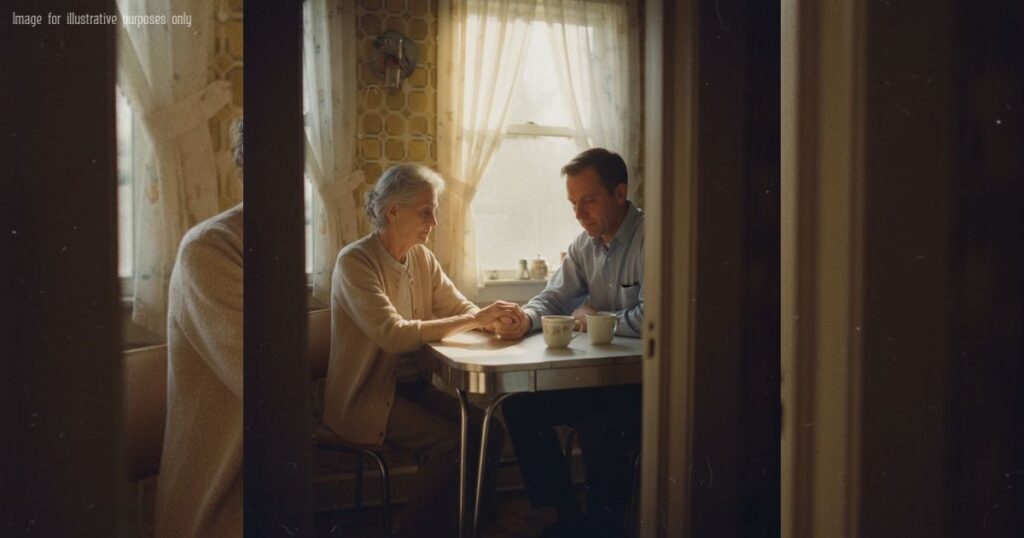
He didn’t. He hovered by the kitchen table, eyes taking in the clutter as if seeing it for the first time.
“You could at least hire someone to clean,” he muttered.
“I know where everything is,” I said. “If someone cleans, I lose half my tools and most of my memory.”
He blew out a breath, trying to reset himself into professional mode.
“Okay. Let’s be systematic,” he said. “You own—what—The Forge building, the gallery, the old print shop, the row of brick townhomes on Harper, the warehouses on 9th—”
“Half that block is in a joint trust,” I said. “I’m the managing trustee.”
He stared. “With who?”
“People who were here when the roofs leaked and the rats were the only paying tenants,” I said. “Folks who put sweat equity in before the word ‘equity’ became a magic spell.”
He opened his tablet, fingers flying. “Jesus, Dad. Do you even understand the numbers here? This portfolio—”
“Don’t call my neighborhood a portfolio,” I snapped.
He flinched, then forced a calm voice back into place.
“Fine. Your… neighborhood,” he said. “Dad, do you know what this is worth? On paper, you’re—”
“Don’t say it,” I warned.
“—you’re sitting on tens of millions,” he finished anyway. “And you live like this? Fixing people’s fans for free? Charging below-market rent because you don’t like seeing spreadsheets?”
“Because I remember their kids’ names,” I said quietly. “Because I remember when Mrs. Lane at the gallery pawned her wedding ring to pay the first month’s rent twelve years ago. Because you can’t rebuild a culture in a building once you’ve evicted it.”
He rubbed his face.
“This is exactly the problem,” he said. “You’re emotional about assets.”
“And you’re emotionless about people,” I replied.
We stood there, two stubborn men with the same jawline, separated by forty years and a dining room table scarred by decades of use.
“Why didn’t you tell me?” he asked finally, voice softer. “About… all of this.”
“Because you started talking about everything in return-on-investment percentages before you were thirty,” I said. “Because you told me once that if a property didn’t ‘perform,’ you didn’t get attached.”
He frowned. “I never said that about homes, Dad. I said that about office complexes.”
“You said it about anything with a deed,” I said. “And I noticed how you looked at my house when the neighborhood started changing. Like it was a missed opportunity.”
He didn’t deny it.
“Look,” he said, switching tactics, “I get that you care about these people. But you can’t live forever. When you’re gone, what happens? You die, the trust transfers, and if there’s no plan, the courts decide. Do you want the city involved? Some stranger? I could manage it with intention. I could keep your rules. Heritage clauses, whatever you want. But I need control to protect what you built.”
I walked to the small cupboard by the fridge. There, behind a box of ancient tea bags, was a battered metal tin that once held cookies.
Inside: envelopes. Keys. Papers. A life, sorted in my own way.
I pulled out a thick envelope and set it on the table between us.
“There is a plan,” I said. “You just weren’t in it the way you assumed.”
His eyes narrowed.
“What is that?”
“My living trust,” I said. “Updated last year. Witnessed. Notarized. Reviewed by a lawyer whose idea of ethics isn’t spelled with a dollar sign.”
He didn’t touch it. “And it says… what?”
“That the buildings hold a Heritage Covenant,” I said. “They can’t be sold to large corporations or investment funds. They can’t be converted into short-term rentals. They can’t triple the rent overnight because someone decides the neighborhood is suddenly fashionable.”
He stared at me like I’d grown another head.
“Dad. That’s… you’re handcuffing future value.”
“I’m handcuffing future greed,” I corrected. “After I die, the properties transfer to a community land trust. The tenants and small business owners elect a board. They decide on improvements, repairs, rent adjustments, all with caps tied to real wages, not just ‘market trends.’”
His face drained of color.
“You’re… giving it away?” His voice cracked on the last word. “All of it?”
“Not all,” I said. “You’re not cut out of my life, Jason. You’re cut out of owning people’s roofs as a revenue stream.”
His eyes glistened with something between rage and hurt.
“So what do I get?” he asked, and that small, blunt question cut me more than anything.
Click the button below to read the next part of the story.⏬⏬