“A paid-off house in a quieter part of town that I bought in your name years ago,” I said. “Enough cash to clear your student loans if you still have any hidden. A cushion. I don’t want you poor, son. I just don’t want you rich off evictions.”
He laughed once, bitter.
“Do you hear yourself? You’re making me the villain of a story you already wrote in your head.”
“Maybe,” I admitted. “But today, you did drive me toward a facility you never even asked if I wanted. You did talk about my home like it was a liability. I didn’t make that up.”
He sank into a chair, finally sitting.
“I was trying to protect you,” he muttered.
“You were trying to protect your schedule,” I said. “There’s a difference.”
Silence stretched between us.
The next day, trouble came to my door wearing a polo shirt and a polite smile.
He arrived with a woman carrying a tablet and a badge that said “Care Coordination Services.” They stood on my porch like a matched set.
“Mr. Rivas?” the woman asked. “We’re here to do a wellness check. We received a report that you might not be safe living alone or managing your own affairs.”
It doesn’t take a “Distressed Asset Consultant” to guess who made that call.
“Come in,” I said.
They looked surprised.
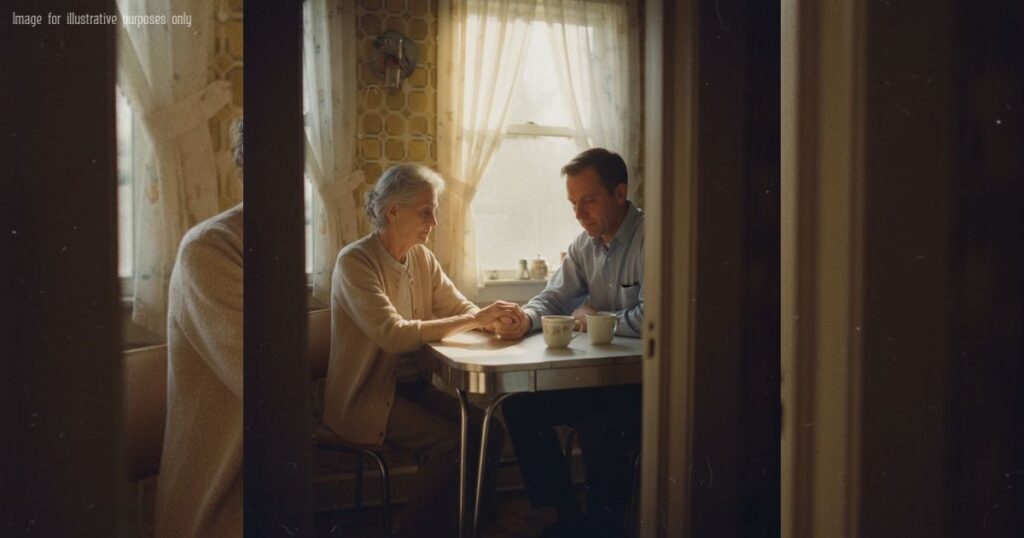
Most people, I guess, fight this kind of thing. Slam doors. Shout about rights. I simply pulled out two chairs at my kitchen table and put on a pot of coffee.
If you’re going to question my competence, you can at least do it over something warm.
They asked me all the standard questions. The date. The current president. My address. My medications. I answered them clearly, maybe with a little extra flourish just to prove a point.
Then the man tried a different angle.
“We’re also concerned about financial exploitation,” he said gently. “You have substantial assets?”
“Depends on who’s counting,” I said. “I own some buildings. I maintain them. My tenants sign leases voluntarily. Nobody’s being shaken down under the streetlight.”
He nodded. “Your son contacted us. He’s worried someone is influencing you. That perhaps you’re making decisions under duress.”
“Someone is influencing me,” I said. “Everyone whose rent I’ve ever kept steady when the market said I could hike it. Every kid who grew up in those apartments and sends me graduation photos. Every small business that survived a recession because I gave them three months grace and a repaired sink. That’s my duress.”
The woman’s lips twitched like she was trying not to smile.
“Look,” I continued, “I understand your job. There are elders in real danger out there. People stolen from, tricked, abandoned. I’m not mocking that. But this is not that story. This is a story about a father who didn’t tell his son how much he built because he was afraid his son would turn it into an abstraction.”
They left after an hour. No emergency guardianship. No court orders. Just a few notes on a form and, if I’m not mistaken, a little more respect in their eyes than when they arrived.
The real storm didn’t start until Sarah came by after her shift.
She showed up with a box of pastries and that look young people get when they’re about to suggest something outrageous.
“So,” she said, dropping into my armchair like she’d always lived there, “Mike told me what happened at the shop. And about Jason. And about the land trust. And about the… what did they call you on that blog?”
I frowned. “What blog?”
She grinned and pulled out her phone.
On the screen was a photo of me from behind, at The Forge counter. My hunched shoulders, my flannel shirt, my oil-stained hands resting on the wood I’d planed years before. Someone had taken the picture that day.
Above it, a headline:
“The ‘Silent Landlord’ Who Refuses To Sell To Chains: Saint Or Problem?”
I squinted at the comments. Hundreds of them.
Some were calling me a hero, a guardian of the old neighborhood.
Others were calling me the problem, an older owner “hoarding real estate” and “distorting the market” by refusing to “unlock value” and let “modern development” come in.
A few were accusing me of being selfish for not giving everything to my son.
Nobody, I noticed, had actually talked to me before forming a strong opinion.
“That’s how the internet works,” Sarah said, reading my face. “But you know what I think? You should answer them.”
“I don’t have an account,” I said. “Or a… handle. Or whatever you call it.”
“I’ll help you,” she said. “You dictate. I type. Your words, my thumbs.”
I thought about it.
I’ve spent my whole life turning wrenches instead of writing essays. But if strangers were going to argue about me, it seemed fair to at least introduce myself to the conversation.
“Fine,” I said. “But I’m not picking a fight.”
“Good,” she said. “Just tell the truth.”
We worked on that post for nearly two hours.
I spoke slowly, Sarah’s fingers flying across the screen, occasionally stopping to ask, “Are you sure you want to say it like that?” or “Can you explain that part again? People my age don’t know what a freight elevator brake shoe is.”
I started with the basics. My name. The fact that I’ve been a mechanic longer than most commenters had been alive. The story of buying dead buildings not because I saw dollar signs, but because I couldn’t stand watching something solid rot when it could be repaired.
Then I got to the part that made Sarah’s eyebrows climb.
Here is, more or less, what we sent out into the world:
“I have one son. He is smart, successful, and believes deeply in efficiency. He drove me today to a place he’d chosen for me to grow old in, without giving me a tour first. He did this because he thinks comfort should be scheduled and outsourced like a service.
I turned the car around without touching the wheel.
If you read this and think, ‘That ungrateful son just wants his inheritance,’ I want you to know it’s more complicated than that. I was not a perfect father. I missed school plays. I worked double shifts. I didn’t talk about my feelings. I talked about torque ratios.
But here is the line I will not cross:
My child is not entitled to the roofs over other people’s heads.
If that makes me a bad father to some of you, so be it. If you believe your parents’ main job is to die on a schedule that maximizes your personal wealth, this story will make you hate me.
I didn’t build an empire. I fixed broken things until they worked again and let other people live and work inside those repairs.
That’s my legacy. Not a check with my last name on it.”
Sarah finished typing, read it back, and looked at me.
Click the button below to read the next part of the story.⏬⏬