“You sure?” she asked. “People are going to fight in the comments for days.”
“Good,” I said. “Maybe somewhere in that fight, someone will think for five minutes before they drop their father at a facility because the lawn looked messy.”
She hit post.
The next evening, Jason came back.
No car in the driveway this time. He walked. That alone worried me more than any wellness check.
He stood in the doorway, holding his phone like it was a piece of evidence.
“So,” he said without greeting, “you decided to put our family business online.”
“Our family business?” I repeated. “For forty years, it was just mine until you tried to drive it to Silver Meadows.”
He winced at the name.
“Do you have any idea what’s happening in those comments?” he asked. “People are threatening me based on a story they only know your side of. People are calling you a saint, calling me a vulture, calling for laws to ‘protect communities from heirs.’”
“I didn’t ask them to,” I said. “I wrote about my choices. Not about what anyone should vote for.”
His jaw tightened. “Screenshots live forever, Dad.”
“So do evictions,” I replied.
We stared at each other, both tired.
“I’m not here to fight,” he said eventually, surprising me. “I’m here because… some of what you wrote hurt. And some of it… made sense. And I hate that both can be true at the same time.”
I gestured to the chair. He sat.
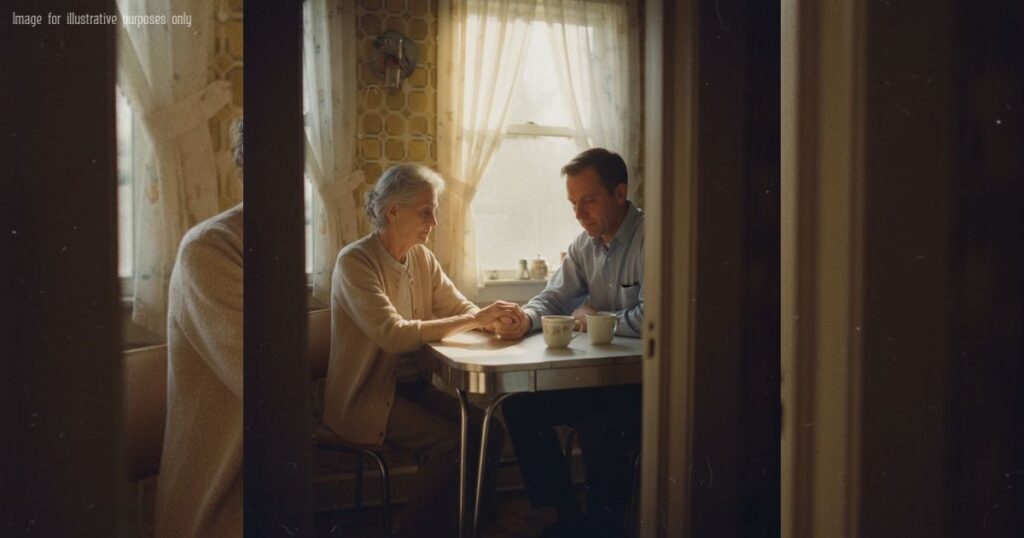
“When Mom got sick,” he said quietly, “I watched you wear yourself out taking care of her. You carried everything. You refused help. After she died, you shrank into this house like a turtle. I thought if I didn’t take control, I’d end up watching you die piece by piece in a place no ambulance could find in time.”
“I remember,” I said. “I also remember you telling me you didn’t have time to meet with the hospice nurse because of a ‘critical closing.’ We both made choices we’re not proud of.”
He swallowed.
“I’m not good with… this,” he said, waving a hand between us, as if emotions were a fog. “Numbers make sense to me. Deals make sense. Feeling like the villain in front of a million strangers doesn’t.”
“You’re not the villain,” I said. “You’re the representative of an idea. The idea that people are supposed to ‘scale’ everything—business, charity, even love—until it fits a model.”
“And you’re representing what?” he asked. “Nostalgia? Stagnation?”
“Resistance,” I said. “To the idea that everything has to be optimized for growth.”
He looked at me for a long time.
“So that’s it?” he asked. “You die, the neighbors get the buildings, I get a starter home and a moral lesson?”
“You get a choice,” I said. “And an opportunity. If you want a role in the trust, it’s possible. But not as owner. As steward.”
He frowned. “What does that even mean?”
“It means,” I said, reaching into the cookie tin again, “you show up.”
I dropped a heavy ring of keys onto the table. Old brass, new steel, tags with address numbers written in my terrible handwriting.
“These are master keys,” I said. “They open every back door, utility closet, and rattling basement where the real work happens. If you want to be part of this after I’m gone, you start now.”
“Doing what?” he asked.
“You spend a year,” I said, “coming with me twice a week. We fix leaky sinks. We clear clogged gutters. We check boiler rooms. We share coffee with tenants. You learn which kid is terrified of the elevator and which old man on the third floor forgets his stove on. You learn why raising rent forty percent on paper means someone’s grandmother has to move an hour away from her doctor.”
He stared at the keys like they were radioactive.
“That’s not… what I do,” he said weakly.
“That’s why it’s a test,” I replied. “At the end of the year, the board will decide if you get a vote. Not me. Them. Because it’s their lives this trust touches.”
“And if I say no?” he asked.
“Then you walk away with a house, some money, and your Saturday mornings free,” I said. “And I hope you live a long, comfortable life closing deals that make sense to you.”
He sat there, wrestling with something no spreadsheet could solve.
“People online are saying I’m entitled,” he said finally.
I shrugged. “People online say a lot of things. I’m asking what you want to say about yourself.”
He picked up the keys.
They were heavier than any contract he’d ever signed.
“I’ll come Sunday,” he said, not quite looking at me. “For the neighborhood market. You can… show me where the circuit breakers are.”
I nodded, keeping my face neutral even as something uncurled in my chest.
“Bring clothes you can ruin,” I said. “And shoes you’re not afraid to get dirty.”
He almost smiled. Almost.
I don’t know how this story ends.
Maybe Jason lasts two weeks and decides community stewardship doesn’t earn enough bonus points. Maybe he surprises me. Maybe the internet forgets about us tomorrow, and the only people who remember the Silent Landlord and his consultant son are the kids who used to play in these alleys and the barista who typed my first and last viral post.
But here is what I know:
If you read all this and feel angry at me, ask yourself why.
If you read all this and feel angry at Jason, ask yourself if you’ve ever looked at an aging parent and seen more burden than person.
And if you read all this and think, “My family would never do that,” call your mother. Call your father. Ask what they actually want, not what makes your life easiest.
Jason thought he was driving me to an ending.
He was really just giving me one last chance to choose the kind of beginning I left behind.
Legacy isn’t a fortune you distribute when someone’s heart stops. It’s the habits you pass on while it’s still beating.
And as long as mine keeps thudding along—arthritic, stubborn, loud—I’m going to keep handing out keys instead of contracts and hoping the next pair of hands knows the difference between owning a building and belonging to a place.
Thank you so much for reading this story!
I’d really love to hear your comments and thoughts about this story — your feedback is truly valuable and helps us a lot.
Please leave a comment and share this Facebook post to support the author. Every reaction and review makes a big difference!
This story is a work of fiction created for entertainment and inspirational purposes. While it may draw on real-world themes, all characters, names, and events are imagined. Any resemblance to actual people or situations is purely coincidenta