The temperature gauge on my dash read twenty below zero. Out here, that’s not just weather; that’s a death sentence. And the kid in the ditch was dressed for a coffee shop, not a funeral.
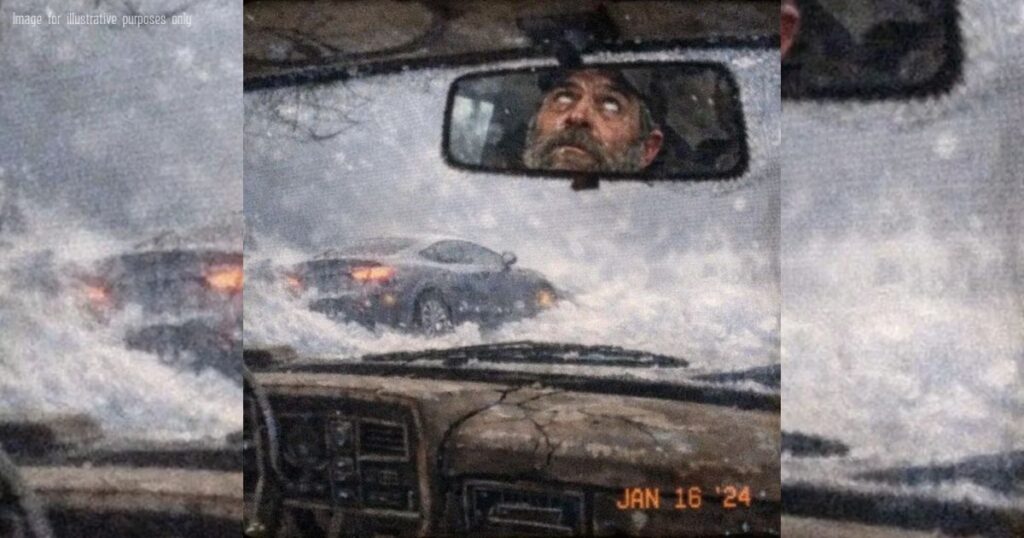
I almost didn’t see him. The North Dakota wind was whipping snow across Interstate 94 in white sheets, turning the highway into a blurring tunnel of gray. I was driving my twenty-year-old pickup, a rusted beast that smelled of diesel and wet dog, crawling along at thirty miles an hour.
Then I saw the flash. Not a flare, but the weak, rhythmic blink of a hazard light.
It was a car. Or at least, it looked like a spaceship that had crash-landed in a snowbank. One of those sleek, silent electric sedans with flush door handles and a glass roof. It was nosediving into the borrow pit, buried up to the wheel wells.
I took my foot off the gas.
I’ll be honest: for a split second, a dark, cynical part of me wanted to keep driving. I was tired. My back ached from a twelve-hour shift at the plant. And when I saw that car, I immediately pictured the driver. Probably some city kid passing through, trusting his navigation screen more than his eyes, driving on tires meant for California asphalt, not Dakota ice. We live in two different Americas, he and I. We vote differently, we eat differently, we speak differently.
But then the wind shook my truck, a violent remind of where we actually were. Out here, the wind doesn’t care about your zip code. It doesn’t care about your politics. It just wants to kill you.
I pulled over, grabbed my heavy canvas coat, my gloves, and the tow strap from the back seat.
The walk to his car was only twenty yards, but the cold hit me like a physical blow. It was the kind of cold that freezes the moisture inside your nose instantly.
I reached the sedan. The windows were iced over. I knocked hard on the glass.
The window slid down an inch. No heat came out. The car was dead.
Inside sat a young man, maybe twenty-five. He was wearing a thin hoodie and a beanie. He was shaking so hard his teeth were audibly chattering. His face was a pale, waxen gray. He held his phone up, tapping furiously on a black screen.
“Dead,” he stammered, his voice thin and panicked. “Everything is dead. The battery… the cold drained it. I can’t… I can’t feel my feet.”
“Unlock the door,” I yelled over the wind.
He fumbled with the latch. I had to yank the door open against the snowdrift.
“Get out,” I said.
He looked at me with wide, terrified eyes. “My… my roadside assistance app… it said help is coming in four hours.”
“Son,” I grabbed him by the shoulder of his flimsy hoodie. “In four hours, you’ll be a statue. Get in my truck.”
He stumbled out, falling twice in the knee-deep drifts. I basically dragged him to the passenger side of my pickup and shoved him inside. I cranked the heat up to the max.
When I climbed in the driver’s side, he was hunched over, hugging himself, staring at the vents like they were a religious shrine.
“Thank you,” he whispered. “I… I didn’t think anyone would stop.”
I poured coffee from my thermos into the cup cap and handed it to him. “Drink. Don’t spill it.”
We sat there for ten minutes while he thawed out. I learned his name was Liam. He was a software engineer from Seattle, driving cross-country to surprise his fiancée in Minneapolis for the weekend. He’d planned his route perfectly, calculating charging stops down to the mile.
“The algorithm said I could make it to Fargo with 12% to spare,” Liam said, staring at his hands, which were slowly turning pink again. “But the wind… the heater… the battery just dropped like a rock.”
“Algorithms don’t account for a Dakota headwind,” I said quietly. “And batteries hate the cold. You can’t code your way out of a blizzard, Liam.”
He looked at me, really looked at me, for the first time. He took in my grease-stained jacket, the pile of tools on the floorboard, the country music playing low on the radio. I saw the hesitation in his eyes—the same hesitation I had felt earlier. The realization that he was sitting next to a man he probably mocked on social media.
“So,” I said, breaking the tension. “We need to get your car out. If we leave it, the plows will bury it, and you won’t find it until spring.”
“It’s dead weight,” he said hopelessly. “It weighs five thousand pounds.”
“I’ve got a chain,” I said. “And I’ve got four-wheel drive. But I need you to steer.”
“I… I don’t know if I can.”
“You don’t have a choice.”
We went back out. The wind seemed to have gotten angrier. I hooked the heavy chain to his tow point. My fingers were numb within seconds. I handed him a shovel I kept in the truck bed.
“Dig out the back tires,” I ordered.
He looked at the shovel like it was an alien artifact. But he took it. He was clumsy, slipping and sliding, his expensive sneakers useless on the ice. But he dug. I watched him struggle, sweat freezing on his forehead. He wasn’t complaining. He was fighting.
I got in my truck, put it in low gear, and waited for his signal. We spent the next twenty minutes in a brutal dance of physics. The tires spun. The chain pulled taut. The electric car groaned.
Finally, with a sickening lurch, the sedan popped out of the ditch and onto the shoulder.
We unhooked the chain in silence. We were both exhausted, breathing hard, white clouds of vapor exploding from our mouths.
He looked at his car, then back at me. “It’s still dead. I can’t drive it.”
“I know,” I said. “I’m towing you to the next exit. There’s a truck stop with a charging station and a motel. It’s five miles.”
The drive was slow. I watched him in my rearview mirror, steering his silent, dark vehicle, following the taillights of my rusted truck.
When we got to the truck stop, we managed to push his car to the charger. As soon as he plugged it in, the screen flickered to life.
He stood there for a moment, shivering, then walked over to me. He pulled out his wallet.
“Sir, I want to pay you,” he said. “I have cash, or I can Venmo you. Seriously. You saved my life. Two hundred? Three hundred?”
I looked at the crisp bills in his hand. I needed that money. My transmission has been slipping, and rent is up again.
But I shook my head.
“Put that away,” I said.
“Please,” he insisted. “Why? Why did you stop? You don’t know me. I’m just some idiot who thought he knew everything.”
I leaned against the door of my truck. The storm was howling around the canopy of the gas station, but under the lights, it felt quiet.
“Look, son,” I said. “You watch the news, right? You see people like me screaming at people like you. You see people like you calling people like me obsolete.”
He nodded slowly.
“It’s easy to hate people when they’re just pixels on a screen,” I told him. “It’s easy to think you don’t need anyone when the sun is shining and the Wi-Fi is working. But out there?” I pointed to the dark highway. “Out there, the signal dies. The battery dies. The status updates don’t matter.”
I zipped up my coat.
“In the cold, there are no red states or blue states,” I said. “There’s just the guy in the ditch, and the guy with the chain. Today, you were in the ditch. Tomorrow, it might be me. That’s how this works. That’s the only way this works.”
Liam stood there, stunned. He looked down at his boots, soaked through with snow, then looked me in the eye. He extended a hand. It wasn’t the weak, polite handshake of a corporate meeting. He gripped my hand hard.
“Thank you,” he said. “I won’t forget this.”
“Get warm,” I said. “And get some snow tires.”
I climbed back into my truck and pulled onto the highway. The storm was still raging, but the cab felt a little warmer than before.
We spend so much time building walls, convinced that we are safer alone, or only with “our own kind.” We think technology has made us independent. But the truth is, we are all just one dead battery, one wrong turn, one bad storm away from needing a stranger’s hand.
We aren’t as divided as they want us to believe. We’re just cold. And the only way to survive the winter is to keep the fire lit for each other.
Drive safe out there. You never know who you might need to pull out of a ditch.
—
Part 2
I thought leaving Liam under the truck stop lights was the end of it.
That’s how those moments are supposed to work, right? A stranger pulls another stranger out of the ditch, they shake hands, and the universe closes the file like it never happened.
But the truth is, the cold doesn’t just freeze your fingers.
It freezes stories into people. It welds them together.
And sometimes—whether you like it or not—it drags your private life right out onto the shoulder where everybody can rubberneck.
Two hours after I dropped him off, I was back on the highway, my wipers thumping like a tired heartbeat. The storm had thickened. Snow came in sideways sheets that made the world look like an old TV with the antenna half-broken.
My truck felt like it had aged ten more years in those ten miles.
Every time I touched the wheel, I could still feel the
Click the button below to read the next part of the story.⏬⏬