Part 2
I thought leaving Liam under the truck stop lights was the end of it.
That’s how those moments are supposed to work, right? A stranger pulls another stranger out of the ditch, they shake hands, and the universe closes the file like it never happened.
But the truth is, the cold doesn’t just freeze your fingers.
It freezes stories into people. It welds them together.
And sometimes—whether you like it or not—it drags your private life right out onto the shoulder where everybody can rubberneck.
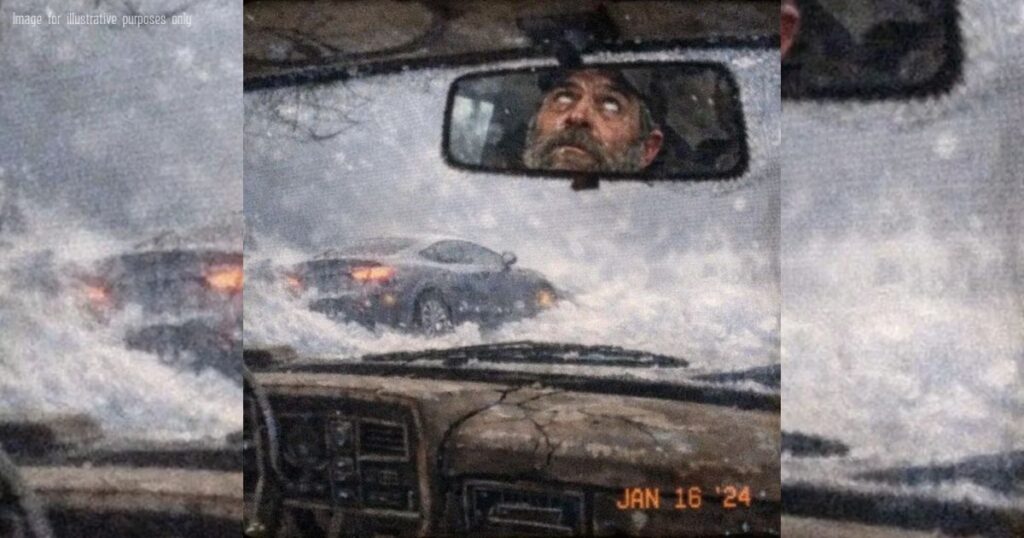
Two hours after I dropped him off, I was back on the highway, my wipers thumping like a tired heartbeat. The storm had thickened. Snow came in sideways sheets that made the world look like an old TV with the antenna half-broken.
My truck felt like it had aged ten more years in those ten miles.
Every time I touched the wheel, I could still feel the chain in my hands—the weight of it, the bite of it, the way cold steel doesn’t forgive you for being made of meat.
I drove home to a trailer park outside a town small enough that the only thing open past nine was a gas station and the bar next door. My place was a rectangle of thin walls and older smells: fried food in the curtains, dog shampoo in the carpet, machine oil in the air from my jacket.
I kicked snow off my boots and stepped inside.
The heat was on, but not the kind of heat you feel. The kind you pay for.
My daughter’s room was dark. She was asleep with her blanket kicked halfway off, one leg hanging out like she’d been fighting her dreams and lost. Her boots—her “winter boots,” if you can call them that—were by the door, split at the seam, duct tape holding the lie together.
I stood there, looking at them, and felt something twist in my chest.
Not guilt.
Not pride.
Just that quiet math you do when you’re a working person: boots cost money, money costs hours, hours cost your back, and your back is already overdue.
I sat at my kitchen table and poured the last inch of coffee from my thermos into a chipped mug. It tasted like burned metal and highway air.
I stared at my phone.
No messages. No calls.
Good. That’s how I wanted it.
Then I heard the wind slam into the side of the trailer so hard the whole place shuddered. It reminded me, all over again, of Liam’s face in that dead electric car—pale and scared, looking at his dark screen like it had betrayed him.
I leaned back in my chair.
I told myself: You did what you were supposed to do. That’s it.
Go to sleep.
At 3:17 a.m., my phone buzzed.
I almost ignored it. My eyes were gritty. My throat was dry. The kind of sleep you get after a twelve-hour shift isn’t sleep—it’s a blackout.
But the buzzing came again, and something in me knew it wasn’t a wrong number.
I picked up.
“Hello?”
A woman’s voice, tight and clipped, like she’d been talking to panicked people all night. “Is this the guy who towed the electric sedan in from the interstate?”
I sat up. “Who’s this?”
“Front desk. Truck stop off 94. The one by the motel.”
I rubbed my face. “Yeah. That was me.”
A pause. Paper shuffling. “The young man. Liam. He asked us to call if… if you left a number.”
I hadn’t.
But I guess in a place like that, people talk. A chain and an old pickup in a blizzard is the kind of thing that sticks in folks’ minds.
“What’s wrong?” I said.
“He’s okay,” she rushed. “He’s warm. He’s not—he’s not in danger like earlier. But he’s… upset. He says his car’s still not taking a charge right. He says the charger keeps stopping, and the motel’s full, and he’s supposed to be somewhere by morning.”
I closed my eyes.
I pictured him, standing under that fluorescent canopy, hands shaking, watching that little digital number crawl upward like a dying animal.
The cold doesn’t care if your car is gas or electric.
But the way people get stranded—yeah. That changes.
“Put him on,” I said.
There was a muffled sound, then his voice, raw with exhaustion. “Hey. It’s Liam. I— I’m sorry to bother you. I just—”
“You’re not bothering me,” I said, even though part of me wanted to throw my phone into the sink. “Talk.”
He swallowed hard. “It keeps stopping. The charger. It’ll run for a few minutes and then it errors out. I tried moving to another one and it did the same thing. The guy inside said maybe the cable’s frozen or the connector’s iced. I don’t— I don’t know. I’m not… I’m not built for this.”
“I told you,” I said, softer than I meant to. “You can’t code your way out of a blizzard.”
“I know,” he said. “I know. That’s why I’m calling. I don’t want to be alone with my own brain right now.”
That sentence landed heavier than the rest.
Because I knew that feeling.
Not the cold. Not the ditch.
The feeling of being alone with your own brain while the world presses in on the walls.
I swung my legs off the couch. My joints protested like old hinges.
“Alright,” I said. “I’ll come take a look.”
“You don’t have to,” he said quickly. “I mean, you already—”
“I said I’ll come,” I cut in. “Give me twenty minutes.”
When I hung up, I sat there for a moment in the dark, listening to the wind.
Then I looked toward my daughter’s room.
She shifted in her sleep.
I thought about the cash Liam held out earlier. Crisp bills. Easy. Warm.
I’d turned it down like a saint.
But I wasn’t a saint.
I was just stubborn.
And stubborn doesn’t buy boots.
The drive back to the truck stop was worse than the first time. The plows had come through, but it didn’t matter. The wind just shoved snow right back into the road like a bully.
When I pulled under the canopy, I saw Liam immediately.
He was standing by his car like a man guarding a campfire that refused to catch. Hoodie under a borrowed jacket from the motel—too thin, still. His beanie pulled low. His face lit up when he saw my truck, and for a second he looked like a kid who’d spotted his dad in a crowded store.
That look did something to me I didn’t like.
Because I didn’t want to be anybody’s hero.
I just wanted to get through winter.
I climbed out, my boots crunching on salted ice.
He jogged over. “Thank you. Seriously.”
“Show me,” I said.
He led me to the charger. The cable looked stiff, the kind of stiff that means the rubber isn’t rubber anymore. The connector had a crust of ice like it had been dipped in sugar.
Liam pointed at the car’s screen. “See? It starts, then stops. It says— it says there’s a fault.”
I bent down, blew on the connector, wiped it with my glove. Then I pulled my pocketknife out and carefully scraped the ice off the contact points, slow and steady.
Liam watched like he was witnessing a surgery.
“That… that’s all it takes?” he asked.
“Sometimes,” I said.
I plugged it back in.
The screen chirped. The charging icon lit.
We stood there, holding our breath, waiting for it to fail.
One minute.
Two.
Three.
The number ticked upward.
Liam let out a shaky laugh that sounded halfway like he might cry. “I hate that this works.”
I glanced at him. “What do you mean?”
He rubbed his face. “Back home, if something breaks, you call someone. Or you reset it. Or you update it. Everything’s… clean. Modular. You don’t scrape ice off a connector with a pocketknife.”
“Back home,” I said, “winter is an idea.”
He nodded slowly. “Yeah.”
We stood there another minute.
Then his phone buzzed.
He looked down, and I saw his expression change, like someone had turned the temperature inside him back down.
He swallowed. “Uh…”
“What?” I asked.
He turned the screen toward me.
At first I didn’t understand what I was looking at. A video. Shaky. Snow blowing sideways. A rusted pickup. A chain.
Me.
My truck’s headlights cutting through the blizzard like two weak eyes.
Liam’s electric sedan stuck in the ditch.
A caption at the top in bold white letters:
“I ALMOST FROZE TO DEATH. THIS GUY SAVED ME.”
My stomach dropped.
“You posted that?” I said.
His cheeks went red. “I— I didn’t mean— I mean, I did, but I didn’t think— I was still shaking. I was pissed at myself, and scared, and I wanted to tell my friends I was okay, and then— it just… took off.”
“How many people?” I asked.
He hesitated. “A lot.”
I stared at the screen. Under the video were thousands of comments scrolling so fast they blurred.
Some were kind.
Some were ugly.
Some were… familiar in the worst way.
People arguing about what kind of car it was.
People arguing about what kind of man I “looked like.”
People arguing about whether I was a hero or a sucker.
People arguing about whether Liam was stupid or brave.
And sprinkled in between, like little shards of glass:
“This is staged.”
“He only stopped because he wanted attention.”
“Electric cars are a joke.”
“Gas guys always think they’re superior.”
“Rural people want to be saved but hate everyone.”
“City people are helpless.”
“Why didn’t you pay him?”
“He should’ve taken the money.”
“No, that’s what’s wrong with the world—everything’s transactional.”
My jaw tightened.
“I didn’t agree to be on the internet,” I said.
“I know,” Liam said quickly, panic rising again. “I know. I didn’t show your face clearly— I mean, I think— I tried not to—”
I watched the video again. My face wasn’t clear, but my truck was. The rust pattern on the door. The dent in the fender. The old sticker in the back window.
In a small town, that’s basically a name tag.
I handed his phone back like it was dirty.
“You need to take it down,” I said.
His eyes flashed with something defensive. “But— it’s doing something. People are talking. They’re donating to— I mean, they’re asking how to help. They’re—”
“I don’t want help from strangers,” I snapped.
And then, because the universe loves irony, my own words from earlier came back to punch me in the mouth:
It’s easy to hate people when they’re just pixels on a screen.
Well, now I was the pixel.
And I hated it.
We went inside the truck stop because the wind was biting through our jackets.
The place smelled like fried food, bleach, and diesel. A few truckers sat hunched over coffee, watching weather on the TV like it was a horror movie.
Liam bought us both coffee without asking. I should’ve refused, but my hands were shaking and the warmth mattered.
We sat in a booth under fluorescent lights that made everyone look a little sick.
He kept glancing at his phone, like it was a live grenade.
I stared at the table.
Finally, Liam said, “I didn’t post it to make you a target.”
I laughed once, sharp. “You didn’t post it to make me a target. But you posted it anyway.”
He flinched. “You’re right.”
Silence stretched.
Then he said something that surprised me. “Do you know what the comments I can’t stop reading are?”
I didn’t answer.
He leaned forward, voice low. “It’s not the ones calling me stupid. I know I was stupid. It’s not even the ones arguing about the car.”
He swallowed. “It’s the ones arguing about whether you were wrong to refuse the money.”
I looked up.
His eyes were tired, but honest. “Half the people are saying you’re the kind of guy we don’t deserve, and the other half are saying you’re an idiot because you probably needed it.”
My throat tightened.
He kept going, gentle but direct. “Did you?”
I stared at my coffee.
I could’ve lied.
I could’ve said, “No, I’m fine,” like men do, because that’s the script.
But I remembered his face in that ditch.
So I told the truth.
“Yeah,” I said quietly. “I did.”
He exhaled like he’d been holding his breath since yesterday. “Then why—”
“Because I didn’t want to owe you,” I said. “And I didn’t want you thinking I stopped because I wanted something.”
“But you did want something,” he said. “You wanted me to live.”
I stared at him, and for a second I felt stupid. Like a man caught pretending he’s made of steel when he’s really made of the same fragile stuff as everyone else.
He reached into his pocket and pulled out an envelope.
I shook my head immediately. “Don’t.”
“It’s not cash,” he said.
“I don’t care.”
He slid it across the table anyway, slow, like he was approaching a stray dog.
“It’s just… a note,” he said. “Read it. If you still want to throw it away, I won’t stop you.”
I didn’t touch it.
He opened his phone again and turned it toward me—not the video, not the comments.
A picture.
A screenshot of a message someone had sent him.
It was from a woman who’d written: My dad used to stop for people in storms. He died on the road when I was twelve. I used to be angry at him for it. Today I showed this video to my son and I cried. Thank you.
Under that, another: I haven’t talked to my brother in two years because we can’t agree on anything. We’re both stubborn. Watching you two out there made me text him. He wrote back. I don’t know what happens next, but it’s something.
Liam’s voice cracked. “I didn’t expect that.”
I stared at the screen.
Then, against my will, my mind drifted to my own father.
He wasn’t a soft man. He didn’t talk about feelings. But when I was eight, driving home from church in a snowstorm, he pulled over for a man whose truck had slid off the road.
My mom sighed like she was tired before she even got out of the car.
My dad said, “You don’t leave a man in the cold.”
Later, when I asked him why, he said, “Because someday that’ll be you.”
I hadn’t thought about that in years.
Now it sat in my chest like a weight.
I reached out and pulled the envelope toward me.
Inside was a folded piece of paper.
Liam’s handwriting was neat, the kind of writing people have when their job is mostly screens and meetings.
I know you didn’t want money. I respect that. But I also respect the truth: you gave me something I can’t repay with a handshake.
So here’s what I’m going to do. I’m going to pay it forward in a way that doesn’t put you on display.
There’s a small local group here that helps stranded drivers during storms—just regular people with chains and shovels. I’m donating to them in your honor, anonymously. And I’m leaving you this prepaid card because you shouldn’t have to choose between pride and boots.
If you don’t use it, I won’t be offended. But I hope you do. Not for me. For the kid whose boots are taped together.
My breath caught.
I stared at the last line.
“You… what?” I whispered.
Liam’s eyes darted away. “You mentioned your daughter’s boots. In your truck. When you were talking about winter being… real. You didn’t say it like you were asking for pity. You said it like it was just a fact. And I— I couldn’t stop thinking about it.”
The truck stop noise faded for a second.
All I could hear was the wind outside and the blood in my ears.
I should’ve been angry.
I should’ve felt invaded.
Instead, I felt… seen.
And that felt worse, somehow.
Because being seen means you can’t hide behind the tough act anymore.
I slid the envelope back to him. My hands were shaking.
“I can’t,” I said.
He didn’t push it this time. He just nodded slowly.
“Okay,” he said. “Then let me ask you something else.”
“What?”
He looked straight at me. “Was I wrong to post it?”
I opened my mouth.
Then closed it.
Because the honest answer was complicated.
“No,” I said finally. “And yes.”
He gave a tired half-smile. “That tracks.”
I rubbed my forehead. “People are gonna tear it apart.”
“They already are,” he said. “They’re tearing us apart. Like we’re characters.”
I stared at him. “You wanted a surprise weekend with your fiancée.”
He laughed bitterly. “Yeah. Instead I got… whatever this is.”
I looked down at my calloused hands.
I thought about the video.
About the comments.
About people arguing about my decision to refuse money like it was a moral sport.
Then I thought about the messages Liam showed me.
About brothers texting again.
About a woman crying with her son.
And I felt that twist in my chest again.
Not guilt.
Not pride.
Just the messy truth.
By morning, the storm eased enough for the highway to reopen.
Liam’s car, finally charging steadily, had enough range to make it to the next major city—barely. He’d bought snow tires from the truck stop’s tiny service bay, the kind of tires that cost more than I liked thinking about.
We stood outside by our vehicles as gray daylight crawled over the snowfields.
Liam looked different in daylight.
Less like a kid in trouble, more like a man who’d learned something the hard way.
He held out his hand again.
This time I took it.
He said, “If you want me to take the post down, I will.”
I stared at the highway.
“Don’t,” I said.
He blinked. “What?”
“I don’t like it,” I said. “But… don’t. Not yet.”
He waited.
I exhaled. “People are talking. They’re arguing. They’re being idiots. But they’re also… remembering. And maybe that matters.”
He nodded, slow.
“But,” I added, voice hardening, “if anyone shows up at my place because of this, I’m gonna be pissed.”
His eyes widened. “I don’t want that. I’ll lock down the details. I’ll— I’ll blur the truck. I’ll—”
“Just be smart,” I said.
He swallowed. “I’m trying.”
We stood there a second longer.
Then he said quietly, “You know what the wildest comment is?”
“What?”
He looked almost embarrassed. “Someone wrote: ‘This is the America I miss.’”
I snorted. “People always say that. Like the past was a warm blanket.”
Liam nodded. “Yeah. But then someone replied: ‘Maybe it wasn’t the past. Maybe you just haven’t been paying attention.’”
I stared at him.
The wind lifted a little snow off the ground, like the land was exhaling.
“Drive,” I said.
He opened his car door, then paused. “And you…?”
“I’ll go to work,” I said, like that was the only possible thing.
He hesitated. “About the prepaid card—”
“Don’t,” I warned.
He nodded. “Okay.”
He got in, closed the door, and his car rolled away with that eerie quiet again, tires crunching on ice.
I watched him merge onto the highway.
Then I climbed into my truck.
I sat there for a long moment without turning the key.
Because I could already feel what was coming.
Not from him.
From the internet.
From my town.
From the kind of people who love a story as long as they can turn it into a weapon.
When I got to the plant, it hit me fast.
Guys were gathered near the entrance, smoking in the cold, shoulders hunched, faces red.
I walked up, and the talking stopped for half a beat—the way it does when you walk into a room and you can tell your name has been living there.
One of the guys, a wiry dude with a permanent grin, held up his phone.
“Hey!” he shouted. “It’s Mr. Hollywood!”
The others laughed.
My stomach sank.
I kept walking.
“C’mon,” another guy called. “Tell us the truth. You get paid? They give you a check from the tech people? You got a book deal?”
More laughter.
I turned, jaw tight. “I didn’t do it for money.”
“Ohhh,” the wiry guy said, dragging it out. “So you’re a saint.”
A bigger guy—older, quieter—stepped in. “Leave him alone.”
The wiry guy shrugged. “I’m just saying, man. You’re famous now. People online are calling you all kinds of stuff.”
I didn’t want to ask.
But I did.
“What kinds of stuff?”
He scrolled, eyes flicking. “Some say you’re a hero. Some say you’re a sucker. Some say you’re… uh…”
Click the button below to read the next part of the story.⏬⏬