He hesitated.
“Say it,” I snapped.
He cleared his throat. “Some say you’re part of the problem. Like you’re the kind of guy who complains about the world but still saves the people you complain about.”
I stared at him.
He lifted his hands. “Hey, I’m just reading it.”
The older guy shook his head. “People don’t know anything.”
The wiry guy grinned. “That’s the point. They think they do.”
I turned away and walked inside.
But the words followed me through the metal hallways, through the smell of hot oil and steel, through the pounding machines.
Hero. Sucker. Problem.
I tried to focus on my job.
Tried to disappear back into the normal rhythm of work.
But at lunch, even the quiet guys were watching the video.
And the arguing wasn’t just online.
It was right there at the table, under buzzing lights, men eating sandwiches out of crinkled wrappers.
One guy said, “Electric cars are for places that don’t get real weather.”
Another guy snapped back, “It’s not the car, it’s the planning.”
Another said, “No, it’s entitlement. People think the world owes them a rescue.”
And then someone looked at me and said, “So what do you think? Should the kid have paid you?”
Every head turned.
Every mouth went quiet, waiting for me to declare something that would let them pick a side.
I stared at my hands again.
The same hands that hooked the chain.
The same hands that refused cash.
The same hands that couldn’t buy boots without thinking about it.
“I think,” I said slowly, “that if a man wants to pay because he’s grateful, that doesn’t make him weak.”
A few nods.
“And I think,” I added, “if a man refuses because he’s proud, that doesn’t make him strong.”
Silence.
Someone snorted. “That’s not an answer.”
I looked up. “It’s the only honest one I’ve got.”
They went back to eating, but the tension stayed.
Because people don’t actually want nuance.
They want a verdict.
That night, my truck’s transmission finally started slipping so bad it felt like the whole vehicle was coughing.
I drove home with my knuckles white on the wheel.
When I got there, my daughter met me at the door, hair messy, cheeks pink from warmth.
“Dad,” she said, “my boots leaked again at recess.”
My chest tightened.
I forced a smile. “We’ll figure it out.”
She held up a paper from school. “We’re doing a winter trip next week. We have to have good boots.”
I took the paper, stared at it like it was a bill.
After she went to her room, I sat at the kitchen table again.
The wind rattled the windows.
My phone buzzed.
A message request from a number I didn’t recognize.
It was Liam.
I’m sorry work people found it. I didn’t think it would reach your town that fast.
Then another message.
I know you don’t want money. But please don’t let pride punish your kid.
I stared at the screen until my eyes burned.
Then I opened the envelope again.
The prepaid card stared back at me like an accusation.
I thought about boots.
About the look on my daughter’s face when she said “leaked again,” like it was her fault for not being tough enough.
I thought about the comments online—strangers debating my morality while my real life kept grinding forward.
And I thought: Maybe refusing help isn’t always noble. Maybe sometimes it’s just ego dressed up as principle.
I didn’t like that thought.
But I couldn’t deny it.
So I took the card.
The next day, I bought my daughter boots.
No speech. No dramatic moment. Just boots that fit and didn’t leak.
When she put them on, she stomped her feet and grinned like she’d been given superpowers.
“Look!” she said. “They’re like moon boots!”
I laughed—actually laughed—and the sound surprised me.
That night, I texted Liam one line:
She’s got boots.
He replied almost immediately.
Good. That’s all I wanted.
Then another message followed.
Also… I might need your help again.
I stared at the phone.
What now? I typed.
His reply came slower.
Not with my car. With me.
He called me that evening.
His voice was quieter than before, like he was afraid of the words.
“My fiancée,” he said. “She saw the video.”
I leaned back in my chair. “How’d that go?”
A dry laugh. “She’s… not thrilled.”
“Because you almost froze to death?”
“That,” he admitted. “And because I didn’t tell her I was coming. And because…” He hesitated. “Because she thinks I made you into content.”
I closed my eyes.
“Did you?” I asked.
He swallowed. “I don’t know anymore.”
Silence.
Then he said, “She said something that made me angry. She said, ‘Why do you think that guy helped you? People don’t do things like that without wanting something.’”
My jaw tightened.
“And I snapped,” Liam said. “I told her she’s wrong. I told her the reason people are miserable is because they assume the worst about everyone.”
I exhaled slowly. “That didn’t go great, I’m guessing.”
“No,” he said. “She told me I was naive. I told her she was cynical. She said I’m addicted to being the main character. I said she’s addicted to being safe.”
He went quiet.
Then: “She hung up on me.”
I stared at the wall.
The storm outside had calmed, but winter was still there, waiting.
Liam’s voice came again, small. “Am I… am I the kind of person she says I am?”
I thought about the ditch.
About the way he dug with that shovel like his life depended on it.
About the way he looked at me when he offered money—not like he was buying me, but like he didn’t know how else to hold the weight of gratitude.
“No,” I said. “But you’re also not innocent.”
He laughed weakly. “Great.”
“You posted,” I said. “You wanted the world to witness something. Maybe because you needed it to be real. Maybe because you needed proof that people aren’t as bad as you’ve been told.”
He didn’t interrupt.
“And now,” I continued, “you’re seeing that the same world that can be moved by a story can also chew it up.”
He exhaled.
“I didn’t want to hurt him,” he said suddenly, voice sharp. “I didn’t want to hurt you. I didn’t want to hurt her. I just wanted… I don’t know. I wanted to believe.”
I stared down at my hands.
“Belief is expensive,” I said. “Sometimes it costs you pride. Sometimes it costs you privacy. Sometimes it costs you people.”
Liam went quiet.
Then he asked, “So what do I do?”
That question—what do I do—is the kind of question people love to answer online.
They love to pretend life is a checklist.
But real life isn’t like that.
So I didn’t give him advice like a guru.
I just told him the truth.
“I don’t know,” I said. “But I know this: when you’re scared, you either reach for somebody or you reach for your screen. You reached for your screen, and it reached back. Hard.”
He breathed out slowly.
“Do you think she’ll forgive me?” he asked.
“I think,” I said, “if she loves you, she’ll want to understand. And if you love her, you’ll stop trying to win and start trying to listen.”
He was quiet again.
Then he said, almost embarrassed, “Can I ask you something else?”
“Sure.”
“If you could go back,” he said, “would you stop again?”
I didn’t hesitate.
“Yes,” I said.
He let out a sound—half relief, half pain.
“And,” I added, “I’d probably take the money.”
He laughed, surprised.
“I’m not proud of that,” I said. “But it’s true.”
The line went quiet.
Then Liam’s voice softened. “People in the comments are fighting about that. Like it’s a test.”
“Yeah,” I said. “That’s what people do. They turn real life into a test so they can feel smart.”
Liam hesitated. “So what’s the answer?”
I looked at my daughter’s new boots by the door.
Then I looked at the window, where the wind had left a thin crust of ice.
I thought about my father.
I thought about that chain.
I thought about how close Liam came to becoming a statue in a ditch because a battery and a storm decided to team up.
“The answer,” I said quietly, “is that you don’t survive winter alone.”
Three days later, the storm came back.
Not the same one.
A different one. Meaner.
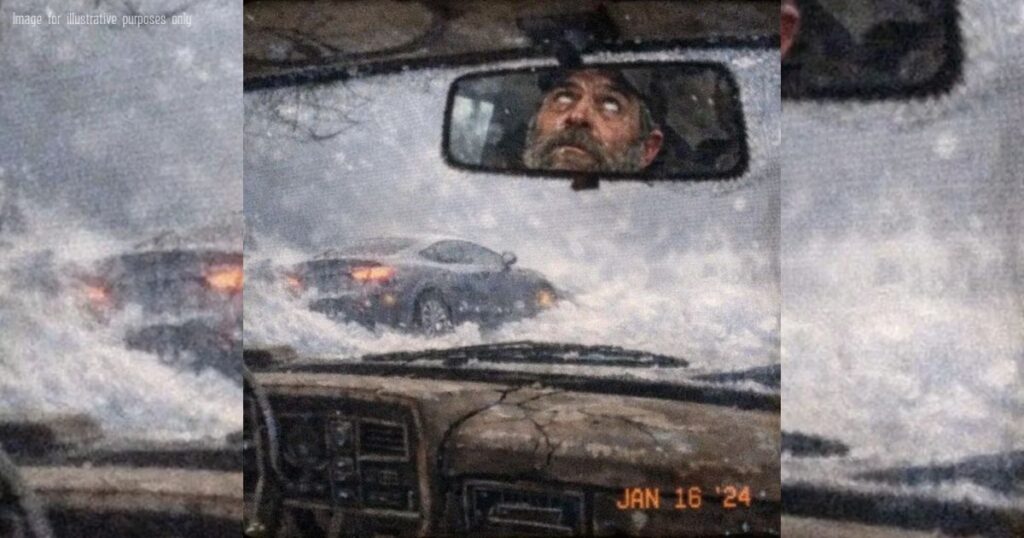
I was driving home after a late shift, road slick and shining under the moon like a knife.
My truck shuddered, then lurched.
The transmission finally gave up.
The engine still ran, but the truck wouldn’t pull. It was like the world’s heaviest sled.
I eased onto the shoulder, heart pounding.
Out here, a shoulder isn’t safety. It’s just where you wait to see what the weather decides to do to you.
I called for help.
No signal.
Of course.
I sat there, heat fading, the old engine idling rough.
And for the first time in a long time, I felt something close to panic.
Not because I thought I’d die right away.
Because I realized how fast things can tip.
How quickly you go from “I’m fine” to “I need someone.”
I stared out at the highway.
Snow was already starting to drift.
Headlights appeared in the distance—two white dots growing closer.
A car slowed.
I tensed, ready for it to blow past.
But it didn’t.
It pulled over ahead of me, hazard lights blinking in the snow like a heartbeat.
A figure climbed out.
And even before he reached my window, I knew who it was.
Not because I could see his face.
Because nobody else walked into a Dakota wind like they were still learning what fear costs.
Liam knocked on my glass.
I rolled the window down an inch. The cold punched in.
He leaned close and shouted, “You’re gonna hate this!”
I stared at him, stunned. “What the hell are you doing?”
“I was coming back through!” he yelled. “Long story!”
I laughed once, sharp and helpless. “Of course you were.”
He looked past me at my dead truck and his face tightened. “You okay?”
I wanted to say yes.
Wanted to act tough.
But the cold doesn’t care about your performance.
“No,” I admitted. “Not really.”
He nodded, quick. “Okay. Then we do what you did.”
I blinked. “You have a chain?”
He grinned, wild and proud. “I bought one. And a shovel. And blankets. And—”
“Don’t get cocky,” I barked, but my chest felt strange, tight in a different way.
He ran back to his car.
It wasn’t the same sleek sedan as before.
Not exactly.
It was still electric, still quiet, but it had snow tires now, and the back window was fogged with warm air. The car looked… prepared.
Like someone had learned.
He popped his trunk and pulled out a tow strap like it was a badge.
I climbed out, the cold slamming into me, and for a second I saw myself from the outside—two men on the shoulder in a storm, one in a fancy modern car, one in a rusted old truck, both of us just trying to not lose.
Liam shouted over the wind, “This is the part where you tell me what to do!”
I stared at him.
Then I felt laughter rise up again, real this time.
“Alright,” I yelled. “First rule—don’t stand behind the vehicles like an idiot!”
“Yes, sir!” he shouted back.
We hooked the strap.
He got in his car.
I got in my truck and steered while it rolled like a stubborn corpse.
Slowly—painfully—we made it to the next exit, where the lights of the same truck stop glowed in the distance like a lighthouse.
When we finally pulled under the canopy, Liam jumped out, breath coming hard.
He looked at me, eyes bright, cheeks red from wind.
And he said the same words I’d said to him.
“In the cold,” he said, voice shaking, “there are no—”
“Don’t,” I cut in, but I was smiling. “Yeah. I know.”
He laughed.
Then, quieter, he added, “So… now you’re in the ditch.”
I swallowed.
“Yeah,” I said. “I guess I am.”
He looked down at the icy ground, then back at me.
“Can I pay you now?” he asked, half-joking, half-serious.
I stared at him.
And here was the controversial truth, the one that would make the comment section explode if anyone heard it:
I wanted to say yes.
Not because I wanted his money.
Because I wanted the universe to feel balanced.
I wanted the act to have a receipt.
But that’s not how it works.
So I shook my head.
“No,” I said. “But you can buy me coffee.”
He grinned like he’d won something.
Inside, under fluorescent lights, with the wind still screaming outside, we sat in a booth with two steaming cups between us.
Two men from two different worlds.
Both humbled.
Both warm.
And both—whether we liked it or not—tied together now by a story the internet was still ripping apart.
Liam looked at his phone, then at me.
“They’re still arguing,” he said softly.
“Let ’em,” I said.
He hesitated. “Do you ever worry they’re right? That we really are as divided as it looks?”
I stared at the coffee.
Then I looked out the window at the storm.
And I thought about the only thing that matters when the temperature drops low enough to turn mistakes into funerals.
“We’re not divided,” I said quietly. “We’re just scared. And being scared makes people mean.”
Liam nodded.
Then I leaned forward and said the thing I knew would make people fight if they ever heard it—because it’s the kind of truth nobody wants to sit with:
“Sometimes the meanest people online are the ones who’ve never had to depend on anyone.”
He blinked.
“And,” I added, “sometimes the proudest people in real life are the ones who should’ve asked for help a long time ago.”
He stared at me, silent.
Then he said, “So what do we do?”
I shrugged.
“We do what we did,” I said. “We show up. Even when it’s inconvenient. Even when it’s messy. Even when somebody’s filming.”
He exhaled. “And if people keep turning it into an argument?”
I looked him dead in the eye.
“Let them,” I said. “Because maybe the argument is the doorway. Maybe the fight is the only way some people know how to touch something real.”
I sat back.
Outside, the storm kept moving.
Inside, the coffee steamed.
And for the first time since that night on Interstate 94, I understood something I didn’t want to admit:
You can’t control what people do with your story.
You can only control what kind of person you are when the next set of hazard lights blinks in the snow.
So here’s the question that’s been eating at me—because it’s the question everyone keeps screaming about like it’s a test:
If someone saves your life… should you be allowed to pay them?
Or does money ruin the only kind of help that actually matters?
And if you were the one with the chain—tired, broke, trying to be proud—would you refuse?
Be honest.
Because winter doesn’t care about your answer.
But the next person in the ditch might.
Thank you so much for reading this story!
I’d really love to hear your comments and thoughts about this story — your feedback is truly valuable and helps us a lot.
Please leave a comment and share this Facebook post to support the author. Every reaction and review makes a big difference!
This story is a work of fiction created for entertainment and inspirational purposes. While it may draw on real-world themes, all characters, names, and events are imagined. Any resemblance to actual people or situations is purely coincidenta