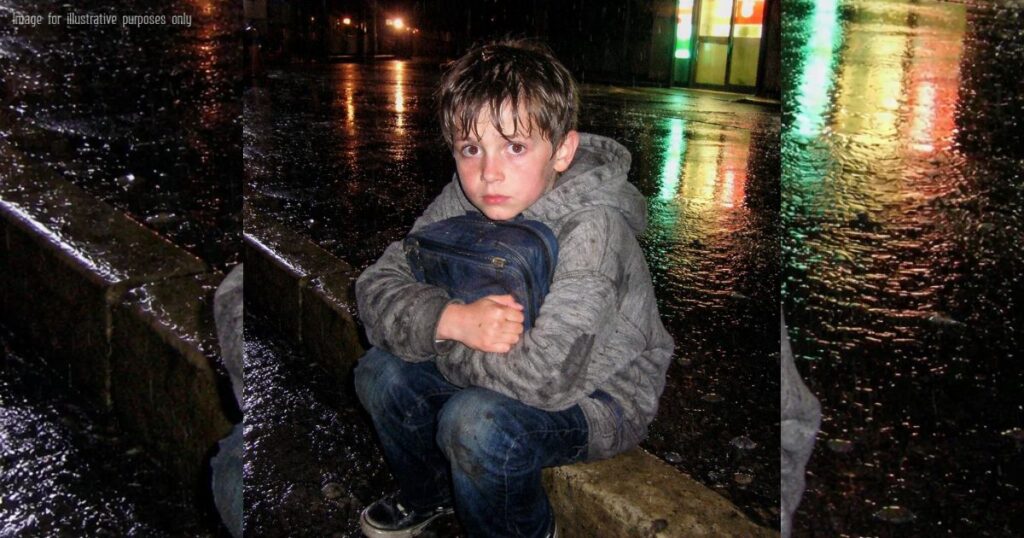
I almost called the police. That’s the first thing you think of when you see a seven-year-old sitting on a curb in the freezing rain at 8:00 PM.
I was filling up my truck at a gas station on the edge of town. The kind of place where the streetlights flicker and people don’t make eye contact. But I couldn’t look away from him.
He was wearing a hoodie that was too thin for November, soaking wet, hugging a backpack to his chest like a life preserver. No umbrella. No adult. Just staring at the door of the 24-hour convenience store.
I’m 68 years old. My knees hurt when it rains, and I don’t have much patience for nonsense. But I have even less patience for a child suffering.
I walked over. “Hey, son. You waiting for a ride?”
He jumped. He looked terrified. “My mom said stay right here. She said don’t move.”
“In this weather? Where is she?”
He pointed toward the massive warehouse distribution center across the street. A gray concrete block where people pack boxes for twelve hours straight. “She’s on overtime. If she leaves, they fire her.”
He said it with a maturity no second-grader should have. He wasn’t complaining; he was explaining the economics of survival.
“Come on,” I said. “I’m not leaving you out here.”
I took him inside the store. I bought him a hot chocolate and a turkey sandwich. We sat on the metal stools by the window.
“I’m Frank,” I said.
“Leo,” he whispered, blowing on the steam.
“Does your mom know you’re out here, Leo?”
“She thinks I’m inside the lobby,” he admitted. “But the guard kicked me out. Said no loitering. So I waited on the curb.”
My heart broke. Not just a crack, but a shatter.
We sat there for two hours. I learned that Leo likes Minecraft and hates math. I learned he wants to be an astronaut because “it’s quiet in space.”
At 10:15 PM, a woman in blue scrubs came running across the street. She looked exhausted, her hair plastered to her face by the rain. She burst into the store, her eyes scanning wildly until they landed on us.
“Leo!”
She ran over, grabbing him, checking his face, his hands. Then she looked at me. The fear in her eyes wasn’t just panic; it was the terror of a mother who thinks she’s about to lose her child to the system.
“Please,” she sobbed, backing away. “Please don’t report me. I’m a good mom. I swear. My sitter canceled last minute. I called five people. I have no family here. If I missed this shift, I can’t pay rent. Rent is $1,800. I had no choice.”
She was shaking.
“Stop,” I said gently. I held up my hands. “Nobody is reporting anyone.”
I looked at her. Really looked at her. I saw my own daughter in her. I saw a generation of parents breaking their backs just to keep a roof over their heads, paralyzed by the cost of childcare that costs more than a mortgage.
“I’m retired,” I said. “I used to be a mechanic. I sit at home and yell at the TV most days. It’s a waste of time.”
I wrote my number on a napkin.
“Next time the sitter cancels, you call me. I live ten minutes away. I’ll sit with him. I’ll help him with his math. No charge.”
She stared at the napkin. “Why? You don’t know us.”
“Because he shouldn’t be in the rain,” I said. “And you shouldn’t have to choose between feeding him and keeping him safe.”
That was six months ago.
Today, I picked Leo up from school. We went to the library. He’s actually getting pretty good at math. We cook dinner before his mom, Sarah, gets off her shift.
But here is the part that matters.
I told my buddies at the VFW hall about Leo. Just old guys, veterans, retirees. Guys who thought their useful days were over.
Now? We have a “Grandpa Patrol.”
My friend Mike picks up a neighbor’s kid for soccer practice because the dad works two jobs. Another guy, Dave, sits on the porch and watches the bus stop so the single mom next door can leave for her nursing shift without worry.
We aren’t doing anything big. We aren’t passing laws. We’re just filling the gaps.
Last week, Sarah got a new job. Better hours. No more night shifts at the warehouse. She cried when she told me she didn’t need me to watch Leo every day anymore.
“You saved us, Frank,” she said.
“No,” I told her. “I just held the umbrella.”
Look around your neighborhood.
There are Leos everywhere. They are the latchkey kids. The quiet ones. The ones waiting in cars while their parents run errands they can’t afford to skip.
The world is hard right now. Prices are up. Patience is down. Parents are drowning in silence because they are too ashamed to ask for help.
You don’t need to be rich to fix this. You don’t need to adopt a child.
You just need to notice. Buy the extra meal. Offer the ride. Be the safe place.
We used to say “it takes a village.” somewhere along the way, the village burned down.
It’s time we build it back up. One kid, one umbrella, and one act of kindness at a time.
Be the village.
—
PART 2 — The Night the Village Tried to Arrest the Umbrella
Six months after that rainy curb, I finally learned something ugly.
Sometimes the world doesn’t punish the people who leave a kid outside.
Sometimes it punishes the person who brings him in.
It happened on a Tuesday.
A normal Tuesday, which is how most disasters arrive—wearing the face of routine.
Leo had a half-day at school. Sarah had started her new job, the one with daylight hours, the one that didn’t make her come home looking like she’d been wrung out like a mop. She’d packed his lunch in the morning and kissed the top of his head and said, “Frank’s picking you up, okay?”
Leo nodded like a little old man.
He trusted me the way kids trust gravity.
Click the button below to read the next part of the story.⏬⏬