PART 2 — The Night the Village Tried to Arrest the Umbrella
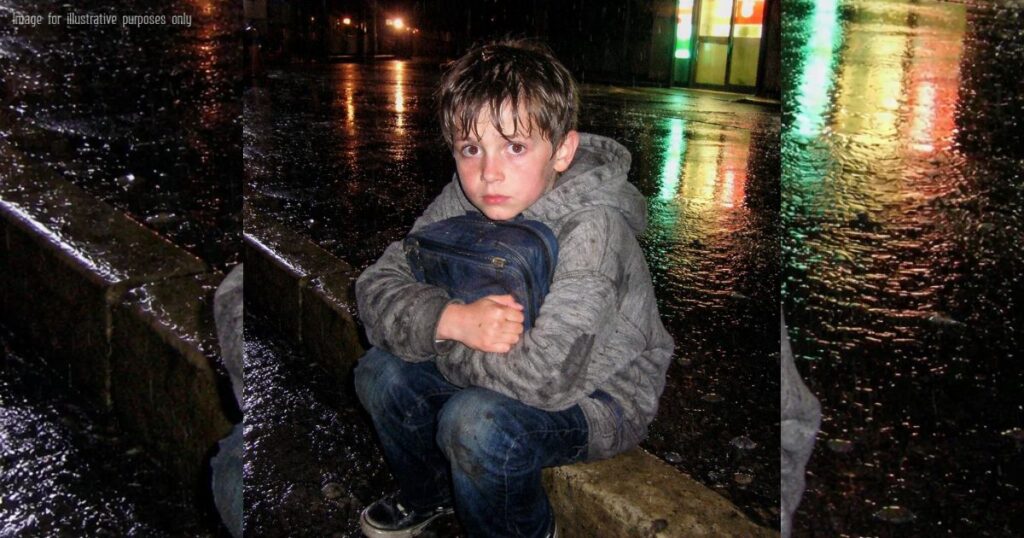
Six months after that rainy curb, I finally learned something ugly.
Sometimes the world doesn’t punish the people who leave a kid outside.
Sometimes it punishes the person who brings him in.
It happened on a Tuesday.
A normal Tuesday, which is how most disasters arrive—wearing the face of routine.
Leo had a half-day at school. Sarah had started her new job, the one with daylight hours, the one that didn’t make her come home looking like she’d been wrung out like a mop. She’d packed his lunch in the morning and kissed the top of his head and said, “Frank’s picking you up, okay?”
Leo nodded like a little old man.
He trusted me the way kids trust gravity.
I pulled into the pickup line in my battered truck. Wipers squeaking, sky the color of dishwater. I had a paperback on my seat and a bag of oranges on the floorboard because I’d been trying to keep my promises small and steady.
When Leo climbed in, he was buzzing.
“Frank,” he said, breathless, “we’re doing space in science. Like, real space.”
“That so?”
“And my teacher said astronauts have to do… fractions.”
He made a face like the word tasted bad.
I laughed. “Then I guess we’re doing fractions.”
He groaned and leaned his forehead against the window, dramatic as a soap opera actor.
We stopped at the library like always. Leo grabbed a book about rockets. I grabbed a book about people who grow tomatoes in buckets, because I’m 68 and I have strange hobbies now.
Then we walked back to the truck.
That’s when I noticed her.
A woman leaning against a car two spaces down. Phone held up, not subtle. Filming.
She wasn’t smiling.
She wasn’t waving.
Her eyes were hard.
Leo didn’t see her. He was talking about how quiet space is, how the quiet makes you feel like your thoughts have room to stretch out.
I opened the passenger door for him because my mother raised me that way.
The woman’s voice cut through the rain.
“Excuse me! Hey!”
I turned.
She pointed her phone at my face like it was a badge. “Is that your child?”
Leo froze halfway into the seat.
My stomach tightened. It was the same feeling I used to get when a car came in with smoke pouring out from under the hood—something was already wrong, you just didn’t know how expensive it was going to be.
“No,” I said carefully. “I’m his neighbor. I’m picking him up for his mom.”
The woman’s nostrils flared. “So… you’re taking a child that isn’t yours.”
I heard the way she said it.
Not as a question.
As a sentence.
Leo’s hands gripped his backpack straps. His knuckles went pale.
“Ma’am,” I said, keeping my voice gentle because I could feel the cliff edge under my feet, “his mother knows. I’m on her list.”
Her laugh was short and sharp. “A list. Sure.”
She turned slightly, angling for a better shot. “There are creeps everywhere these days. You know that, right?”
There it was.
That word.
Creep.
A word that can turn a person into a monster in one breath.
Leo looked at me like he was checking if I was going to disappear.
“Frank,” he whispered, small, “what’s happening?”
“Nothing,” I told him. “Get in the truck.”
The woman’s voice rose, louder, feeding on attention. “Do not get in that vehicle!”
I felt heat crawl up my neck.
I am not a violent man. I’m an old mechanic with sore knees and a bad shoulder and a soft spot for kids in the rain.
But in that moment, with her phone pointed at Leo like a weapon, I understood something about fear.
Fear doesn’t just protect people.
Fear hunts.
A man in a security jacket started walking over from the edge of the lot, eyes darting between us.
“Everything okay?” he asked, cautious, the way people talk when they’re ready to call for backup.
The woman waved her phone. “This man is trying to take a child.”
I opened my mouth.
And I realized I was about to give a speech I shouldn’t have to give in a decent world.
“My name is Frank,” I said, slow and clear. “I live ten minutes away. Leo’s mother asked me to pick him up. I do it all the time.”
The woman didn’t blink. “Prove it.”
Prove it.
Like kindness needed paperwork.
Like compassion required a license.
I reached for my phone with shaking fingers and pulled up Sarah’s last message.
Can you grab him at 12:30? Thank you. I owe you.
I held the screen up.
The woman barely glanced. “That could be anyone.”
The security guy shifted his weight, uncomfortable. He wasn’t sure who to believe, which meant the decision was already leaning away from me.
Because I’m an older man.
Because Leo is a child.
Because it’s easier to assume the worst than to admit the world is letting parents drown.
And then I heard the sound that made my heart drop straight through my ribs.
A siren.
Not loud. Not dramatic.
Just close.
Coming closer.
The woman smiled like she’d won.
Two police officers stepped into the rain. Calm faces. Hands near their belts. The practiced posture of people trained to walk into chaos.
“Sir,” one of them said, eyes on me, “we got a call about a possible child abduction.”
Possible.
But it landed like a hammer.
Leo made a sound I will never forget.
Not a scream.
Not a cry.
Just a small, broken inhale like his lungs forgot how to work.
“Frank?” he said, voice cracking.
I turned toward him. “Hey. Look at me.”
His eyes were wide. Wet. Confused.
“I’m right here,” I said. “You’re safe.”
But his little body was shaking, and I realized he wasn’t scared of the police.
He was scared of losing the one stable thing he’d gotten used to.
He was scared the adults were going to break the village again.
The officer asked, “Where’s his mother?”
“Working,” I said. “I can call her.”
“Do that.”
My fingers fumbled. I hit Sarah’s name.
It rang once.
Twice.
I pictured her at her new job, trying to keep her head down, trying to be grateful, trying not to get fired for something she didn’t do.
She answered, breathless. “Frank?”
“Sarah,” I said, and I hated how my voice sounded—too tight, too old, too tired. “I need you to come to the library parking lot. Now.”
There was a beat of silence.
Then, sharp fear. “What happened? Is Leo—”
“He’s okay,” I said quickly. “He’s right here. But… the police are here.”
A sound escaped her like she’d been punched.
“Don’t,” she whispered. “Please tell me this isn’t—”
“Just come,” I said. “Please.”
She didn’t ask questions after that. She just said, “I’m coming.”
And then I stood in the rain, beside my truck, while strangers looked at me like I might be a headline.
The officers asked Leo questions.
“What’s your name?”
“Who is this man?”
“How do you know him?”
Leo answered in a small voice, clutching his backpack like armor.
“He’s Frank. He helps my mom. He makes spaghetti.”
One officer’s expression softened at that.
The other still looked like he was weighing probabilities.
Because that’s what the world does now.
It weighs people.
It calculates risk.
It forgets that love is also a kind of safety.
Sarah arrived ten minutes later, hair damp, eyes wild, breath coming too fast.
She ran straight to Leo and grabbed him, checking his face, his hands, his shoulders, like she could physically confirm he was still hers.
Then she turned to the officers.
“I’m his mother,” she said, voice shaking but fierce. “Frank is our neighbor. He picks him up. He watches him when my schedule changes. He’s the reason I didn’t lose my job six months ago.”
Her eyes flashed toward the woman with the phone.
“And whoever called you—” Sarah’s voice broke, rage and humiliation twisting together— “you don’t know what you’re doing to people like us.”
The woman lifted her chin. “I did the right thing.”
Click the button below to read the next part of the story.⏬⏬