Sarah stared at her. “Did you?”
The question hung there.
Heavy.
Because it’s a question a lot of people don’t want to answer.
The officers spoke quietly with Sarah. They asked for her ID. They asked for confirmation. They asked for details.
She provided everything, hands trembling, like she was presenting evidence that she deserved to keep her child.
When it was finally over, the officers apologized in that careful, bureaucratic way that doesn’t really touch the bruise.
“Ma’am, sir,” one of them said, “we have to respond to calls like this.”
I nodded because I didn’t have the energy to argue with a system that runs on “just in case.”
Leo climbed into the truck and didn’t talk.
Not about rockets.
Not about fractions.
Not about space.
He just stared at his lap like he’d been reminded that the world can snatch comfort away without warning.
When we got to my house, he didn’t run inside like usual.
He stood on my porch and looked up at me.
“Frank,” he said softly, “are you gonna get in trouble?”
Something cracked in my chest.
“No,” I said, even though part of me wasn’t sure. “No, buddy. You didn’t do anything wrong. Your mom didn’t do anything wrong. And I didn’t do anything wrong.”
He swallowed. “Then why did they…?”
Why did they.
The question kids ask when they feel the rules shifting under their feet.
I crouched down slowly, knees protesting, and I put my hand on his shoulder.
“Because some people are scared,” I said. “And when people are scared, they sometimes forget how to be kind.”
He nodded like he was filing that away for later.
Then he whispered something that hit harder than the siren.
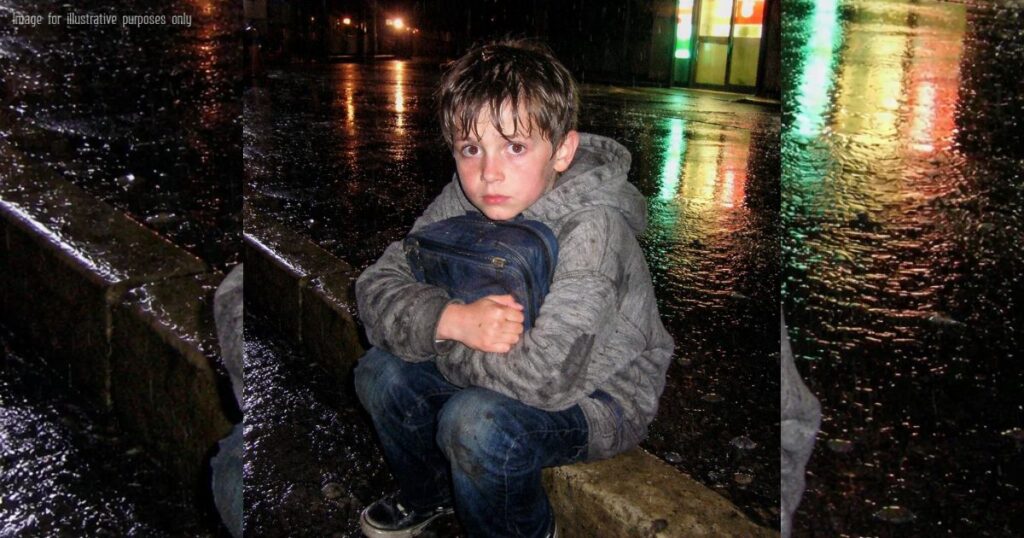
“I liked it better when it was just rain.”
That night, after Sarah picked him up, I sat in my kitchen with the lights off.
I didn’t turn on the TV.
I didn’t read my book about bucket tomatoes.
I just listened to the house creak and thought about how fast a person can be turned into a threat in someone else’s story.
I thought about all the people online who would see a shaky video and decide who I was in ten seconds.
I thought about how “protect the kids” can be used as a shield… and also as a spear.
And I thought about the part nobody wants to say out loud:
If the only childcare that’s considered “safe” is the kind you can afford…
Then safety is a luxury product.
The next day, one of the guys from our little “Grandpa Patrol” called me.
“Frank,” he said, voice tight, “you okay?”
“I’m fine.”
He snorted. “Don’t lie to me. My niece sent me a clip. Some woman posted it. You and Leo. Comments are… ugly.”
My stomach dropped.
“So it’s up,” I said.
“It’s up,” he confirmed. “And half the town thinks you’re a hero, and the other half thinks you should be locked up.”
There it was.
The controversy.
The internet’s favorite sport: deciding whether a stranger is a saint or a monster.
No middle ground.
No context.
No room for the truth, which is usually messier than a comment section can handle.
I didn’t sleep much that night.
In the morning, Sarah texted me.
Ignore it. I’m with you. Leo’s with you.
Then another message.
But I’m scared.
I stared at those words for a long time.
Because that fear… it wasn’t just about me.
It was about everything.
It was about how close parents like her live to the edge.
How one misunderstanding can become a case file.
How one phone call can become a domino.
That evening, Sarah came over alone.
She looked older than she had six months ago, even with the better job. Stress doesn’t always lift. Sometimes it just changes shape.
“I’m sorry,” she said, the moment she stepped inside my kitchen.
I frowned. “For what?”
“For putting you in this position,” she said, eyes shining. “For needing help.”
I felt my throat tighten.
“Don’t you dare,” I said softly. “Don’t you ever apologize for needing a village.”
She covered her mouth with her hand like she was trying to hold herself together.
“You know what’s messed up?” she whispered. “If I had money, nobody would’ve called. If I had a paid sitter in a nice car, nobody would’ve filmed.”
She looked up at me.
“But because I’m a mom who’s tired and broke and asking for help… it looks suspicious.”
I didn’t have a clever answer.
I just nodded.
Because she was right.
And the truth is… a lot of people hate that truth, because it means the world isn’t just scary.
It’s unfair.
Sarah took a breath. “I don’t want to stop,” she said. “I don’t want Leo to lose this. But I also… I can’t risk losing him.”
I heard the tremble under her words.
So I made a decision.
Not a big, dramatic, movie decision.
A small, stubborn one.
The kind old men make when they’ve lived long enough to know that good things don’t survive unless someone protects them.
“We’re going to do this out loud,” I said.
Sarah blinked. “What?”
“We’re going to stop acting like helping is something we have to hide,” I said. “We’re going to put it in the light.”
That weekend, we held a meeting at the community room near the library. Folding chairs. Coffee in a cheap plastic dispenser. A stack of blank forms and pens.
No logos.
No big organization names.
Just neighbors.
Parents showed up with tired eyes.
Retirees showed up with creaky joints.
A couple of young guys showed up, looking nervous, like they weren’t sure they were allowed to care.
Sarah stood up and told the story of the curb.
She told the story of the hot chocolate.
She told the story of how close she came to losing everything because childcare fell through.
Then she told the story of the siren.
And the room went dead quiet.
Not because they were shocked.
Because they recognized it.
A dad in the back said, “I’ve left my kid in the car outside my second job before. Ten minutes. Twenty. I hated myself.”
A woman near the front whispered, “I’ve waited outside places when my mom was working. People acted like I was a problem.”
One of the retirees cleared his throat. “I’ve stopped offering help because I don’t want to be misunderstood.”
The air felt heavy with something we don’t talk about enough:
How many people are choosing isolation over connection… because connection feels risky now.
We created a simple neighbor network that night.
Parents who wanted help could opt in.
Volunteers could opt in.
Everything with permission, in writing, with clear boundaries, in daylight, in public spaces whenever possible.
Not because kindness needs bureaucracy…
But because we live in a world where mistrust is the default, and we weren’t going to let mistrust burn the village down again.
When the meeting ended, a woman who had been quiet the whole time walked up to me.
She looked like she hadn’t slept in weeks.
“My son is seven,” she said, voice barely audible. “I work evenings. I don’t have anyone.”
Her eyes filled.
“I saw the video,” she whispered. “And I’m sorry. I’m sorry people are like that.”
I wanted to tell her not to apologize.
But I could see the shame in her face—shame for needing, shame for existing in a world that treats need like negligence.
So I just said, “What’s your son’s name?”
“Eli,” she said.
I nodded. “Tell Eli I’ve got an extra umbrella.”
That night, when I walked out to my truck, the rain had stopped.
The air was cold and clean.
And I realized something that might make people mad.
Something people will argue about in the comments for hours.
Maybe we should be careful with children.
Of course we should.
But if our only response to danger is suspicion…
If our only tool is a camera and a call-out and a siren…
Then we’re not building safety.
We’re building cages.
And the people who get caged first are always the ones already struggling.
So here’s the question I can’t stop thinking about:
When you see an older man holding an umbrella over a kid who isn’t his…
Do you see a threat?
Or do you see a village trying to survive?
Because the answer you choose…
That answer is the kind of world you’re helping build.
Thank you so much for reading this story!
I’d really love to hear your comments and thoughts about this story — your feedback is truly valuable and helps us a lot.
Please leave a comment and share this Facebook post to support the author. Every reaction and review makes a big difference!
This story is a work of fiction created for entertainment and inspirational purposes. While it may draw on real-world themes, all characters, names, and events are imagined. Any resemblance to actual people or situations is purely coincidenta