They told me to just drive the bus. But when a kid rides past the last stop three nights in a row, staring at a black phone screen like it’s a tombstone, you stop being a driver. You become a witness.
I’ve driven Route 42 through the heart of the city for twenty years. I know the rhythm of this town better than the politicians do. I know the sound of exhausted nurses heading for the night shift, the smell of rain on hot asphalt, and the specific, heavy silence of people who have given up.
But last November, amidst the noise of the holidays and the election ads on the radio, I noticed him.
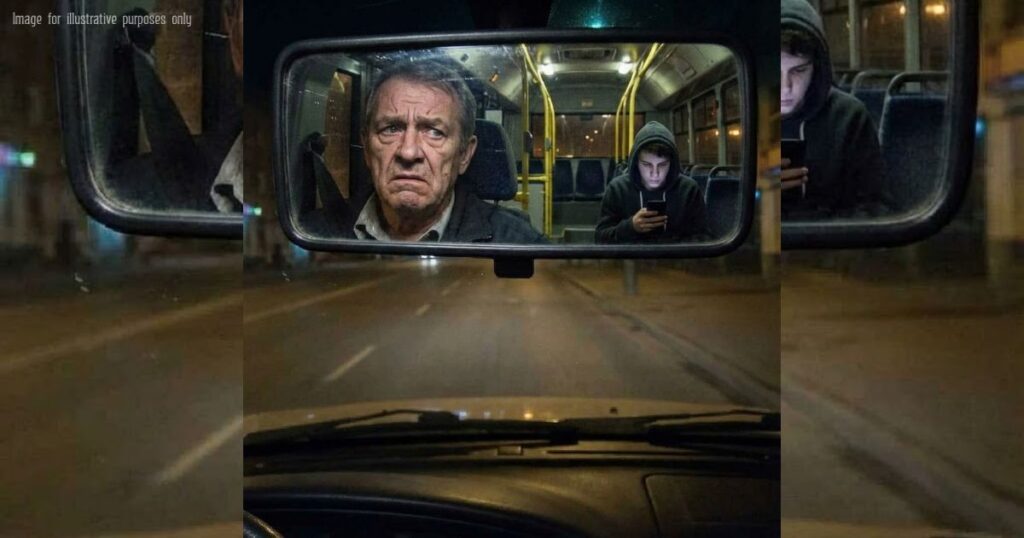
He looked like any other American teenager—oversized hoodie, expensive sneakers that looked scuffed, headphones on. He got on at 4th and Main every afternoon at 3:30 PM. He swiped his pass, kept his head down, and went straight to the back corner.
Most kids are glued to TikTok or shouting over Facetime. Not him. He just sat there.
He rode the line to the end of the depot—the desolate turnaround where the streetlights flicker—and then he’d pay again to ride back. He wasn’t commuting. He was hiding.
By the fourth day, I killed the engine at the depot but didn’t open the doors immediately. I looked in the rearview mirror. He was shivering, just slightly, though the heater was blasting.
I’m 63 years old. I’ve got grandkids I don’t see enough and a bad back. I’m not a social worker. I’m not a hero. I’m a guy who transports people from Point A to Point B. But in this country, right now, it feels like everyone is shouting and nobody is listening. We are so connected by our devices, yet we’ve never been lonelier.
I couldn’t leave him there.
I tore a page out of my shift notebook. I didn’t want to scare him with a lecture. I didn’t want to be another adult telling him what to do.
I walked to the back, pretending to check for trash. I slid the paper onto the empty seat next to him and walked away. I didn’t look at his face.
The note said: “You don’t have to speak. You don’t have to explain. But if you need to write it down to get it out of your head, I’ll read it. No judgment. Just a bus driver.”
When I looped back to his stop an hour later, he got off. The seat was empty. The paper was gone.
I thought I’d scared him off. But the next day, he was there. Same seat. Same hoodie. As he walked past me to exit, he dropped a folded piece of lined paper into my tip jar.
My hands shook a little when I unfolded it later. The handwriting was jagged, pressed hard into the paper:
“My dad lost his job six months ago. Now the house is so quiet it scares me. If I breathe too loud, I feel like I’m the reason everything is falling apart. I just need noise that isn’t angry.”
I didn’t offer money. I didn’t call the state. I just taped a cheap spiral notebook to the back of the driver’s seat the next morning with a pen attached to a string. On the cover, I wrote: “The Quiet Zone.”
That night, he wrote in it. “Thank you for the ride.”
But then, the unexpected happened.
The notebook stayed there. Other kids started finding it.
A girl with purple hair and sad eyes wrote: “I haven’t eaten a real dinner in two days. Inflation, I guess. My mom is trying her best.”
A varsity athlete, the kind of kid you think has it all, wrote: “I blew out my knee. Scholarships are gone. I don’t know who I am anymore.”
A younger kid, maybe twelve, wrote: “I get bullied for my shoes. Every day. I wish I could disappear.”
My bus ceased to be a vehicle. It became a confessional. It became a sanctuary moving at 35 miles per hour. In a world of filtered Instagram photos and perfect LinkedIn updates, this notebook was the only place these kids were being honest. They were screaming in ink because they couldn’t scream out loud.
I read every single one. sometimes I’d leave a granola bar on the seat for the hungry girl. Sometimes I’d just write a generic note in the margins: “You matter. Keep going.”
Of course, the real world tried to intervene.
My supervisor, a man who lives by spreadsheets and liability clauses, pulled me aside two months later. He’d seen the notebook on the security camera.
“Mac, you can’t do this,” he said, tapping his desk. “This is unauthorized. You’re opening the transit authority up to lawsuits. What if a kid writes something dangerous? You aren’t a counselor. Get rid of the book.”
I looked at him. I thought about my pension. I thought about the rules. Then I thought about the boy in the hoodie.
“Sir,” I said, my voice steady. “We drive past drug deals, we drive past homeless encampments, and we drive past broken homes every day. We act like we don’t see it. For once, I’m letting them know someone sees them. If you want to fire me for letting kids write down their pain instead of acting on it, you go ahead.”
He stared at me. He sighed, rubbed his temples, and waved me out. “Just… keep it under the radar, Mac.”
The notebook stayed.
Spring came. The snow melted into dirty slush, and the city started to turn green again.
The boy in the hoodie stopped riding the loop. I hadn’t seen him in three weeks. I worried. In this line of work, you always fear the worst. You fear the empty seat means a tragedy.
Then, on a Tuesday, he stepped on. He wasn’t wearing the hoodie. He had a clean shirt on. He looked… lighter. Like he had put down a heavy backpack he’d been carrying for miles.
He didn’t go to the back. He stopped at the driver’s seat.
He handed me a new piece of paper, folded into a tight square. He looked me in the eye—the first time he’d ever done that—and nodded. A small, genuine nod.
“I’m moving to my uncle’s place in Ohio,” he said quietly. “My dad is getting help. I just wanted to say goodbye.”
He got off at the station. I watched him walk away until he disappeared into the crowd.
I waited until the bus was empty to open the note.
“You were the only person who didn’t try to fix me, judge me, or ignore me. You just let me be here. That silence saved my life. I didn’t give up because I knew I had a ride the next day. Thank you, Mac.”
I sat in that driver’s seat, surrounded by the smell of diesel and old vinyl, and I wept.
I am not a rich man. I don’t have power. I can’t change laws, and I can’t fix the economy. I’m just a bus driver.
But I learned something on Route 42.
We are so busy trying to create “solutions”—new policies, new apps, new committees—that we forget the most powerful tool we have: Availability.
Sometimes, you don’t need to have the right words. You don’t need to be an expert. You just need to be the one safe place in a loud, chaotic world.
If you see someone hurting, you don’t always have to ask “What’s wrong?”
Sometimes, you just need to open the door, offer a seat, and let them know that for this ride, they aren’t alone.
We can’t fix everything. But we can listen. And sometimes, listening is the thing that stops the crash.
—
PART 2 — When The Quiet Zone Stopped Being Quiet
They think the story ended when the boy in the hoodie walked away.
Like it was a tidy little lesson wrapped in diesel fumes and a goodbye note.
But Route 42 doesn’t do tidy. It does tomorrow. And tomorrow always shows up with its hand out.
The morning after he left, I drove the same line with the same bad back and the same cracked steering wheel.
Same potholes. Same tired faces.
Click the button below to read the next part of the story.⏬⏬