PART 2 — When The Quiet Zone Stopped Being Quiet
They think the story ended when the boy in the hoodie walked away.
Like it was a tidy little lesson wrapped in diesel fumes and a goodbye note.
But Route 42 doesn’t do tidy. It does tomorrow. And tomorrow always shows up with its hand out.
The morning after he left, I drove the same line with the same bad back and the same cracked steering wheel.
Same potholes. Same tired faces.
But the back corner of the bus felt different—like a church after the last candle goes out.
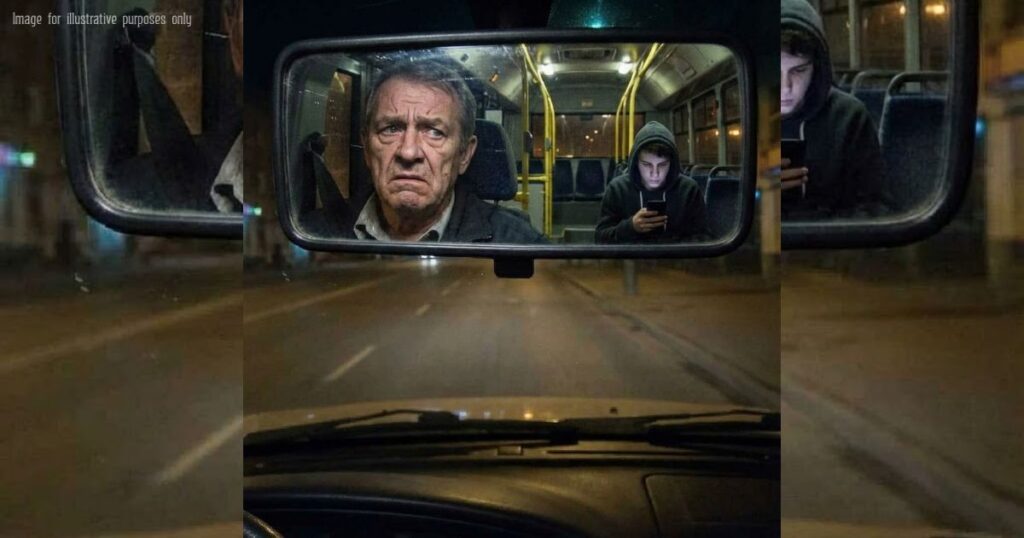
I kept glancing at that seat in the mirror anyway.
Habit. Hope. Maybe both.
At my first layover, I opened the notebook—the one still taped behind my seat—like I was checking a pulse.
The last page the boy had written on was still there.
His handwriting had already started to fade where other palms had smudged it. Like his words were trying to slip back into silence.
I should’ve taken it down right then.
A sane man would’ve. A man who liked his pension. A man who didn’t want trouble.
But I’m not sure sane is what this city needs anymore.
So I turned the key, and the bus shuddered back to life.
And I left “The Quiet Zone” right where it was.
By the end of that week, the notebook wasn’t just a notebook.
It was a magnet.
Kids would climb on, pretend to scroll their phones, then lean forward like they were tying a shoe and scribble something quick.
Some wrote a sentence. Some wrote a paragraph.
Some didn’t write at all—they just ran their finger over other people’s words, like Braille for pain.
One afternoon, a kid I’d never seen before left a message that was so neatly written it looked printed.
“Adults say we should talk. But when we do, they punish us for what we say.”
I stared at it after my shift.
Because I’ve heard that sentence in a thousand different ways.
In break rooms.
At family dinners.
In the eyes of people who don’t trust the world to hold them gently.
A couple days later, something new appeared on the cover.
Someone had added to my marker letters, smaller underneath mine:
THE QUIET ZONE
NO NAMES. NO PHOTOS. NO SNITCHING.
I didn’t write that.
And if I’m honest, it scared me a little.
Not because the rule was wrong.
Because it meant the kids were building their own code—right there on my bus—because the world outside had taught them they needed one.
That’s what nobody wants to admit about “these kids.”
They’re not soft.
They’re trained.
Trained by rent notices and slammed doors and parents who stare through them because the math doesn’t math anymore.
Trained by classrooms where everyone has an opinion but nobody has time.
Trained by screens that scream all day and still don’t offer a lap to cry in.
Then the real world did what it always does when something human starts happening without permission.
It noticed.
It was a Thursday, close to dusk, when I saw her.
A woman in her thirties, hair pulled tight, coat too nice for my route.
She got on at the hospital stop. Didn’t swipe a pass.
Just stood near the front and watched.
Her eyes weren’t on the city.
They were on me.
I get plenty of looks in this job. People stare at bus drivers like we’re furniture.
But this was different.
This was a look that said, I have paperwork with your name on it.
When we hit a long red light, she leaned in.
“Mac?” she asked quietly, like she didn’t want to set off an alarm.
“That’s me.”
“I’m with Compliance.”
I hate that word. Compliance. It sounds like a collar.
She nodded toward the notebook taped behind my seat.
“That yours?”
I didn’t play dumb.
“Yes.”
She sighed like she’d already had this conversation with herself in a mirror.
“We’ve had… concerns.”
“What kind of concerns?” I asked.
She glanced at the security camera above the aisle, then back at me.
“Privacy. Liability. Safety. Parents. The board.”
I wanted to laugh. Not because it was funny—because it was predictable.
Nobody panics when kids are hungry.
Nobody panics when kids are alone.
They panic when kids write it down where someone might have to admit it exists.
She lowered her voice.
“Someone posted a photo.”
My stomach tightened.
“A photo of what?”
She pulled out her phone and turned the screen toward me.
It was a picture of a notebook page.
One of the kids’ entries, close-up, framed like a trophy.
The handwriting was recognizable. The page was unmistakable.
The caption underneath said something like:
“This is what’s on our city buses. Is this okay?!”
No name.
No face.
But it didn’t matter.
Because once the internet smells blood, it doesn’t need a name.
It just needs a target.
I felt heat rise in my neck.
“Who took it?” I asked.
“We don’t know,” she said. “But now everyone has an opinion.”
I stared straight ahead as the light turned green.
“Well,” I said, “that part’s true.”
By the time I reached the depot, there were already messages waiting for me.
Not from the kids.
From adults.
My supervisor called me into his office like it was a courtroom.
He had the same spreadsheets. Same liability clauses. Same face that said please don’t make my life harder.
But now he looked tired instead of annoyed.
“We’ve got emails,” he said. “Some people are calling you a hero. Some are calling you a creep.”
I felt my jaw tighten.
“A creep,” I repeated.
“Mac…” He rubbed his temples. “This is the world we live in. People don’t trust anything anymore.”
“No,” I said. “People don’t trust each other anymore.”
He slid a printed paper across the desk.
A notice.
TEMPORARY SUSPENSION PENDING REVIEW.
I read the words twice, like they might change if I blinked.
“You’re suspending me,” I said, “for letting kids write their feelings down.”
“For running an unauthorized program on public property,” he corrected automatically.
Then his voice softened.
“And because someone made it public.”
I stared at him.
“So the problem isn’t the pain,” I said. “It’s that somebody saw it.”
He didn’t answer.
That was answer enough.
They told me to remove the notebook immediately and turn it in.
I walked back to my bus, heart thumping like a teenager’s.
The notebook was still there, dangling from the tape, pen swinging on its string like a tiny noose.
I un-taped it slowly.
It felt like taking down a memorial.
I tucked it under my arm and turned around—
—and nearly ran into a kid standing at the front door.
Sixteen, maybe. Baggy jacket. Eyes too old.
He looked past me at the empty spot behind my seat.
“Where is it?” he asked.
I swallowed.
“It’s… being reviewed.”
He stared at the floor for a long second, then said, “My little sister wrote in there.”
His voice cracked on the word sister.
He looked up at me, angry and terrified at the same time.
“She don’t talk at home. She don’t talk at school. That book was the only place she said anything.”
I wanted to hand it back to him right then.
I wanted to tell him the adults would do the right thing.
But I’ve lived long enough to know adults don’t always deserve the faith kids give them.
“I’m sorry,” I said, and I hated how small it sounded.
He shook his head, like he’d heard apologies his whole life.
“You know what’s crazy?” he said. “They got cameras everywhere. They watch us all day. But the second we write something real, they freak out.”
Click the button below to read the next part of the story.⏬⏬