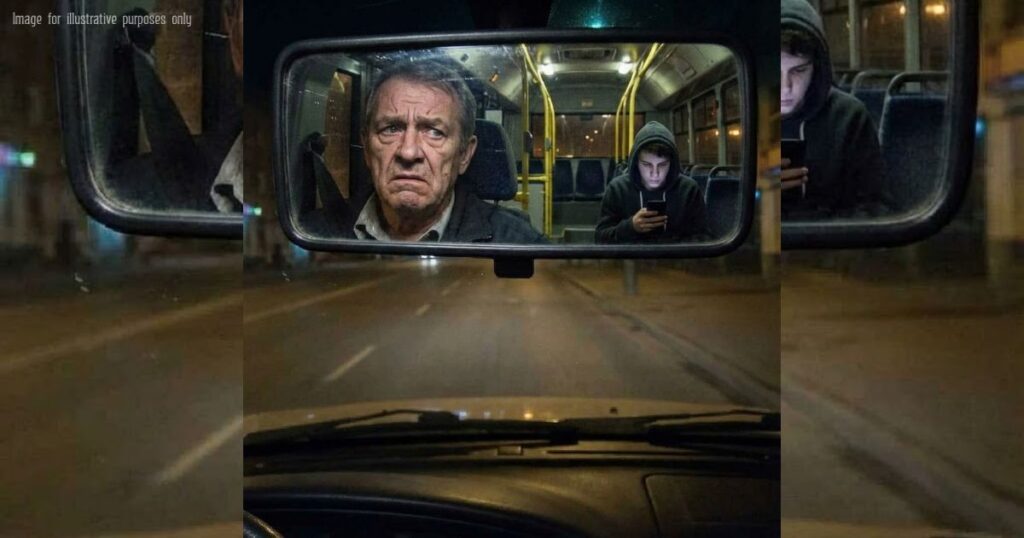
Then he stepped off the bus and disappeared into the station crowd like a ghost.
That night, I sat at my kitchen table with the notebook open.
My apartment was quiet in the way that isn’t peaceful.
Quiet like a waiting room.
I read page after page.
Not to snoop.
To remember why I’d risked everything.
And then I found an entry I hadn’t seen before.
It was written in cramped letters, like the person had been shaking.
“I don’t want to die. I just don’t want to live like this.”
I stared at it until my eyes blurred.
This is the part nobody wants to talk about online.
Not the dramatic part.
The ordinary part.
The part where a kid sits in the back of a bus and thinks, Is this all there is?
This was the line.
The one my supervisor had warned me about.
The one that could turn a notebook into a headline.
And here it was—already written—weeks ago.
And I didn’t see it until now.
My throat tightened with guilt.
Because I had been reading, but I had also been driving.
I had been trying to be a safe place, but I wasn’t trained.
And sometimes good intentions aren’t enough.
I did the only thing I could do without turning that kid into a spectacle.
I called the transit office and asked for the school outreach liaison—an actual professional, someone whose job was to connect dots without shaming the people who drew them.
No names. No accusations. Just the truth.
“There’s a message in that notebook,” I said, voice low. “It needs attention.”
The next day, I was called into a meeting with people who didn’t smell like buses.
There was Compliance. Legal. PR. A counselor from the school district. A woman from a local youth center.
They sat in a circle like they were about to dissect me.
One of them spoke gently, like you talk to a dog you’re not sure will bite.
“Mac,” she said, “why did you start this?”
I looked around at their clean hands and their polished shoes.
“Because nobody else was listening,” I said.
That should’ve been enough.
But in this country, “enough” doesn’t matter if it’s not bulletproof.
A man in a suit cleared his throat.
“We can’t endorse an anonymous writing space without safeguards,” he said. “It creates risk.”
I leaned forward.
“You know what creates risk?” I said. “A kid with nowhere to put the pain.”
A different woman, the counselor, nodded slowly.
“We don’t have to kill it,” she said. “We can shape it.”
The suit frowned.
“We can’t have a bus driver acting as a counselor.”
“I wasn’t acting as anything,” I snapped. “I was acting like a human being.”
Silence.
Then the counselor spoke again, calm as rain.
“What if,” she said, “we make it official? Not tied to Mac as a person. A citywide ‘Quiet Zone’ program—trained volunteers, clear boundaries, crisis protocols, secure drop boxes. No cameras pointed at the pages. No photos allowed. And signage that explains where kids can get real help.”
The word protocols made the suit relax a little.
That’s the secret, you know.
You can sell compassion if you wrap it in paperwork.
I sat back, exhausted.
“So you’ll let it exist,” I said, “as long as it has a form.”
The counselor didn’t flinch.
“As long as it keeps kids alive,” she said.
Two weeks later, I was back on Route 42.
Not celebrated. Not fired.
Just back where the city breathes.
The notebook wasn’t taped behind my seat anymore.
There was a locked metal box up front now—plain, unmarked—installed by the transit authority.
Next to it was a small sign:
THE QUIET ZONE
WRITE WHAT YOU CAN’T SAY.
NO NAMES. NO PHOTOS.
IF YOU NEED HELP NOW, TELL THE DRIVER OR CALL FOR SUPPORT.
It wasn’t perfect.
It wasn’t as intimate.
But it was something.
And more importantly—it wasn’t just mine anymore.
On my first night back, a kid hovered near the box like it might bite.
He slipped a folded note through the slot and stepped back quickly.
Like even hope was embarrassing.
At the next stop, another kid got on, saw the sign, and just stood there reading it.
Her eyes filled up.
She didn’t write.
She didn’t have to.
She just mouthed, thank you, without sound, and went to the back.
Later, after my shift, I opened the box with the key they’d assigned me.
Inside were five folded notes.
Five small, shaking truths.
And at the very top, written in big, messy letters:
“WHY DO ADULTS ONLY CARE WHEN IT GOES VIRAL?”
I stared at that question for a long time.
Because it wasn’t just about the bus.
It was about everything.
We live in a world where people scroll past suffering until it fits in a frame.
Where compassion has to be shareable to be acceptable.
Where kids learn early that privacy is a myth—but vulnerability is still punished.
I’m just a bus driver.
I don’t have a microphone.
But I do have a route.
And every day, I pick up the future and carry it through a city that argues about who’s to blame instead of asking who’s alone.
So here’s the controversial part—if you want it:
Maybe the problem isn’t that kids are “too sensitive.”
Maybe the problem is that we built a society where they have to be tough just to survive ordinary life.
Maybe the problem isn’t that a bus driver offered a notebook.
Maybe the problem is that it took a notebook on a bus for anybody to notice what’s happening in the back rows of America.
And if you’re reading this, I’ll ask you what they asked me—only I’ll say it plain:
Should I have followed the rules and taken it down the first day?
Or should every adult who saw those pages and still called it “liability” be forced to admit what it really was:
A kid asking, quietly, not to disappear.
Thank you so much for reading this story!
I’d really love to hear your comments and thoughts about this story — your feedback is truly valuable and helps us a lot.
Please leave a comment and share this Facebook post to support the author. Every reaction and review makes a big difference!
This story is a work of fiction created for entertainment and inspirational purposes. While it may draw on real-world themes, all characters, names, and events are imagined. Any resemblance to actual people or situations is purely coincidenta