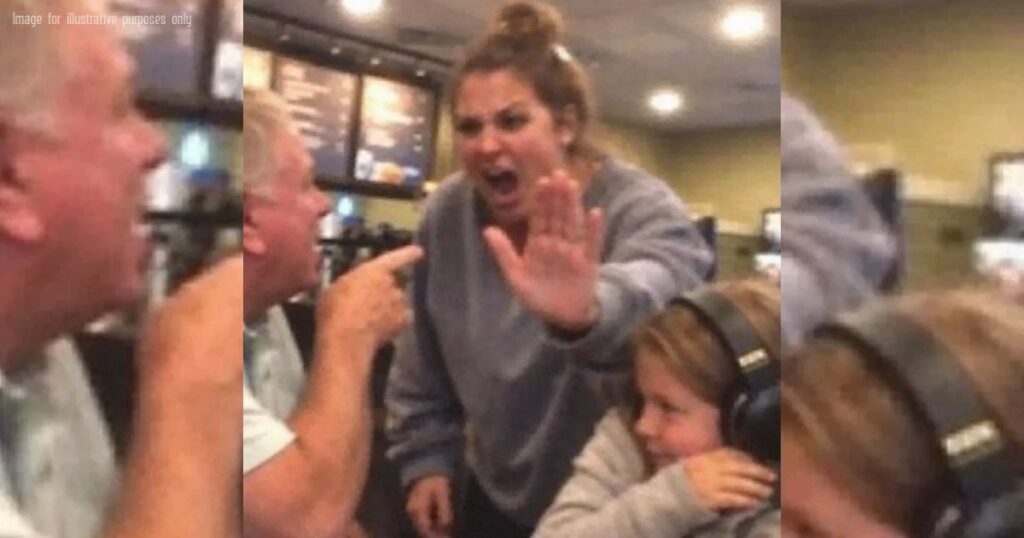
I saw the red recording dot on the stranger’s phone before I even realized I was standing between a grown man and my seven-year-old daughter, my hands shaking not from fear, but from the adrenaline of breaking a lifetime of conditioning.
It started ten minutes earlier in a generic, overpriced coffee shop—the kind with reclaimed wood tables and Edison bulbs, where everyone ignores everyone else in a polite, synchronized dance of digital isolation. I was there for the free Wi-Fi, trying to finish a freelance deck due at 5:00 PM. My daughter, Mia, was sitting opposite me, wearing her noise-canceling headphones, lost in a world of markers and a sketchbook.
The shop wasn’t crowded. That’s why it was weird when he sat at the small round table directly next to ours. He was older, maybe mid-sixties, dressed in a clean polo and khakis. He looked like a grandfather. He looked like a retired teacher. He looked “safe.”
That is exactly how the trap works.
“That’s a mighty serious face for such a little lady,” he said. His voice was booming, designed to cut through the ambient noise of the espresso machine.
Mia didn’t hear him. She was coloring a dragon, her tongue poking out of the corner of her mouth in concentration.
I looked up, offering the standard, tight-lipped smile women are taught to give to keep the peace. “She’s just in the zone,” I said lightly, turning back to my laptop. “Deadline day.”
He didn’t take the hint. He leaned in, his elbow encroaching on our table’s airspace. He tapped his knuckles on the wood near Mia’s elbow. Rap. Rap. Rap.
Mia jumped. She pulled her headphones down around her neck, eyes wide.
“There she is,” the man beamed, ignoring her startled expression. “I was just saying, you’re too pretty to be frowning at a piece of paper. Why don’t you give us a smile?”
My stomach tightened. It was a physical sensation I remembered from my own childhood. The command to perform. The requirement to be decorative.
Mia looked at him, then at me. She didn’t smile. She looked confused and slightly annoyed. “I’m drawing,” she said flatly. Then she pulled her headphones back up.
I was proud of her. But the man let out a sharp, theatrical huff.
“Well,” he said, loud enough for the barista to look up. “Whatever happened to manners?”
He turned his gaze to me. The ‘kindly grandfather’ mask was slipping, revealing the entitlement underneath. “You know, in my day, when an adult spoke to a child, the child answered. It’s called respect. You should teach her some.”
I felt the heat rise up my neck. The old me—the one raised to be a ‘good girl,’ to never make a scene, to accommodate everyone else’s comfort above my own—wanted to apologize. I almost did. I almost told Mia to take off her headphones and say hello.
But then I looked at Mia. She had shrunk into herself. She was hunching her shoulders, trying to make her body smaller, trying to disappear.
I remembered being eight years old. I remembered my Great Aunt Tessie’s husband, a man who smelled like stale tobacco and mints, demanding a hug at Thanksgiving. I remembered saying no. I remembered my mother hissing in my ear, “Don’t be rude. He’s family. Just do it.”
I remembered learning that my body wasn’t mine if it made an adult feel awkward. I remembered learning that my discomfort was less important than a man’s ego.
“She answered you,” I said to the man, my voice steady. “She said she’s drawing.”
He blinked, clearly not used to pushback. “She ignored me. She put those things back on her ears. It’s rude. I’m just trying to be friendly. Being friendly is a dying art in this country, apparently.”
“She doesn’t know you,” I said. “She’s seven. She’s not here to entertain you.”
“Entertain?” He laughed, a dry, incredulous sound. “I asked for a smile. My God, you people are sensitive. You can’t even say hello anymore without someone getting offended.”
He stood up then. He didn’t leave; he just loomed. He looked at Mia again. “You’re going to have a hard life, sweetheart, if you turn your nose up at people just trying to be nice.”
He reached out.
It happened in slow motion. His hand, heavy and calloused, moved toward her face. He was going to tap her chin. He was going to force the engagement he felt he was owed.
“Don’t touch her!”
I didn’t yell, but my voice was projected, sharp and commanding. I stood up, kicking my chair back, placing my body between him and Mia.
The coffee shop went silent. The espresso grinder stopped.
The man recoiled as if I’d slapped him. “I wasn’t going to hurt her! You’re crazy. I was just—”
“You were touching a child who does not know you and does not want to talk to you,” I said.
“I am a nice guy!” he shouted, his face turning a mottled red. “I am a father! I am a grandfather! I have never been treated with such disrespect!”
That’s when the phones came out.
I saw a teenager two tables away hold up an iPhone. I saw a woman in business casual near the counter angle her screen toward us.
I knew what this looked like. A frantic mother. An ‘innocent’ old man. In a thirty-second clip on social media, I would look like a lunatic. I would be the ‘Karen’ screaming at a senior citizen in a coffee shop. I could lose my clients. I could be the internet’s main character for the day.
The fear was paralyzing. The societal pressure to sit down, shut up, and de-escalate was a crushing weight.
But then I felt a small hand grip the back of my shirt. Mia.
If I backed down now, if I apologized to “smooth things over,” what lesson would I be teaching her? I would be teaching her that when a man crosses a boundary, she is the one who should feel guilty. I would be teaching her that her safety matters less than his reputation.
I looked directly at the teenager filming us. Then I looked back at the man.
“You are not asking for kindness,” I said, loud enough for the microphone on that iPhone to pick up every syllable. “You are demanding submission. There is a difference.”
The man sputtered. “This is ridiculous. I’m leaving.”
“Good,” I said. “But before you go, hear this: My daughter does not owe you a smile. She does not owe you her time. She does not exist to make you feel relevant. If she wants to talk to you, she will. If she doesn’t, you leave her alone. That is what respect looks like.”
He opened his mouth to retort, looked around the room, realized the audience wasn’t entirely on his side anymore, and scoffed. “You’re raising a brat,” he muttered, grabbing his coat. “And you’re a piece of work.”
He stormed out, the bell on the door jingling cheerfully behind him.
I sat down. My legs felt like jelly.
The shop remained quiet for a beat too long. Then, the barista called out, “Order for Sarah!” breaking the spell. The hum of conversation returned, but it was hushed.
I turned to Mia. She had taken her headphones off. She looked terrified.
“Mom?” she whispered. “Was I bad?”
My heart broke. It shattered right there in booth four. Because at seven years old, she had already internalized the script. She thought that because a man was angry, she must have done something wrong.
I pulled her onto my lap, ignoring the fact that she was getting too big for it. I hugged her tight.
“No, Mia. Look at me.” I waited until her big brown eyes locked with mine. “You were perfect. You didn’t want to talk, so you didn’t. You didn’t want to smile, so you didn’t. That is your right. You never, ever have to pretend to be happy just to make a stranger feel better. Do you understand?”
“But he was mad,” she said.
“He was mad because he couldn’t control you,” I told her. “And that is his problem, not yours. If someone doesn’t listen when you show them you want to be left alone, you tell them to stop. And if they don’t stop, you get loud. Just like Mommy did.”
She nodded slowly, processing. “You were really loud, Mom.”
“I was,” I agreed, kissing the top of her head. “And I’d do it again.”
We didn’t stay to finish the coffee. We packed up and walked to the car, hand in hand.
As we drove home, passing the manicured lawns and the fences that separate our little lives, I realized something. The video might end up online. People might judge me. They might say I was unhinged, or that I should have just let the ‘nice old man’ have his moment.
But I don’t care.
For generations, we have raised our daughters to be ‘nice.’ We taught them to hug the creepy uncle. We taught them to smile at the catcallers to avoid escalation. We taught them to be polite even when their gut was screaming danger. We sacrificed their instincts on the altar of decorum.
We told them that “No” was a rude word.
Today, I didn’t just defend my daughter from a stranger in a coffee shop. I defended her future self.
I want her to know that she is the protagonist of her own life, not a supporting character in a stranger’s day. I want her to know that her boundaries are not a negotiation.
The world has enough “nice” girls who are silently suffering, afraid to speak up because they don’t want to cause a fuss. I am not raising a nice girl. I am raising a safe woman.
And if that makes me the villain in someone else’s story? Fine. I’ll take the title. Because “No” is a complete sentence, and it’s the most powerful one she’ll ever learn.
—
If you think it ended when the bell jingled behind him—when my daughter’s fingers finally loosened their death-grip on my shirt—you don’t understand how the world works anymore.
It didn’t end at the coffee shop.
It started there.
Because the moment we got home, my phone lit up like a slot machine.
A text from a friend I hadn’t spoken to in months: “Is this you???”
A message request from a stranger: “You should be ashamed.”
Then another: “Thank you for doing what I wish my mom had done.”
I opened the first link with the kind of dread you feel right before you look at a medical test result.
A video. Shot vertically. Shaky. Zoomed in on my face at the exact moment my voice hardened.
DON’T TOUCH HER.