Part 2
If you think it ended when the bell jingled behind him—when my daughter’s fingers finally loosened their death-grip on my shirt—you don’t understand how the world works anymore.
It didn’t end at the coffee shop.
It started there.
Because the moment we got home, my phone lit up like a slot machine.
A text from a friend I hadn’t spoken to in months: “Is this you???”
A message request from a stranger: “You should be ashamed.”
Then another: “Thank you for doing what I wish my mom had done.”
I opened the first link with the kind of dread you feel right before you look at a medical test result.
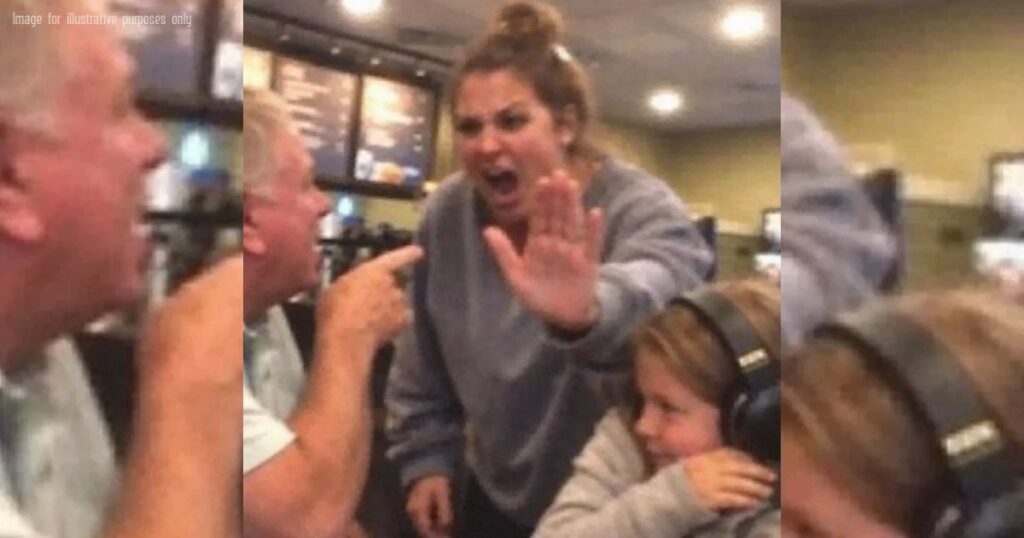
A video. Shot vertically. Shaky. Zoomed in on my face at the exact moment my voice hardened.
DON’T TOUCH HER.
No context. No lead-up. None of the knuckles tapping our table. None of the way Mia flinched. None of the way his hand moved toward her.
Just me. Standing. Between an older man and a child. Looking, in the worst possible edit, like an overreacting woman ruining the day of a harmless grandpa.
The caption was even worse.
“Modern moms are unhinged. This poor man just wanted to say hi.”
The comments had already turned feral.
“People have lost basic respect.”
“Kids today are spoiled.”
“She’s raising a monster.”
“He’s old. Let him talk.”
“This is why society is broken.”
Then, buried like a lifeline:
“Why was he reaching toward the kid?”
“Why is anyone filming a child without consent?”
“My stomach dropped watching this.”
I stared at that red recording dot I’d noticed in real life—now weaponized into content—and I felt something ugly bloom in my chest.
Not guilt.
Rage.
Because it wasn’t just that someone had filmed us.
It was that they’d filmed Mia.
Her face wasn’t clear, thank God—headphones and hair and angle—but she was there. A child caught in the background of an adult war she never signed up for. A child who had done nothing except exist quietly, and still ended up turned into a debate.
I set my phone down on the counter like it might burn me.
Mia was at the kitchen table, drawing again. Dragons. Always dragons. She was safe. She was home. She was humming under her breath.
And the world was deciding whether she deserved boundaries.
I walked into the bathroom and locked the door like I was sixteen again, hiding from my own shame.
I pressed my palms to the sink and watched my face in the mirror.
There she was—the girl I used to be. The one who learned early that being “good” meant being agreeable. The one who mastered the art of smiling with her stomach in knots. The one who apologized when someone else bumped into her.
That girl was whispering now.
You made a scene.
You should’ve just left.
You should’ve been nicer.
You’re going to pay for this.
I turned the faucet on to drown her out.
Then my phone buzzed again. A new email.
Subject line: “Quick Question”
From a client. A small, local business owner I’d done freelance presentations for all year. No brand names. No big corporation. Just a person with a budget and an opinion.
I opened it.
I hope your daughter is okay.
I saw a video going around.
I’m sure there are two sides, but I need to protect my image right now.
I think we should pause our work for a bit.
Protect my image.
I laughed—one sharp, humorless sound—because it was so on-the-nose it felt scripted.
A grown man tried to touch my kid. I stopped him. The internet decided the real emergency was whether I was “polite” enough while I did it.
And now my ability to pay rent might depend on the editing choices of a stranger with a phone.
I walked back into the kitchen with my heart beating too fast.
Mia looked up. “Mom? You’re doing that face.”
“What face?”
“The one where your eyebrows go like this.” She scrunched her forehead, mimicking me perfectly.
I tried to smile. It came out thin. “Just… work stuff.”
She stared a beat longer. Kids always know when you’re lying. Then she went back to her dragon.
But she didn’t put her headphones on.
That’s what broke me.
Because in the coffee shop, headphones were her shield. Her little portable wall against a world that always wants something from her. And now she was sitting in our own home, unprotected, listening for danger that wasn’t there.
That night, after she fell asleep, I got into bed and made the mistake of opening the video again.
It had spread. Of course it had.
Someone had reposted it on a “community” page. Someone else had stitched their opinion to it. Someone had slowed my voice down, added captions, and put dramatic music under it like my daughter’s safety was a trailer for entertainment.
People were arguing in the comments like they were watching sports.
Team “Respect Your Elders.”
Team “Protect Your Kids.”
And the loudest voices were the ones most certain they knew everything from thirty seconds.
I scrolled until my thumb ached.
One comment said: “She’s teaching her daughter to be rude.”
Another said: “No, she’s teaching her daughter to survive.”
Survive.
That word sat in my throat like a stone.
Because I knew what people meant when they said it. I knew the statistics they were hinting at without saying out loud. I knew every woman I’ve ever met has a story that starts with a man who “was just being friendly.”
And I also knew something else.
Most of those stories end with the woman blaming herself for not being nicer.
I put my phone down and stared at the ceiling in the dark.
The worst part wasn’t the criticism.