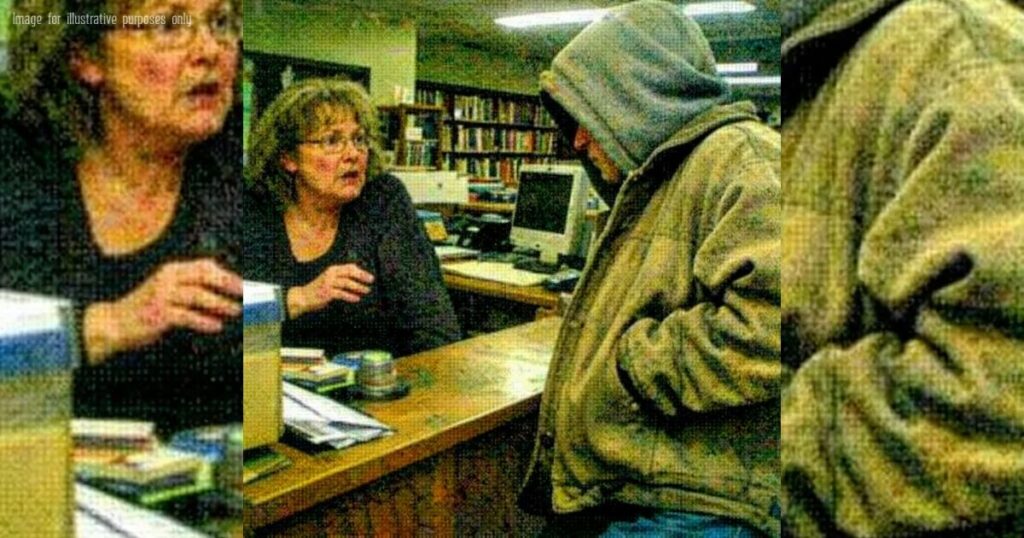
The $12 Debt! I honestly thought he was reaching for a weapon. It was 7:45 PM on a Tuesday, fifteen minutes to closing. The library was empty, save for the hum of the heater and the scent of old paper. Then the automatic doors hissed open.
He walked in with his hood pulled low, hands shoved deep into the pockets of a faded, grease-stained work jacket. He couldn’t have been more than nineteen. He stood by the entrance for a moment, scanning the room, his eyes darting toward the security cameras.
In this neighborhood, you learn to read body language fast. We aren’t just librarians; we’re social workers, security guards, and therapists. I kept one hand near the silent alarm button under the desk and asked, “Can I help you find something, son?”
He flinched. He walked toward me, not aggressively, but with the heavy, dragging steps of someone carrying the weight of the world. He stopped at the circulation desk, looking everywhere but at my face.
“I have to return something,” he whispered. His voice cracked.
Slowly, he pulled his hand out of his jacket. I braced myself.
But it wasn’t a weapon. It was a book.
He slid it across the counter. It was a thick hardcover fantasy novel, the first in a famous series about wizards and magic. But this copy was barely recognizable. The spine was held together by silver duct tape. The corners were smashed. The cover was faded to white at the edges, and the pages were swollen, as if they’d been wet and dried a dozen times.
I scanned the barcode. The system beeped a harsh, angry red alert.
STATUS: LOST. BILLING DATE: NOVEMBER 12, 2019.
“I stole it,” he said. The words rushed out of him. “Five years ago. I put it in my backpack and I walked right out. The sensors didn’t go off because I peeled the tag off in the bathroom.”
I looked at the screen, then at the boy. “Why brings it back now?”
“I turned eighteen last week,” he said. He reached into his pocket again. This time, he pulled out a crumpled fistful of cash. Ones, fives, a few quarters. He smoothed them out on the counter with trembling fingers.
“I work at the auto-shop down on 5th now. I’m trying to get my credit right. Trying to… you know, be a citizen.” He pointed at the battered book. “That’s the only thing I ever stole. I couldn’t sleep thinking about it.”
He pushed the pile of money toward me. It counted out to exactly twelve dollars.
“Is that enough?” he asked. “For the fine?”
I looked at the computer screen. The book was marked as “Lost.” In the system, the replacement cost was $28.99. The processing fee was $10.00. The accumulated overdue fines were capped at $15.00.
Total owed: $53.99.
Fifty-four dollars. In this economy, that’s a week of groceries for a single guy. That’s a tank of gas to get to work.
I looked at the twelve dollars on the counter. Then I looked at the book. I opened it.
It wasn’t just read; it was devoured.
There were grease stains on the margins—likely from reading during a lunch break at the mechanic shop. There were faint circles where a cup of instant noodles had sat. And then I saw the inside back cover.
In shaky handwriting, someone—presumably him, years ago—had written: “You are not alone.”
“I didn’t have a home back then,” he said softly, noticing me staring at the writing. “My mom got sick, we lost the apartment. We were living in a van. No internet. No TV. Just… cold.”
He looked me in the eye for the first time.
“I read that book forty times,” he said. “Every time I felt like giving up, I read about the boy under the stairs who found out he was special. It was the only place I could go where I wasn’t just a homeless kid. It saved my life, ma’am. I’m sorry I took it. But I needed it.”
My throat tightened.
We live in a world that loves rules. We have policies for late fees, replacement costs, and collection agencies. The system is designed to protect the inventory.
But why do we have the inventory?
We don’t stack books on shelves to keep them pristine. We stack them to save lives. We stack them to give a kid in a van a reason to survive another night.
I looked at the computer. I looked at the “delete” button.
“Actually,” I lied, my voice steady, “You have incredible timing.”
He blinked. “I do?”
“Yes. You see, the county just passed a new initiative for young adults,” I said, typing furiously on my keyboard. I wasn’t typing anything important—just clearing the screen. “It’s called the ‘Fresh Start Literacy Program.’ For anyone under twenty-one returning ‘long-term borrowed’ materials, the fees are waived. Completely.”
I hit Enter with a dramatic flourish.
“Balance is zero,” I said.
The boy stood frozen. “But… I stole it.”
“You borrowed it for a very long time,” I corrected him. “And it looks like you made good use of it.”
I pushed the pile of crumpled bills back across the counter toward him.
“Keep your money,” I said. “Gas prices are up again. You’ll need it.”
He hesitated, his hand hovering over the cash. “Are you sure? I don’t want to owe anyone.”
“You don’t,” I said. “But there is one condition.”
He stiffened. “What?”
I reached under the desk and pulled out a paperback. It was brand new. The glossy cover shone under the fluorescent lights. It was the sequel—the second book in the series.
“You have to read the next one,” I said. “And you have to check it out legally. With a library card.”
He stared at the book. His eyes started to water. He wiped them quickly with his rough, grease-stained sleeve.
“I can get a card?” he asked. “Even with… my past?”
“The library belongs to everyone,” I said, sliding a registration form toward him. ” especially those who know what a book is really worth.”
He filled out the form. He took his twelve dollars. He took the sequel.
Before he left, he turned back. He stood a little straighter. The hood stayed down.
“Thank you,” he said. “For the fresh start.”
“See you in two weeks,” I replied.
He walked out into the cold night, not as a thief, but as a patron.
That was six months ago. He comes in every other Tuesday now. He’s working his way through the fantasy section. He washes his hands before he touches the pages.
Sometimes, the most valuable thing we can do in this world isn’t enforcing the law. It’s knowing when to break the rules to save the human.
Libraries aren’t about accounting. They are about hope. And hope is always free.
—
I thought that lie would stay between me, the boy, and the quiet hum of the library printers. I thought it had dissolved into the same air that smells like dust and ink and cheap hand sanitizer.
I was wrong.
Six months after I “invented” the Fresh Start Literacy Program, the lie walked back into my life in the most modern way possible: as a viral post.
It started with an email.
SUBJECT: “We need to talk. – M.”
M is my manager, Marcy. Forty-eight, sharp bob haircut, burn-out hovering just behind her eyes, and a heart that beats in Dewey Decimal.
Click the button below to read the next part of the story.⏬⏬