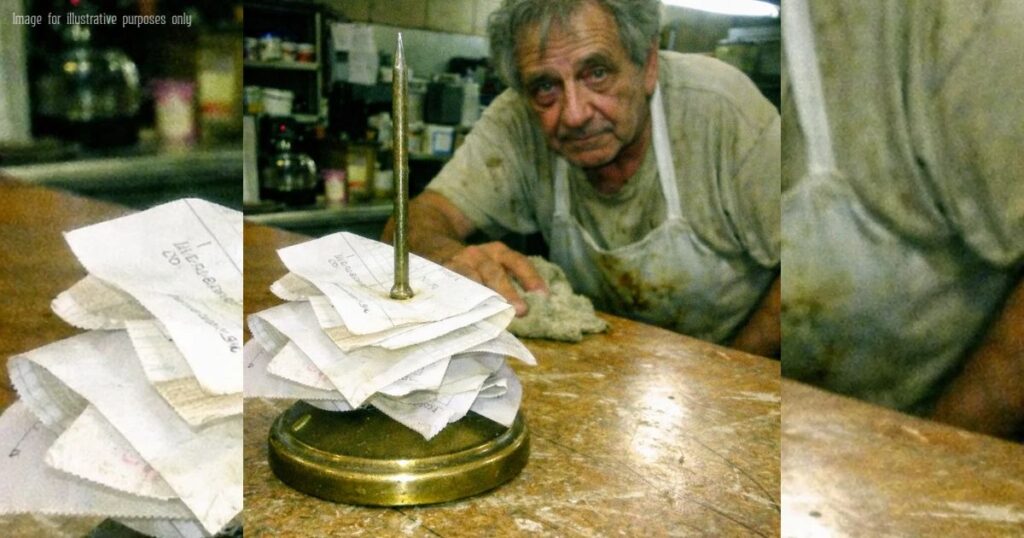
I keep a six-inch brass spike next to my cash register. It looks like a murder weapon, but in this town, it’s the only thing keeping dignity alive.
My diner, “The Rusty Spoon,” sits on the edge of a town that the economy forgot about ten years ago. We have vinyl booths that are cracked like dried riverbeds and a neon sign that buzzes in the key of G-minor. I’ve been running this place since a cup of coffee cost a dime. Now? I have to charge three bucks just to break even, and I hate myself for it every single time I ring it up.
The brass spindle sits right there on the Formica counter. You know the kind—a heavy metal base with a sharp upright needle. Back in the good old days, cooks used it to stab completed order tickets.
Now, it holds paid receipts.
We don’t call it charity. We don’t call it “suspended coffee.” We don’t call it anything. If you have a good week, you pay for an extra burger or a breakfast combo, and you spike the receipt on the needle. If you’re having a bad week—and Lord knows, everyone is having a bad week lately—you walk up to the counter, pull a ticket off the spike, and hand it to me.
No questions. No “God bless yous.” No shame. You just eat.
The system worked because it was invisible. Until last Tuesday.
It was 7:00 AM. The breakfast rush was just a trickle. In walked Frank. Frank is seventy-something, wears a faded utility jacket, and walks with a limp he got overseas in a war people stopped talking about decades ago. Frank is proud. He’s the kind of guy who thinks the world went soft the minute they stopped teaching cursive. He comes in for dry toast and black coffee because that’s all his fixed income allows.
Two minutes later, in walked Leo.
Leo is twenty-two. He has hair dyed the color of electric lime, piercings in places that make Frank wince, and he’s always staring at his phone. To Frank, Leo is everything wrong with America.
“Look at him,” Frank grumbled to me, loud enough for Leo to hear. “Glued to that screen. Probably never worked a day in his life. In my day, we built things. Now they just tweet things.”
I poured Frank’s coffee. “Leave him be, Frank. Kid’s hustling.”
I knew what Frank didn’t. I knew Leo wasn’t doom-scrolling. He was refreshing three different gig-work apps, praying for a delivery order or a ride-share ping. I knew Leo slept in his Corolla three nights a week because rent in this zip code had doubled while wages stayed flat. I knew Leo’s “laziness” was actually exhaustion.
But on the surface? They were enemies. The Boomer and the Zoomer. The Past and the Future, staring at each other across a laminate table with nothing but resentment in between.
The incident happened when Frank went to pay.
He reached into his pocket and pulled out a leather wallet that was falling apart at the seams. He laid out two singles. Then he dug for change. He counted quarters. Then dimes. His hand started to shake. He was forty cents short.
The price of toast had gone up twenty cents last week. He didn’t know.
I saw the panic in Frank’s eyes. It wasn’t about forty cents. It was about control. It was the terrifying realization that the ground was slipping out from under him.
“I… I think I left a dollar in the truck,” Frank lied. His voice cracked. We both knew he didn’t have a truck anymore. He took the bus.
“It’s on the house, Frank,” I said quickly.
“No,” Frank snapped. His pride was a fortress. “I don’t take handouts, Sal. You know that. I pay for what I eat.” He started to push the toast back toward me, his hands trembling with humiliation.
The diner went silent. The air felt heavy, thick with that specific American anxiety of being one bad surprise away from ruin.
Then, the bell on the door jingled. It was Leo. He had gotten a ping on his phone. A delivery order.
He walked up to the register, ignoring Frank completely. He slapped a crumpled five-dollar bill on the counter.
“To-go cup. Large. And ring up a side of bacon,” Leo said, not looking up from his screen.
“You want the bacon now?” I asked.
“No. I’m late.” Leo grabbed his coffee. Then, he did something fast. He took the receipt for the bacon—five dollars worth of meat—and he slammed it down onto the brass spindle. Chk.
He didn’t look at Frank. He didn’t make a speech about unity. He just looked at me and said, “Spike’s looking empty, Sal.”
And then he walked out.
Frank stood there. He looked at the five-dollar bill on the counter, then at the receipt on the spindle. The receipt that Leo, the “lazy kid with the blue hair,” had just put there.
Frank looked at me. I didn’t say a word. I just nodded at the spindle.
For a long minute, the only sound was the refrigerator compressor humming. Frank was fighting a war inside his head. To take that ticket was to admit he needed help. But to take it from him? From the generation he claimed was ruining everything?
Slowly, Frank reached out. His calloused, oil-stained fingers hovered over the brass needle.
He pulled the ticket off.
“I’ll take that bacon now, Sal,” he whispered. He didn’t look up.
He sat back down and ate. He ate like a man who hadn’t had protein in three days. He wiped the grease from his chin, and for the first time in months, his shoulders dropped.
The next morning, Frank came back.
He didn’t order coffee. He walked up to the counter and placed a small, brown paper bag on the Formica. inside were three large, red apples. Polished to a shine.
“My tree out back,” Frank said. “They’re good this year. Sweet.”
He pushed the bag toward me.
“If that kid comes in…” Frank cleared his throat, looking at the floor. “If the kid with the green hair comes in. Tell him these are for him. Tell him… tell him they’re organic. I hear they like that organic stuff.”
I smiled. “I’ll tell him, Frank.”
“And Sal?”
“Yeah, Frank?”
He pointed a jagged finger at the brass spindle. It had three new tickets on it. One from a nurse, two from a construction foreman.
“It’s a good system,” Frank said. “Keeps the wolves away.”
He adjusted his cap and walked out into the cold.
I looked at the spindle. It’s a strange thing. On the news, they tell us we hate each other. They tell us the divide is too wide to cross. They tell us it’s Us versus Them.
But here, at the counter, there are no politics. Hunger doesn’t have a political party. Dignity doesn’t have an age demographic.
There is just a sharp piece of brass, holding onto a small piece of paper that says: I’ve got you. I don’t know you, but I’ve got you.
We are all just one bad month away from needing that spindle. And we are all just one small kindness away from being the one who fills it.
So, if you’re ever in town, stop by The Rusty Spoon. Buy a coffee. And if you can, leave a little extra on the spike. Because the hardest part of struggling isn’t asking for help. It’s remembering that you’re worthy of it.
That’s how a receipt becomes armor. And that’s how we survive—together.
—
PART 2 — The Day the Spike Stopped Being Invisible
By the time I unlocked The Rusty Spoon the next morning, the town had already found a new thing to fight about.
It was still dark. The kind of dark that makes your breath look like smoke and your joints feel like they’ve been left outside overnight. I flipped on the lights, and the diner blinked awake—vinyl booths, cracked like old knuckles. The neon sign outside buzzing its sad little hymn.
And my phone.
It wouldn’t stop vibrating.
At first, I thought it was my sister again, calling to remind me I’m one broken freezer away from bankruptcy. But it wasn’t family. It wasn’t suppliers. It wasn’t the guy who always calls at 6:03 AM asking if we serve breakfast “all day” like it’s a moral test.
It was messages from numbers I didn’t recognize.
You seein’ this, Sal?
Dude your diner’s on my feed.
Tell Frank he’s a legend.
Tell Frank he’s a freeloader.
Tell the punk kid I said thank you.
Tell the punk kid to get a real job.
Click the button below to read the next part of the story.⏬⏬