Resolve.
He turned slightly so he could be heard—not like a speech, not like a politician, just like an old man who’s tired of being used as an idea.
“You people got a lot to say,” Frank said.
The diner went quiet the way it had yesterday. That thick silence. The kind that makes you hear the coffee drip.
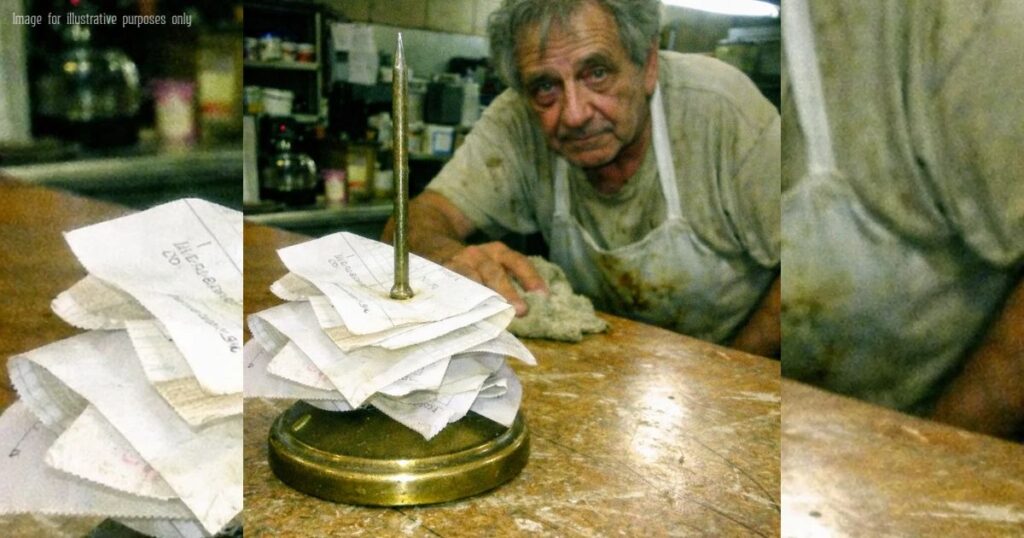
Frank pointed at the spike. “I took a ticket.”
A woman near the window scoffed. “Well, some of us work for what we eat.”
Frank swung his gaze to her. It wasn’t cruel. It wasn’t hateful.
It was tired.
“I worked,” he said. “My whole damn life.”
He lifted his hand—calloused, stained from engines and time. “I built things. Fixed things. Paid taxes. Paid bills. Missed birthdays because someone’s heat was out and I was the guy crawling under a house at midnight.”
His voice cracked, just a hair. “And last Tuesday, I was forty cents short.”
You could feel the room shift. People don’t know what to do with honesty when it doesn’t fit in a caption.
Frank’s throat bobbed. He swallowed it down like pride.
“I didn’t take that ticket because I’m lazy,” he said. “I took it because I was hungry.”
Then he jabbed a finger toward the phones. “And if you need to film that to feel like you did something good, then maybe you’re not helping for the reason you think you are.”
A low murmur rippled through the booths.
Some people bristled.
Some people looked away.
Someone muttered, “So we’re just supposed to give money with no rules?”
Frank’s eyes narrowed. “Rules?”
He let the word sit there like a bad taste. “Here’s a rule. If you’re not hungry, don’t take it.”
He turned to Leo then, and the change in his expression was small but real. Less fortress. More man.
“And you,” Frank said, voice softer now. “I called you lazy.”
Leo’s chin lifted. “Yeah.”
Frank nodded like he deserved the sting. “I was wrong.”
Leo didn’t smile. Didn’t forgive on command. Just stared at him, waiting to see if this was real.
Frank looked down at the apples. “My daughter used to dye her hair. Not green. Pink. I hated it.”
He snorted, almost amused at himself. “She said it made her feel like she had some control in a world that didn’t ask her permission.”
He looked back up. “I didn’t understand it then.”
Leo’s voice came out thin. “Do you understand it now?”
Frank paused. Long enough to feel dangerous.
Then he said, “I understand being tired.”
That did it.
Not the war story. Not the economics. Not the viral video.
That sentence.
Because every person in that diner—young, old, proud, broke, pretending not to be broke—felt it land in their ribs.
I watched Leo’s face change, just a fraction. The anger didn’t vanish. It doesn’t work like that.
But it loosened.
Leo reached for the bag and pulled out one apple. Turned it in his hands like he was checking if it was a trick.
Then he set it back down.
“Thanks,” he said, quiet.
Frank nodded. Then, like he couldn’t stand the softness too long, he looked at me.
“Sal,” he said.
“Yeah?”
He jerked his chin toward the spike. “This thing. It’s gonna get ruined.”
“I know,” I said.
“And you’re gonna have people trying to make you the Mayor of Charity Town or whatever,” he added, eyes flicking to the phones again.
“I know.”
Frank’s mouth tightened. “So do something.”
I looked at the spike—too full, too visible, too loud. The brass needle was supposed to be armor. Now it was a billboard.
I reached under the counter and pulled out a cardboard box.
I set it beside the register.
No label.
No slogans.
Just a plain box.
I took the stack of receipts off the spike, folded them once, and slid them inside.
Then I took the brass spike—this little sharp symbol of invisible mercy—and I turned it around so it faced me instead of the room.
A few people protested immediately.
“Why’d you hide it?”
“That’s the whole point!”
“Transparency matters!”
“So people can just take stuff now?”
I kept my voice calm. “The point was never for you to watch someone need it.”
I tapped the box. “If you can cover a meal, put it in.”
Then I pointed to the empty table where Frank usually sat. “If you need a meal, you come to me. Quiet. No audience.”
A man at the counter crossed his arms. “So we’re supposed to trust people won’t abuse it?”
I looked him dead in the eye.
“You want to live in a town where the first thing you do when someone’s hungry is assume they’re lying?” I asked.
The room went still again.
That’s the controversial part, isn’t it?
Not whether people need help.
But whether we think they deserve it.
I leaned closer, lowered my voice, made it simple.
“Hunger doesn’t fill out paperwork,” I said. “And dignity doesn’t perform.”
I glanced around the diner. “You want rules? Here’s the only one that matters: Don’t turn someone’s worst week into your feel-good story.”
Some people didn’t like that.
I could see it in their faces. The discomfort of being told their “good deed” had sharp edges.
But I also saw something else.
Relief.
Because even the people who argue the loudest about freeloaders are terrified of becoming one.
Frank took his usual booth. Leo took the stool at the counter like it didn’t feel as dangerous now. The phones, slowly, lowered.
And the Rusty Spoon became a diner again.
Not a stage.
Not a battleground.
Just a place where people eat.
Later, when the lunch rush thinned, Leo came up to pay. He slid a bill across the counter.
“You don’t have to,” I started.
“I know,” he said.
Then he glanced at the box. “Put… two in there.”
“For what?”
“For whoever doesn’t want to be on camera,” he said, eyes flat.
I took the bill and slipped it into the box.
Frank watched from his booth. He lifted his coffee mug in the smallest salute.
No speeches.
No hashtags.
Just two people who had been taught to hate each other, choosing—quietly—not to.
When I locked up that night, I looked at the brass spike turned inward behind the counter.
It didn’t look like a weapon anymore.
It looked like a boundary.
A reminder that the best kind of help is the kind you don’t have to announce.
Because the truth nobody wants to admit in the comment section is this:
Most of us aren’t one viral moment away from being heroes.
We’re one bad month away from needing the box.
And if you ever do need it—if you ever find yourself forty cents short, or one bill away from the floor falling out—then I hope the world lets you stay invisible while you’re trying to survive.
That’s what the spike was really holding.
Not receipts.
Not bacon.
A promise:
You can be hungry and still be human.
Thank you so much for reading this story!
I’d really love to hear your comments and thoughts about this story — your feedback is truly valuable and helps us a lot.
Please leave a comment and share this Facebook post to support the author. Every reaction and review makes a big difference!
This story is a work of fiction created for entertainment and inspirational purposes. While it may draw on real-world themes, all characters, names, and events are imagined. Any resemblance to actual people or situations is purely coincidenta