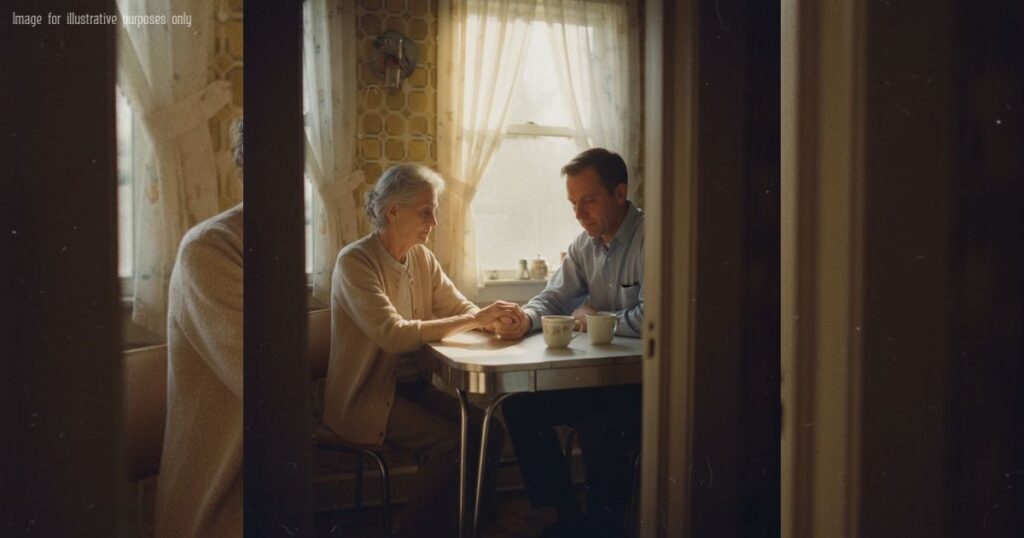

And then he said the sentence that made my throat close.
“I don’t know who I am if I’m not useful.”
There are moments where you stop being a child.
Not because you want to.
Because your parent hands you something too heavy to carry as a kid.
My dad—my iron rule, my vice-grip hands—was telling me he was afraid of becoming invisible in his own house.
So I didn’t do what I wanted to do.
I didn’t rush in with solutions.
I didn’t say “We’ll fix it.”
I didn’t treat him like a problem to solve.
I just sat down across from him.
And I said, “Okay. Then let’s redefine useful.”
He frowned, confused.
I pointed at the jar of pickles on the counter.
“You know what you did Tuesday?” I said. “You didn’t lift a bag.”
He scoffed. “Sure felt like I lifted a bag.”
“You taught me how to help you without humiliating you,” I said. “You showed me what dignity looks like when the body starts betraying you. That’s useful.”
His eyes flickered, but he looked away quickly—like emotion was a spark he couldn’t allow near his pride.
My mom finally turned around and leaned against the counter.
“You scared me,” she said softly, to him. Not accusing. Honest.
My father’s shoulders sank.
“I know,” he whispered.
Then he did something I had never seen him do in forty-four years.
He apologized.
Not the gruff “sorry” that means “drop it.”
A real apology.
“I’m sorry,” he said, voice tight. “I thought if I let him help, it would mean I’m done.”
My mom walked over and put her hand on his shoulder.
“You’re not done,” she said. “You’re just not twenty-five.”
He blinked hard.
And then he looked at me with an expression that was almost childlike.
“Is this what it feels like?” he asked quietly. “To be… in the way?”
My chest ached.
“No,” I said. “This is what it feels like to be loved by people who aren’t keeping score.”
That’s the part that makes people mad, by the way.
Because some families do keep score.
Some people reading this will say, “Must be nice. My parents weren’t like that.”
And you know what?
They’re not wrong.
So here’s where the story got complicated.
That night—after I went home, after the adrenaline wore off—I wrote about it.
Not with names. Not with details that could hurt anyone.
Just the truth.
How pride can be more dangerous than weakness.
How some workplaces treat empathy like an inconvenience.
How aging isn’t a medical event—it’s a thousand small humiliations stacked on a man’s identity.
I posted it online.
And it blew up.
Within hours, strangers were arguing in the comments like it was a trial.
Some said: “You’re a good son. We need more of this.”
Others said: “Stop guilt-tripping people. Not everyone has parents worth visiting.”
Some said: “If your job punishes you for helping your family, that job isn’t loyal to you.”
Others said: “Easy to say when you have money and a flexible career.”
I sat there reading it, jaw tight, heart weirdly open.
Because for every person who felt inspired, there was someone who felt accused.
And I realized something important:
A message can be true… and still hurt people who live a different truth.
So I added one more comment under my own post.
I wrote:
If your parents were safe, loving people—go see them. Don’t wait.
But if they weren’t… you are allowed to protect your peace.
This isn’t about guilt. It’s about choice.
And if you can’t go, call. If you can’t call, send love in the way you can.
The point is: don’t let life numb you into forgetting what matters.
That’s where the fighting really started.
Because the internet loves one thing more than it loves kindness.
It loves a simple rule.
It loves a side to pick.
But real life doesn’t fit in a slogan.
My dad called me the next morning—at 10:14 AM again.
This time his voice was steadier.
“You cause a lot of noise,” he grumbled.
I smiled. “Did you see it?”
“I didn’t see it,” he lied immediately.
Then, quieter: “Your mother read me some.”
“And?”
A long pause.
Then, the smallest crack of softness in his voice.
“There were people saying… they miss their dads.”
I swallowed. “Yeah.”
He cleared his throat like he was trying to clear emotion out of his lungs.
“Well,” he said. “Tell ’em… tell ’em I’m sorry for their loss.”
That was it.
That was his version of a viral message.
Not “like and share.”
Not “thoughts and prayers.”
Just a hard old man, learning how to be gentle in public.
Before he hung up, he added, almost as an afterthought:
“And Davey?”
“Yeah?”
“I… I won’t go outside for the bags anymore.”
I exhaled.
“Good,” I said. “That’s the crew rule.”
He muttered, “Yeah, yeah.”
But his voice sounded lighter.
Not because he was stronger.
Because he wasn’t carrying it alone.
So here’s my controversial truth—say whatever you want in the comments:
Some of us are being trained to treat human beings like interruptions.
To treat love like something you schedule.
To treat aging parents like a problem you outsource.
And I get it.
We’re tired.
We’re stretched thin.
We’re surviving.
But if you have someone in your life who loved you well—someone who taught you leverage, who taught you work, who taught you how to be a decent person—
Don’t let the world turn you into someone who only shows up when it’s too late.
And if you didn’t have that kind of parent?
If your story is pain instead of pickles?
Then hear me clearly:
You don’t owe anyone your soul.
But you do owe yourself a life that isn’t numb.
A life where you choose what matters—on purpose.
Because one day the phone will stop ringing.
And the silence will be the only thing that never misses a meeting.
Thank you so much for reading this story!
I’d really love to hear your comments and thoughts about this story — your feedback is truly valuable and helps us a lot.
Please leave a comment and share this Facebook post to support the author. Every reaction and review makes a big difference!
This story is a work of fiction created for entertainment and inspirational purposes. While it may draw on real-world themes, all characters, names, and events are imagined. Any resemblance to actual people or situations is purely coincidenta