To the neighborhood Facebook group, I am a “Level 4 Liability.” To the woman who lives in the pristine beige house next door, I am a ticking time bomb wrapped in fur. She pulls her son behind her designer yoga pants whenever I inhale. She doesn’t know that I am the only thing standing between her family and the dark.
My name is Atlas. I am ninety pounds of retired Belgian Malinois, held together by titanium pins and scar tissue. I spent seven years hunting improvised explosive devices in the dust of Kandahar. The sand there burned my paws, and the air tasted like copper. Now, I spend my retirement in a subdivision outside Chicago, waging a war against arthritis and trying to understand why the silence of suburbia feels louder than the mortar shells.
My handler is Mac. We are the same. Two old soldiers discarded by a world that loves the parade but hates the aftermath. We live in a small ranch house with a chain-link fence. In the quiet of the night, Mac drinks bourbon to forget the screams. In the quiet, I patrol the perimeter to remember the purpose.
The problem isn’t the war. The problem is the fence. Specifically, Mrs. Elena Vance on the other side of it.
Elena moved in six months ago. She drives a massive white SUV that looks like a tank but has never seen dirt. She smells like expensive vanilla latte and fear. She has a son, Toby. He is seven years old, non-verbal, and smells like fabric softener and innocence.
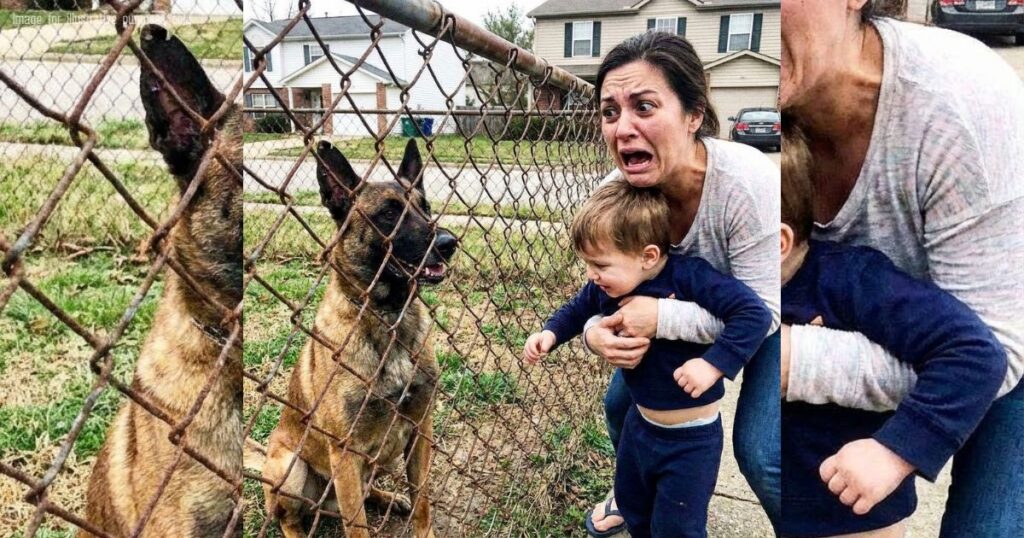
Toby doesn’t play like other kids. He stands at the fence, gripping the metal diamonds, rocking back and forth, staring at me.
I stare back.
It’s not aggression. It’s a connection. In the field, you learn to read eyes. Toby’s eyes are chaotic but kind. I sit at attention, my ears swiveling. I know he is an “asset” that needs protection.
But Elena doesn’t see a guardian. She sees a wolf.
“Get away from that thing, Toby!” she screams, rushing out to drag the boy inside. She looks at me with pure terror. She sees the notch missing from my ear. She sees the metal teeth capping my canines—dental work from biting through a Kevlar vest to stop an insurgent. She sees a monster.
Last Tuesday, the letter came. It was on heavy cardstock with the Homeowners Association logo.
Mac sat at the kitchen table, his hands shaking. “They voted, Atlas,” he whispered, his voice cracking. “They say you’re a ‘menace to the community aesthetic and safety.’ We have thirty days to build a ten-foot privacy wall, or I have to surrender you.”
I didn’t know the words, but I smelled the cortisol spiking in his sweat. Despair. I rested my heavy head on his good knee. I have taken bullets. I have jumped from helicopters. But seeing Mac cry hurt more than the shrapnel in my hip.
Then came the Polar Vortex.
The weatherman called it a “historic event.” Temperatures dropped to twenty below zero in an hour. The wind howled like a banshee, shaking the siding of the house. Mac had taken his heavy medication—the ones the VA gives him to knock out the nightmares. He was dead to the world in his recliner.
I was pacing. My joints ached, a deep, grinding throb. The air pressure was plummeting.
Then, I heard it. Click.
It came from the Vance backyard.
I went to the sliding glass door and let out a low whine. Mac didn’t move. I barked—a sharp, concussive “alert” bark. Nothing. The wind was screaming too loud.
I pressed my nose to the glass. Through the whiteout, I saw a shadow in the neighbor’s yard. The high-tech vinyl gate, frozen brittle by the cold, had shattered open in the wind.
And the small shadow—Toby—was walking out.
He was wearing Spider-Man pajamas. No coat. No boots. He was wandering, drawn by the swirling snow, heading straight for the retention pond at the edge of the woods. The pond where the ice was thin and treacherous.
Elena’s SUV wasn’t in the driveway. A nanny? I smelled burnt pizza from their house. Distraction. No one knew the asset was unsecured.
I looked at Mac. He was safe. The perimeter next door was breached.
I had a choice. I could stay warm. I could be the “liability” that stays in his cage. Or I could be the soldier I was built to be.
I threw my weight against the old kitchen door. The deadbolt held. I backed up, ignoring the fire in my hips, and launched myself. The wood frame splintered. The latch gave way.
The cold hit me like a hammer. The wind blinded me. I didn’t run; I engaged. I put my nose to the snow, filtering out the smell of woodstoves and exhaust, hunting for fabric softener and milk.
There. Faint, burying under the scent of ozone.
I scrambled over the low chain-link fence. My back leg clipped the top rail, and I swallowed a yelp of pain, landing hard on the frozen earth. I sprinted toward the woods.
The retention pond was down a steep, icy hill. I skidded to a halt at the edge.
Toby was there. He had walked out onto the ice. It had cracked. He was waist-deep in the freezing sludge, stuck in the mud, too shocked to scream. He was just flapping his hands, staring at the snow, his lips turning a terrifying shade of violet.
I slid down the bank, my claws tearing up the frozen grass. When I reached him, he didn’t flinch. He looked at me—the monster his mother feared.
I didn’t bark. I grabbed the back of his pajama shirt. Gently. Precision bite. I pulled.
He was stuck deep. I dug my paws into the mud, growling with effort, hauling him backward until he popped free onto the solid bank. But he wouldn’t stand up. The cold had already seized his small muscles.
If I left him to get help, his heart would stop before I got back.
So, I engaged Protocol: Warmth.
I lay down in the snow. I curled my ninety-pound body around him, pressing my belly—the furnace of my core—against his freezing back. I draped my heavy head over his legs. I created a living wall of fur and muscle between him and the wind.
Toby stopped flapping. He turned into me. He buried his frozen face in the rough fur of my neck. His sticky fingers gripped my collar.
I have you. I am the shield. Nothing gets past me.
We stayed like that for an eternity. My hip throbbed with a sickening rhythm. The snow piled up on my back, burying me. I started to shake, my body temperature dropping, but I didn’t break contact. I kept my eyes open, scanning the treeline.
Finally, the sirens cut through the wind. Blue and red lights shattered the darkness.
“TOBY! OH GOD, TOBY!”
It was Elena. And the police. And Mac, stumbling through the snow in his robe.
They were screaming, frantic. I waited until they were close, then I let out a single, deep woof. Not a threat. A coordinate.
A tactical flashlight hit us.
“Gun!” a rookie cop shouted, reaching for his holster. “The dog is on him!”
“NO!” Mac’s voice cracked through the storm like a whip. “STAND DOWN! LOOK AT HIM!”
The officer froze. The beam of light held steady on us.
They didn’t see a beast mauling a child. They saw a statue made of snow and scars, shielding a boy from death.
Elena scrambled down the bank, falling to her knees in the slush. She grabbed Toby, pulling him from my warmth. “He’s alive,” she sobbed, checking his pulse. “He’s warm. Oh god, he’s warm.”
I tried to stand up to give them space. My back legs failed. The cold had locked my bad hip. I collapsed back into the snow, whining softly.
“Atlas!” Mac was there. He fell into the mud next to me, wrapping his arms around my neck. “Good boy. You’re a good boy, Atlas.”
It took two officers and Mac to carry me up the hill. They put me in the back of a heated patrol SUV.
Elena was holding Toby, wrapped in thermal blankets. She looked across the swirling snow, her mascara running down her face. Her eyes met mine through the glass.
The fear was gone. In its place was a look that shattered me: pure, agonizing shame.
Three weeks later.
The snow has melted into gray slush. I am lying on my front porch, chewing on a heavy-duty rubber Kong.
A car pulls up. It’s the white SUV. Elena walks up the driveway. She isn’t holding a clipboard. She isn’t holding a phone to record me.
She is holding a large box from the butcher shop.
She stops at the gate. Mac walks out, looking defensive, his arms crossed.
“Mr. MacAllister,” she says. Her voice is shaking. “I… I spoke to the HOA board this morning. I told them if they touch a single hair on that dog, I will sue them into bankruptcy.”
She pushes the box toward him. Huge, raw marrow bones. Then she looks at me.
“Can I…?” she asks.
Mac nods, slowly unlatching the gate.
The woman who wanted me destroyed walks up the steps. She kneels on the wet concrete, ruining her beige pants. She reaches out a trembling hand.
I don’t growl. I lean forward and press my cold nose into her palm. She starts to cry, quiet, heaving sobs.
“I didn’t see you,” she whispers, scratching behind my scarred ear. “I looked right at you every day, and I didn’t see you at all.”
Mac smiles, a real smile this time. “He’s not a pet, Elena. He’s a partner.”
“No,” she says, wiping her eyes and looking at the window where Toby is waving at me. “He’s a hero.”
We aren’t just a soldier and a dog anymore. We are a neighborhood.
The world is full of things that look scary. We put up fences. We write letters. We judge the scars and the silence because it’s easier than asking the story behind them. But I learned a long time ago, out in the sand, that you can’t tell the difference between a monster and a guardian just by looking at the silhouette.
You have to look at the heart.
My name is Atlas. I am a Level 4 Liability to the bad guys, and a heating pad for the good ones. And for the first time in my life, I think I’m finally off duty.
The real danger isn’t the dog behind the fence; it’s the wall we build around our own empathy. Judgment costs us nothing, but understanding? That pays a debt we didn’t even know we owed.
—
If you think dragging a half-frozen kid out of a pond earns a dog a quiet retirement, you don’t understand cul-de-sacs in 2025. Three weeks after I kept Toby breathing in the snow, the neighborhood decided to put me on trial—with Wi-Fi, lawn chairs, and store-bought cookies.
They didn’t call it a trial, of course.
They called it “A Community Safety Listening Session.”
Humans like soft words for hard things.
Click the button below to read the next part of the story.⏬⏬